
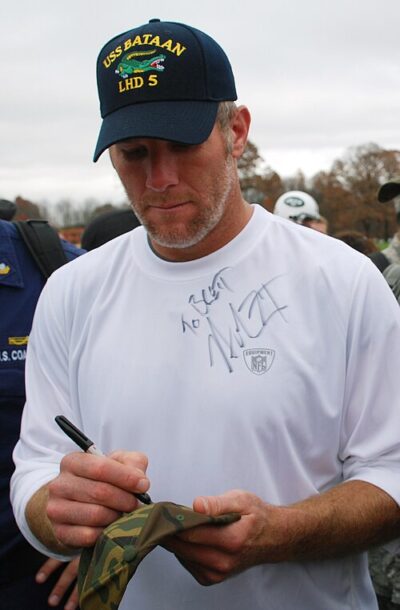
Brett Favre
Brett Favre is an American football player. Born October 10, 1969, in Gulfport. Teams include Atlanta Falcons (1991), Minnesota Vikings (2009–2010) and Green Bay Packers (1992–2007). Educated at Hancock North Central High School and Hancock High School. Awards include Pro Football Hall of Fame.
Facts
18 facts · 1 confirmed by two sources · 2 cited · 15 from one source
Where this comes from
Papalocal keeps its own record. It started from these sources; what each one said is kept here as it was copied, so a change on their side never changes this page by itself. Tap one to read its version.
What Wikidata says · copied November 15, 2026 · revision 2546557040
- Described as
- American football player (born 1969)
- Other names
- The Prophet, Brett Lorenzo Favre
- Born
- October 10, 1969 · 2 references
- Born in
- Gulfport
- Citizen of
- United States
- Occupation
- NASCAR team owner; American football player
- Political party
- Republican Party
- Education
- Hancock North Central High School; Hancock High School · 1 reference
- Teams
- Atlanta Falcons (1991); Minnesota Vikings (2009–2010); Green Bay Packers (1992–2007); New York Jets (2008)
- Sport
- American football · 1 reference
- Awards
- Pro Football Hall of Fame
- Spouse
- Deanna Favre (1996–)
- Father
- Irvin Ernest Favre · 1 reference
- Height
- 1.88 m (6 ft 2 in)
- Website
- http://www.brettfavre.com
- Wikipedias with a page
- 34
Wikidata item Q267088 (wikidata.org/wiki/Q267088), public domain (CC0). Copied November 15, 2026.
What Wikipedia says · copied November 15, 2026 · revision 1385879357
Brett Lorenzo Favre ( FARV; born October 10, 1969) is an American former professional football quarterback who played in the National Football League (NFL) for 20 seasons, primarily with the Green Bay Packers.
Favre played college football for the Southern Mississippi Golden Eagles and was selected in the second round of the 1991 NFL draft by the Atlanta Falcons, where he spent one season as a backup. Traded to the Packers, he became their starter early in the 1992 season and revitalized a franchise which had been in a period of decline since the late 1960s. During his 16 seasons with Green Bay, he led the team to 11 playoff appearances, seven division titles, four NFC Championship Games, two consecutive Super Bowl appearances, and one championship title in Super Bowl XXXI, the team's first in nearly three decades. Favre was traded in 2008 to the New York Jets, where he played one year, and spent his final two seasons with the Minnesota Vikings. His 2009 campaign for the Vikings saw him guide them to a division title and NFC Championship Game appearance, while having one of his strongest statistical seasons.
Favre had 321 consecutive starts from 1992 to 2010, including 297 regular season games, the most in league history. He was also the first NFL quarterback to obtain 70,000 yards, 10,000 passes, 6,000 completions, 500 touchdowns, and victories over all 32 teams. At the time of his retirement, Favre was the NFL leader in passing completions, passing attempts, passing yards, passing touchdowns, and quarterback wins. He holds the NFL record for career interceptions. From 1995 to 1997, he was named Most Valuable Player three times, the most the award was consecutively received. Favre also received 11 Pro Bowl and three first-team All-Pro selections. He was inducted to the Pro Football Hall of Fame in 2016.
In 2022, Favre began to face controversy for the Mississippi welfare funds scandal after investigations determined $8 million intended for welfare programs went to Favre or causes he championed. Favre has denied the allegations and filed a defamation lawsuit against the State Auditor of Mississippi and two media personalities over their coverage of him.
- Born, in its opening lines
- October 10, 1969
From the Wikipedia article “Brett Favre” (en.wikipedia.org/wiki/Brett_Favre), by its contributors, under CC BY-SA 4.0 (creativecommons.org/licenses/by-sa/4.0/). Copied November 15, 2026; not changed.
Confirmed Two sources agree. Cited One source, and it names where it got it. One source One source, without a reference of its own. Sources disagree The sources disagree. We show the best-supported value and keep theirs below.
