
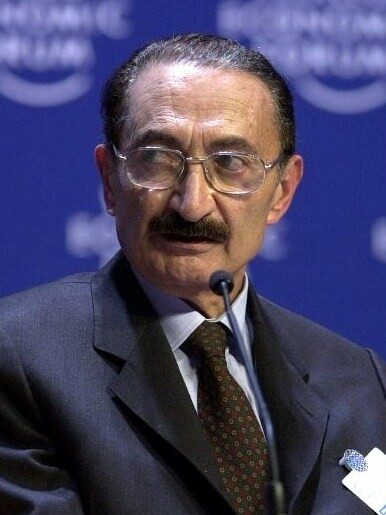
Bülent Ecevit
Bülent Ecevit was the 16th Prime Minister of the Republic of Turkey. Born May 28, 1925, in Istanbul. Died November 5, 2006, in Ankara. Positions held include Prime Minister of Turkey (3 times) (1974–2002), Deputy Prime Minister of Turkey (1997–1999) and member of the Grand National Assembly of Turkey. Educated at Robert College and SOAS, University of London. Awards include Order of the Star of Romania.
Facts
33 facts · 2 confirmed by two sources · 5 cited · 26 from one source
Where this comes from
Papalocal keeps its own record. It started from these sources; what each one said is kept here as it was copied, so a change on their side never changes this page by itself. Tap one to read its version.
What Wikidata says · copied November 16, 2026 · revision 2565565569
- Described as
- 16th Prime Minister of the Republic of Turkey (1925–2006)
- Other names
- Mustafa Bülent Ecevit, Conqueror of Cyprus, Ecevit the Populist, Conqueror of Kenya, Populist Ecevit
- Born
- May 28, 1925 · 9 references
- Died
- November 5, 2006 · 9 references
- Born in
- Istanbul · 2 references
- Died in
- Ankara · 1 reference
- Buried in
- Turkish State Cemetery
- Cause of death
- cerebral hemorrhage
- Citizen of
- Turkey
- Occupation
- politician · 1 reference; writer; poet; translator; journalist; diplomat
- Positions held
- Prime Minister of Turkey (3 times) (1974–2002); Deputy Prime Minister of Turkey (1997–1999); member of the Grand National Assembly of Turkey; Representative of the Parliamentary Assembly of the Council of Europe (1958–1959) · 1 reference
- Political party
- Democratic Left Party (1987–2004); Republican People's Party (1954–1980)
- Education
- Robert College; SOAS, University of London; Ankara University
- Member of
- Parliamentary Assembly of the Council of Europe
- Awards
- Order of the Star of Romania
- Field
- politics · 1 reference; journalism · 1 reference; essay · 1 reference; opinion journalism · 1 reference; literature · 1 reference
- Spouse
- Rahşan Ecevit · 1 reference
- Father
- Fahri Ecevit
- Mother
- Nazlı Ecevit
- Religion
- Islam
- Wikipedias with a page
- 71
Wikidata item Q192634 (wikidata.org/wiki/Q192634), public domain (CC0). Copied November 16, 2026.
What Wikipedia says · copied November 16, 2026 · revision 1383974051
Mustafa Bülent Ecevit (28 May 1925 – 5 November 2006) was a Turkish statesman, poet, writer, scholar, and journalist. He served as the Prime Minister of Turkey four times between 1974 and 2002, specifically in 1974, 1977, 1978–79, and 1999–2002. Ecevit was Chairman of the Republican People's Party (CHP) from 1972 to 1980, and became Chairman of the Democratic Left Party (DSP) in 1987.
Ecevit was elected a CHP MP from Ankara in the 1957 general election and came to prominence as Minister of Labour in İsmet İnönü's cabinets, representing the rising left-wing faction of the party. In 1972, Ecevit became leader of the CHP. His leadership reached out to working-class voters and cemented the party as "Left of Centre".
Ecevit first became Prime Minister in 1974, during which he retracted the ban on cultivation of opium and invaded Cyprus. He formed two more governments in 1977 and 1978–1979 which were marked by increasing polarisation, deadlock, and political violence that ended with the 1980 coup.
Following the coup, Ecevit was banned from politics for ten years. During this decade, the Democratic Left Party (DSP) was established under the leadership of his wife, Rahşan. When the ban was lifted in 1987, he became the head of the DSP. While heading a caretaker government for the 1999 general election, PKK leader Abdullah Öcalan was captured in Kenya, allowing DSP to emerge victorious. The DSP-MHP-ANAP coalition (1999–2002) introduced important political and economic reforms, as well as beginning Turkish accession into the European Union. The MHP's withdrawal from the coalition led to the government's collapse, and at the subsequent 2002 snap election, the DSP was ejected from Parliament after being unable to clear the electoral threshold. Ecevit resigned as Chairman of the party in 2004. He died on 5 November 2006 of circulatory and respiratory failure.
Ecevit is known for being Turkey's only left-wing Prime Minister. His chairmanship resulted in the highest shares of votes CHP or any other left-wing party have ever gained in Turkish history. He is credited for introducing social democratic politics to Turkey by a combination of Kemalism with social democracy, thus making social democracy a core tenet in modern Kemalist ideology. Ecevit is the last non-AKP Prime Minister of Turkey.
- Born, in its opening lines
- May 28, 1925
- Died, in its opening lines
- November 5, 2006
From the Wikipedia article “Bülent Ecevit” (en.wikipedia.org/wiki/Bülent_Ecevit), by its contributors, under CC BY-SA 4.0 (creativecommons.org/licenses/by-sa/4.0/). Copied November 16, 2026; not changed.
Confirmed Two sources agree. Cited One source, and it names where it got it. One source One source, without a reference of its own. Sources disagree The sources disagree. We show the best-supported value and keep theirs below.
