
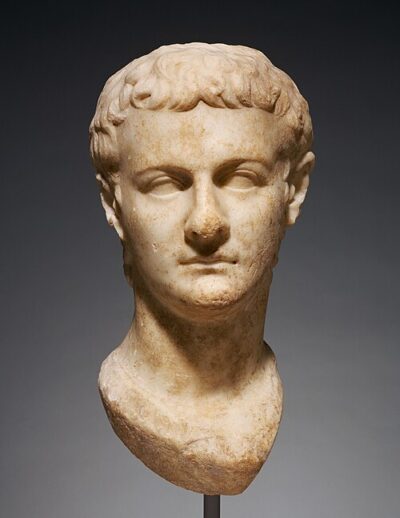
Caligula
Caligula was a third Roman emperor. Born August 31, 12, in Antium. Died January 24, 41, in Palatine Hill. Positions held include Roman emperor (37–41), ancient Roman senator and Roman consul.
Facts
30 facts · 0 confirmed by two sources · 10 cited · 19 from one source · 1 where the sources disagree
What’s different
- Name at birth: we show GAIVS IVLIVS GERMANICI FILIVS TIBERI NEPOS AVGVSTI PRONEPOS DIVI ABNEPOS CAESAR GERMANICVS (Sources disagree). Wikidata also lists GAIVS IVLIVS CAESAR GERMANICVS
Where this comes from
Papalocal keeps its own record. It started from these sources; what each one said is kept here as it was copied, so a change on their side never changes this page by itself. Tap one to read its version.
What Wikidata says · copied November 16, 2026 · revision 2568656973
- Described as
- third Roman emperor (37–41)
- Other names
- Gaius Iulius Caesar Germanicus Caligula, Gaius Julius Caesar Augustus Germanicus, Julius Caesar Germanicus, Emperor of Rome Gaius, Gaius Julius Caesar Germanicus Minor, Emperor of Rome Caligula, Gaius Julius Caesar Germanicus, Gaius Caesar, Gaius Caesar Germanicus, Emperor of Rome Gaius Caesar Germanicus, Gaius, Emperor of Rome Gaius, Julius Caesar Germanicus
- Born
- August 31, 12 · 2 references
- Died
- January 24, 41 · 2 references
- Born in
- Antium · 2 references
- Died in
- Palatine Hill · 1 reference
- Buried in
- Mausoleum of Augustus
- Cause of death
- stab wound
- Name at birth
- GAIVS IVLIVS GERMANICI FILIVS TIBERI NEPOS AVGVSTI PRONEPOS DIVI ABNEPOS CAESAR GERMANICVS; GAIVS IVLIVS CAESAR GERMANICVS
- Citizen of
- Ancient Rome
- Occupation
- politician
- Positions held
- Roman emperor (37–41); ancient Roman senator; Roman consul
- Spouse
- Junia Claudilla · 1 reference; Livia Orestilla · 1 reference; Lollia Paulina (38) · 1 reference; Milonia Caesonia (39–41) · 1 reference
- Children
- Julia Drusilla; Tiberius Gemellus
- Father
- Germanicus · 2 references
- Mother
- Agrippina the Elder · 2 references
- Siblings
- Julia Livilla; Agrippina the Younger; Julia Drusilla; Drusus Caesar · 1 reference; Nero Caesar · 1 reference; Gaius Julius Caesar Germanicus Major; Tiberius Caesar; Ignotus Julius Caesar Germanicus
- Religion
- ancient Roman religion
- Military rank
- imperator
- Wikipedias with a page
- 132
Wikidata item Q1409 (wikidata.org/wiki/Q1409), public domain (CC0). Copied November 16, 2026.
What Wikipedia says · copied November 16, 2026 · revision 1385462431
Gaius Julius Caesar Augustus Germanicus (31 August AD 12 – 24 January AD 41), also called Gaius or Caligula (), was the third Roman emperor, ruling from AD 37 until his assassination in AD 41. He was the son of the Roman general Germanicus and Agrippina the Elder, Augustus's granddaughter, members of the first ruling family of the Roman Empire. He was born two years before Tiberius became emperor. Gaius accompanied his father, mother and siblings on campaign in Germania, at little more than four or five years old. He had been named after Gaius Julius Caesar, but his father's soldiers affectionately nicknamed him "Caligula" ('little boot').
Germanicus died in Antioch in AD 19, and Agrippina returned with her six children to Rome, where she became entangled in a bitter feud with Emperor Tiberius, who was Germanicus' biological uncle and adoptive father. The conflict eventually led to the destruction of her family, with Caligula as the sole male survivor. In 26, Tiberius withdrew from public life to the island of Capri, and in 31, Caligula joined him there. Tiberius died in 37, and Caligula succeeded him as emperor, at the age of 24.
Of the few surviving sources about Caligula and his four-year reign, most were written by members of the nobility and Senate, long after the events they purport to describe. For the early part of his reign, he is said to have been "good, generous, fair and community-spirited", but increasingly self-indulgent, cruel, sadistic, extravagant, and sexually perverted thereafter, an insane, murderous tyrant who demanded and received worship as a living god, humiliated the Senate, and planned to make his horse, Incitatus, a consul. Most modern commentaries instead seek to explain Caligula's position, personality and historical context. Some historians dismiss many of the allegations against him as misunderstandings, exaggeration, mockery or malicious fantasy.
During his brief reign, Caligula worked to increase the unconstrained personal power of the emperor, as opposed to countervailing powers within the principate. He directed much of his attention to ambitious construction projects and public works to benefit Rome's ordinary citizens, including racetracks, theatres, amphitheatres, and improvements to roads and ports. He began the construction of two aqueducts in Rome: the Aqua Claudia and the Anio Novus. During his reign, the empire annexed the client kingdom of Mauretania as a province. He had to abandon an attempted invasion of Britain, and the installation of his statue in the Temple in Jerusalem. In early 41, Caligula was assassinated as a result of a conspiracy by officers of the Praetorian Guard, senators, and courtiers. At least some of the conspirators might have planned this as an opportunity to restore the Roman Republic and aristocratic privileges. If so, their plan was thwarted by the Praetorians, who seem to have spontaneously chosen Caligula's uncle Claudius as the next emperor. Caligula's death marked the official end of the Julii Caesares in the male line, though the Julio-Claudian dynasty continued to rule until the demise of Caligula's nephew, the Emperor Nero.
From the Wikipedia article “Caligula” (en.wikipedia.org/wiki/Caligula), by its contributors, under CC BY-SA 4.0 (creativecommons.org/licenses/by-sa/4.0/). Copied November 16, 2026; not changed.
Confirmed Two sources agree. Cited One source, and it names where it got it. One source One source, without a reference of its own. Sources disagree The sources disagree. We show the best-supported value and keep theirs below.
