
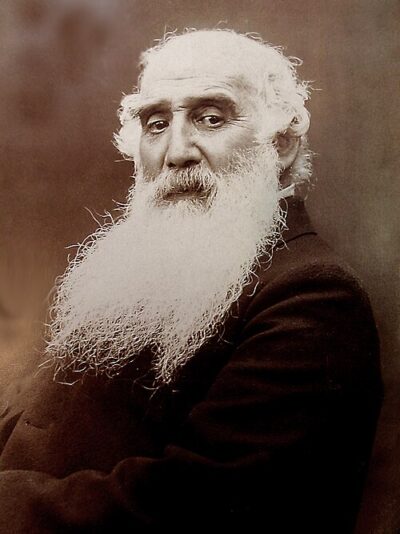
Camille Pissarro
Camille Pissarro was a Danish-French painter. Born July 10, 1830, in Charlotte Amalie. Died November 13, 1903, in Paris. Known for Pont Boieldieu in Rouen, Rainy Weather, Hay Harvest at Éragny and Steamboats in the Port of Rouen. Educated at Académie Suisse.
Facts
44 facts · 2 confirmed by two sources · 19 cited · 22 from one source · 1 where the sources disagree
What’s different
- Buried in: we show Père Lachaise Cemetery (Sources disagree). Wikidata also lists Grave of Camille Pissarro
Where this comes from
Papalocal keeps its own record. It started from these sources; what each one said is kept here as it was copied, so a change on their side never changes this page by itself. Tap one to read its version.
What Wikidata says · copied November 16, 2026 · revision 2569046216
- Described as
- Danish-French painter (1830-1903)
- Other names
- Camille Jacob Pissaro, Jacob-Abraham-Camille Pissarro, Camille-Abraham-Jacob Pissarro, C. Pissarro, Pissaro, C. Pissaro, Camillo Pissarro, Camille Jacob Pissarro, Jacob Abraham Camille Pissarro, Pissarro, Camille Pissaro
- Born
- July 10, 1830 · 16 references
- Died
- November 13, 1903 · 10 references
- Born in
- Charlotte Amalie · 3 references
- Died in
- Paris · 4 references
- Buried in
- Père Lachaise Cemetery · 1 reference; Grave of Camille Pissarro
- Cause of death
- sepsis
- Name at birth
- Jacob Abraham Camille Pissarro
- Citizen of
- France · 3 references; Kingdom of Denmark · 1 reference
- Occupation
- pastellist · 1 reference; architectural drafter · 1 reference; lithographer · 2 references; printmaker · 1 reference; painter · 2 references; graphic artist · 1 reference
- Education
- Académie Suisse (1859–) · 1 reference
- Genre
- landscape painting · 1 reference; figure painting · 1 reference; portrait · 1 reference; still life · 1 reference
- Known for
- Pont Boieldieu in Rouen, Rainy Weather; Hay Harvest at Éragny; Steamboats in the Port of Rouen; The Red Roofs, Côte Saint-Denis at Pontoise, Winter Effect; Boulevard Montmartre, Mardi Gras; The Banks of the Oise near Pontoise; The Côte des Bœufs, Pontoise; The House of the Deaf Woman and the Belfry at Eragny; Rue Saint-Honoré in the Afternoon. Effect of Rain; Boulevard Montmartre, Spring
- Spouse
- Julie Vellay (1871–) · 2 references
- Children
- Lucien Pissarro · 1 reference; Félix Pissarro · 1 reference; Georges Henri Manzana Pissarro · 1 reference; Paul-Émile Pissarro · 1 reference; Ludovic Rodo Pissarro · 1 reference; Jeanne Bonin-Pissarro; Jeanne Rachel Pissarro · 1 reference
- Father
- Frédéric-Abraham-Gabriel Pissarro
- Mother
- Rachel Pissarro
- Siblings
- Alfred Pissarro
- Lived in
- Charlotte Amalie; Venezuela; France
- Wikipedias with a page
- 94
Wikidata item Q134741 (wikidata.org/wiki/Q134741), public domain (CC0). Copied November 16, 2026.
What Wikipedia says · copied November 16, 2026 · revision 1385437262
Jacob Abraham Camille Pissarro ( piss-AR-oh; French: [kamij pisaʁo]; 10 July 1830 – 13 November 1903) was a Danish-French Impressionist and Neo-Impressionist painter born on the island of Saint Thomas (now in the United States Virgin Islands, but then in the Danish West Indies). His importance resides in his contributions to both Impressionism and Post-Impressionism. Pissarro studied from great forerunners, including Gustave Courbet and Jean-Baptiste-Camille Corot. He later studied and worked alongside Georges Seurat and Paul Signac when he took on the Neo-Impressionist style at the age of 54.
In 1873 he helped establish a collective society of fifteen aspiring artists, becoming the "pivotal" figure in holding the group together and encouraging the other members. Art historian John Rewald called Pissarro the "dean of the Impressionist painters", not only because he was the oldest of the group, but also "by virtue of his wisdom and his balanced, kind, and warmhearted personality". Paul Cézanne said "he was a father for me. A man to consult and a little like the good Lord", and he was also one of Paul Gauguin's masters. Pierre-Auguste Renoir referred to his work as "revolutionary", through his artistic portrayals of the "common man", as Pissarro insisted on painting individuals in natural settings without "artifice or grandeur".
Pissarro is the only artist to have shown his work at all eight Paris Impressionist exhibitions, from 1874 to 1886. He "acted as a father figure not only to the Impressionists" but to all four of the major Post-Impressionists, Cézanne, Seurat, Gauguin, and Van Gogh.
- Born, in its opening lines
- July 10, 1830
- Died, in its opening lines
- November 13, 1903
From the Wikipedia article “Camille Pissarro” (en.wikipedia.org/wiki/Camille_Pissarro), by its contributors, under CC BY-SA 4.0 (creativecommons.org/licenses/by-sa/4.0/). Copied November 16, 2026; not changed.
Confirmed Two sources agree. Cited One source, and it names where it got it. One source One source, without a reference of its own. Sources disagree The sources disagree. We show the best-supported value and keep theirs below.
