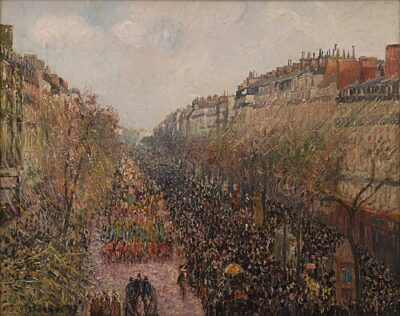
Boulevard Montmartre, Mardi Gras
Boulevard Montmartre, Mardi Gras is a painting by Camille Pissarro. It came out in 1897.
- Came out
- 1897
- Created by
- Camille Pissarro
- Genre
- cityscape
All 5 facts, and where they come from
Facts
5 facts · 0 confirmed by two sources · 0 cited · 5 from one source
Where this comes from
Papalocal keeps its own record. It started from these sources; what each one said is kept here as it was copied, so a change on their side never changes this page by itself. Tap one to read its version.
What Wikidata says · copied November 17, 2026 · revision 2496797951
- Described as
- painting by Camille Pissarro
- Other names
- Boulevard Montmarte, Mardi Gras
- What it is
- painting
- Created by
- Camille Pissarro
- Genre
- cityscape
- Part of the series
- Boulevard Montmartre
- Came out
- 1897
- Wikipedias with a page
- 7
Wikidata item Q4949655 (wikidata.org/wiki/Q4949655), public domain (CC0). Copied 2026-11-17.
What Wikipedia says · copied November 17, 2026 · revision 1361245288
Boulevard Montmartre, Mardi Gras (Paris, 1897) by Camille Pissarro currently resides in the permanent exhibition at the Armand Hammer Museum in Los Angeles, California. This work is part of a series of fourteen paintings depicting different times of the day and seasons of the Boulevard Montmartre in Paris. Camille Pissarro is known as the "Father of Impression" for his "teacher's eye" of drawing what he saw in front of him.
Pissarro first sketched this idea, before using oil on canvas to paint from his balcony window of the Grand Hôtel de Russie overlooking the grand boulevard. He depicts a nineteenth century Mardi Gras procession, also known as the Carnaval de Paris from the streets below extending its grandeur far into the distance. The Carnaval de Paris also included a parade before the masked ball at the Paris Opera House. This street scene focuses on the idea of a "New Paris" that reveals an outdoor natural setting of beauty without adulteration in order to educate the public of real ideas. This painting marks one of Pissarro's last major works due to his weakening eyesight commonly associated with his elderly age. Many critics believe that this disability formed his appearance of unclear, spontaneous, artistic freedom.
From the Wikipedia article “Boulevard Montmartre, Mardi Gras” (en.wikipedia.org/wiki/Boulevard_Montmartre,_Mardi_Gras), by its contributors, under CC BY-SA 4.0 (creativecommons.org/licenses/by-sa/4.0/). Copied 2026-11-17; not changed.
Confirmed Two sources agree. Cited One source, and it names where it got it. One source One source, without a reference of its own. Sources disagree The sources disagree. We show the best-supported value and keep theirs below.
Picture: Camille Pissarro, via Wikimedia Commons · Public domain