
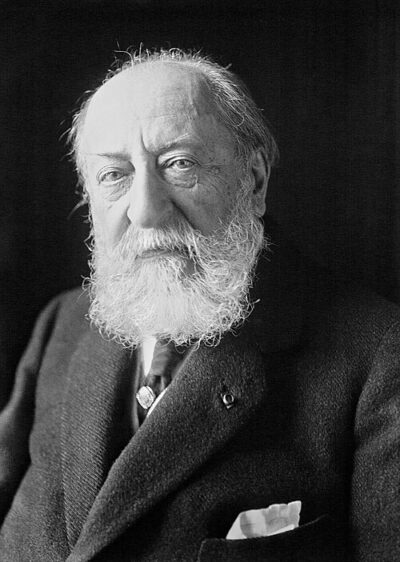
Camille Saint-Saëns
Camille Saint-Saëns was a French composer, organist, conductor and pianist. Born October 9, 1835, in 11th arrondissement of Paris. Died December 16, 1921, in Algiers. Known for Piano Concerto No. 1, Piano Concerto No. 2 and Symphony No. 3. Educated at Conservatoire de Paris. Awards include Grand Cross of the Legion of Honour, Pour le Mérite for Sciences and Arts order and Grand Officer of the Legion of Honour.
Facts
42 facts · 2 confirmed by two sources · 17 cited · 23 from one source
Where this comes from
Papalocal keeps its own record. It started from these sources; what each one said is kept here as it was copied, so a change on their side never changes this page by itself. Tap one to read its version.
What Wikidata says · copied November 16, 2026 · revision 2564774508
- Described as
- French composer, organist, conductor and pianist (1835–1921)
- Other names
- Camille Saint-Saens, Saint-Saëns, Saint-Saens, Charles-Camille Saint-Saëns, C. Camille Saint-Saens, Charles Camille Saint-Saens, Charles Camille Saint-Saëns
- Born
- October 9, 1835 · 19 references
- Died
- December 16, 1921 · 19 references
- Born in
- 11th arrondissement of Paris · 3 references
- Died in
- Algiers · 3 references
- Buried in
- Montparnasse Cemetery · 1 reference
- Cause of death
- myocardial infarction
- Name at birth
- Charles Camille Saint-Saëns
- Citizen of
- France · 1 reference
- Occupation
- composer · 2 references; organist · 2 references; conductor; pianist · 2 references; music critic; music teacher · 1 reference; clarinetist · 1 reference; musicologist · 1 reference
- Education
- Conservatoire de Paris
- Member of
- Académie des beaux-arts (1881–1921) · 1 reference
- Genre
- opera; symphony; classical music; concerto
- Instrument
- piano; violin; pipe organ
- Known for
- Piano Concerto No. 1; Piano Concerto No. 2; Symphony No. 3; Danse macabre; The Carnival of the Animals
- Awards
- Grand Cross of the Legion of Honour (1913) · 1 reference; Pour le Mérite for Sciences and Arts order; Grand Officer of the Legion of Honour (1900) · 1 reference; Commander of the Legion of Honour (1894) · 1 reference; Officer of the Legion of Honour (1884) · 1 reference; Knight of the Legion of Honour (1869) · 1 reference; Pour le Mérite · 1 reference; Royal Victorian Order (1902); honorary doctorate from the University of Cambridge (1893); Honorary doctor of the University of Oxford (1907); Grand Cross of the Order of Saint-Charles (1904) · 1 reference
- Spouse
- Marie-Laure Truffot
- Wikipedias with a page
- 80
Wikidata item Q150445 (wikidata.org/wiki/Q150445), public domain (CC0). Copied November 16, 2026.
What Wikipedia says · copied November 16, 2026 · revision 1383659553
Charles-Camille Saint-Saëns (UK: , US: ; French: [ʃaʁl kamij sɛ̃sɑ̃(s)] 9 October 1835 – 16 December 1921) was a French composer, organist, conductor and pianist of the Romantic era. His best-known works include Introduction and Rondo Capriccioso (1863), the Second Piano Concerto (1868), the First Cello Concerto (1872), Danse macabre (1874), the opera Samson and Delilah (1877), the Third Violin Concerto (1880), the Third ("Organ") Symphony (1886) and The Carnival of the Animals (1886).
Saint-Saëns was a musical prodigy; he made his concert debut at the age of ten. After studying at the Paris Conservatoire he followed a conventional career as a church organist, first at Saint-Merri, Paris and, from 1858, La Madeleine, the official church of the French Empire. After leaving the post twenty years later, he was a successful freelance pianist and composer, in demand in Europe and the Americas.
As a young man, Saint-Saëns was enthusiastic for the most modern music of the day, particularly that of Schumann, Liszt and Wagner, although his own compositions were generally within a conventional classical tradition. He was a scholar of musical history and remained committed to the structures worked out by earlier French composers. This brought him into conflict in his later years with composers of the impressionist and expressionist schools of music; although there were neoclassical elements in his music, foreshadowing works by Stravinsky and Les Six, he was often regarded as a reactionary in the decades around the time of his death.
Saint-Saëns held only one teaching post, at the École Niedermeyer in Paris, and remained there for less than five years. It was nevertheless important in the development of French music: his students included Gabriel Fauré, among whose own later pupils was Maurice Ravel. Both of them were strongly influenced by Saint-Saëns, whom they revered as a genius.
- Born, in its opening lines
- October 9, 1835
- Died, in its opening lines
- December 16, 1921
From the Wikipedia article “Camille Saint-Saëns” (en.wikipedia.org/wiki/Camille_Saint-Saëns), by its contributors, under CC BY-SA 4.0 (creativecommons.org/licenses/by-sa/4.0/). Copied November 16, 2026; not changed.
Confirmed Two sources agree. Cited One source, and it names where it got it. One source One source, without a reference of its own. Sources disagree The sources disagree. We show the best-supported value and keep theirs below.
