
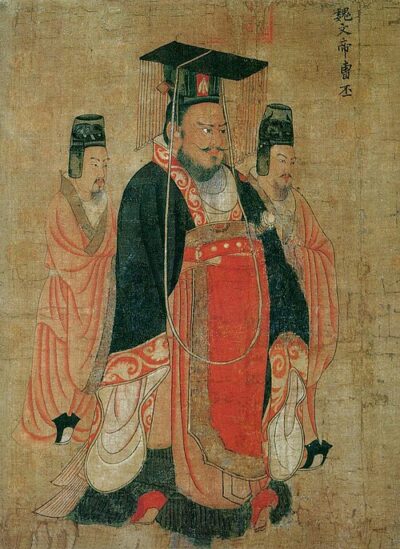
Cao Pi
Cao Pi was a Cao Wei Emperror. Born May 29, 187, in Bozhou. Died June 29, 226, in Luoyang. Positions held include Emperor of China (220–226) and Chinese king (220).
Facts
37 facts · 0 confirmed by two sources · 6 cited · 31 from one source
Where this comes from
Papalocal keeps its own record. It started from these sources; what each one said is kept here as it was copied, so a change on their side never changes this page by itself. Tap one to read its version.
What Wikidata says · copied November 16, 2026 · revision 2565823232
- Described as
- Cao Wei Emperror (187-226)
- Other names
- Emperor Wen, the Wen Emperor, Wen Di, Zihuan, Wei Wendi, Cao Zihuan, Ts'ao P'i, Tsao Pi, Wei Wen-ti, Tzu-huan, Ts'ao Tzu-huan, Tsao Tzu-huan
- Born
- May 29, 187
- Died
- June 29, 226
- Born in
- Bozhou
- Died in
- Luoyang
- Citizen of
- Cao Wei · 1 reference
- Occupation
- poet; writer; king; politician · 1 reference
- Positions held
- Emperor of China (220–226); Chinese king (220)
- Spouse
- Lady Zhen · 1 reference; Guo Nüwang · 1 reference; datter av keiser Xian
- Children
- Cao Rui · 1 reference; Cao Lin; Cao Jie; Cao Rui; Cao Yan; Cao Xie; Cao Li; Cao Gong; Cao Yong; Cao Jian; Princess Dongxiang
- Father
- Cao Cao · 1 reference
- Mother
- Empress Dowager Bian · 1 reference
- Siblings
- Princess Jinxiang; Cao Xian; Cao Hua; Empress Cao Jie; Princess Anyang; Princess Qinghe; Cao Zishang; Cao Zicheng; Cao Zijing; Cao Ziqin
- Wikipedias with a page
- 50
Wikidata item Q313333 (wikidata.org/wiki/Q313333), public domain (CC0). Copied November 16, 2026.
What Wikipedia says · copied November 16, 2026 · revision 1385280959
Cao Pi () (c.late 187 – 29 June 226), courtesy name Zihuan, was the first emperor of the state of Cao Wei in the Three Kingdoms period of China. He was the second son of Cao Cao, a warlord who lived in the late Eastern Han dynasty, but the eldest son among all the children born to Cao Cao by his concubine (later wife), Lady Bian. According to some historical records, he was often in the presence of court officials in order to gain their support. He was mostly in charge of defence at the start of his career. After the defeat of Cao Cao's rival Yuan Shao at the Battle of Guandu, he took Yuan Xi's wife, Lady Zhen, as a concubine, but in 221 Lady Zhen died and Guo Nüwang became empress.
On 25 November 220, Cao Pi forced Emperor Xian, the last ruler of the Eastern Han dynasty, to abdicate in his favour, after which on 11 December 220 he proclaimed himself emperor and established the state of Cao Wei. Cao Pi continued the wars against the states of Shu Han and Eastern Wu, founded by his father's rivals Liu Bei and Sun Quan, respectively, but did not make significant territorial gain in the battles. Unlike his father, Cao Pi concentrated most of his efforts on internal administration rather than on waging wars against his rivals. During his reign, he formally established Chen Qun's nine-rank system as the base for civil service nomination, which drew many talents into his government. On the other hand, he drastically reduced the power of princes, stripping off their power to oppose him, but at the same time, rendering them unable to assist the emperor if a crisis arose within the state. After Cao Pi's death, his successor Cao Rui granted him the posthumous name "Emperor Wen" and the temple name "Gaozu".
Cao Pi was also an accomplished poet and scholar, just like his father Cao Cao and his younger brother Cao Zhi. He wrote Yan Ge Xing (燕歌行), the first Chinese poem in the style of seven syllables per line (七言詩). He also wrote over a hundred articles on various subjects. The zhiguai collection Lieyi Zhuan was also attributed to him.
From the Wikipedia article “Cao Pi” (en.wikipedia.org/wiki/Cao_Pi), by its contributors, under CC BY-SA 4.0 (creativecommons.org/licenses/by-sa/4.0/). Copied November 16, 2026; not changed.
Confirmed Two sources agree. Cited One source, and it names where it got it. One source One source, without a reference of its own. Sources disagree The sources disagree. We show the best-supported value and keep theirs below.
