
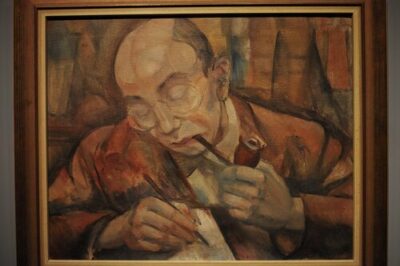
Carl Einstein
Carl Einstein was a German art historian. Born April 26, 1885, in Neuwied. Died July 5, 1940, in Pau. Educated at Humboldt-Universität zu Berlin.
Facts
22 facts · 2 confirmed by two sources · 9 cited · 11 from one source
Where this comes from
Papalocal keeps its own record. It started from these sources; what each one said is kept here as it was copied, so a change on their side never changes this page by itself. Tap one to read its version.
What Wikidata says · copied November 18, 2026 · revision 2569021943
- Described as
- German art historian (1885-1940)
- Other names
- Savine Ree Urian
- Born
- April 26, 1885 · 6 references
- Died
- July 5, 1940 · 6 references
- Born in
- Neuwied · 3 references
- Died in
- Pau
- Cause of death
- drowning
- Citizen of
- German Empire; Germany · 1 reference; France · 1 reference; Spain · 1 reference
- Occupation
- art historian · 4 references; anarchist; writer · 3 references; screenwriter · 1 reference; art critic · 1 reference; poet · 1 reference; prose writer · 1 reference; critic · 2 references
- Education
- Humboldt-Universität zu Berlin
- Spouse
- Lyda Guévrékian Einstein
- Children
- Nina Auproux-Einstein
- Military branch
- Durruti Column
- Website
- https://www.carleinstein.org
- Wikipedias with a page
- 22
Wikidata item Q66282 (wikidata.org/wiki/Q66282), public domain (CC0). Copied November 18, 2026.
What Wikipedia says · copied November 18, 2026 · revision 1376461921
Carl Einstein, born Karl Einstein, also known by pseudonym Savine Ree Urian (26 April 1885 – 5 July 1940), was a German writer, art historian, anarchist, and critic.
Regarded as one of the first critics to appreciate the development of Cubism, as well as for his work on African art and influence on the European avant-garde, Einstein was a friend and colleague of such figures as George Grosz, Georges Braque, Pablo Picasso and Daniel-Henry Kahnweiler. His work combined many strands of both political and aesthetic discourse into his writings, addressing both the developing aesthetic of modern art and the political situation in Europe.
Einstein's involvement in social and political life was characterized by communist sympathies and anarchist views. A target of the German right wing during the interwar Weimar period, Einstein left Germany for France in 1928, a half-decade ahead of the rise of Adolf Hitler and the Nazi Party, later taking part in the Spanish Civil War on the side of the Republican forces during the 1930s.
Trapped in southern France following Nazi Germany's defeat of the French Third Republic, Einstein killed himself by jumping from a bridge on 5 July 1940.
- Born, in its opening lines
- April 26, 1885
- Died, in its opening lines
- July 5, 1940
From the Wikipedia article “Carl Einstein” (en.wikipedia.org/wiki/Carl_Einstein), by its contributors, under CC BY-SA 4.0 (creativecommons.org/licenses/by-sa/4.0/). Copied November 18, 2026; not changed.
Confirmed Two sources agree. Cited One source, and it names where it got it. One source One source, without a reference of its own. Sources disagree The sources disagree. We show the best-supported value and keep theirs below.
