
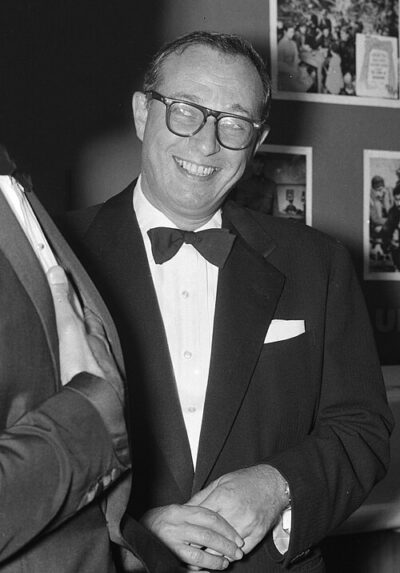
Carl Foreman
Carl Foreman was an American screenwriter and film producer. Born July 23, 1914, in Chicago. Died June 26, 1984, in Los Angeles. Educated at University of Illinois Urbana-Champaign and Theodore Roosevelt High School. Awards include Commander of the Order of the British Empire, Academy Award for Best Writing, Adapted Screenplay and Golden Globe Award for Best Motion Picture – Drama.
Facts
23 facts · 2 confirmed by two sources · 7 cited · 14 from one source
Where this comes from
Papalocal keeps its own record. It started from these sources; what each one said is kept here as it was copied, so a change on their side never changes this page by itself. Tap one to read its version.
What Wikidata says · copied November 16, 2026 · revision 2557829026
- Described as
- American screenwriter and film producer (1914-1984)
- Born
- July 23, 1914 · 4 references
- Died
- June 26, 1984 · 6 references
- Born in
- Chicago · 4 references
- Died in
- Los Angeles
- Cause of death
- brain tumor
- Citizen of
- United States
- Occupation
- screenwriter · 1 reference; film director · 1 reference; film producer · 3 references; producer · 1 reference; director · 1 reference
- Political party
- Communist Party of the United States of America
- Education
- University of Illinois Urbana-Champaign; Theodore Roosevelt High School · 1 reference
- Member of
- Writers Guild of America West
- Awards
- Commander of the Order of the British Empire; Academy Award for Best Writing, Adapted Screenplay (1958) · 1 reference; Golden Globe Award for Best Motion Picture – Drama (1961); Laurel Award for Screenwriting Achievement (1969); Valentine Davies Award (1977)
- Children
- Jonathan Foreman; Amanda Foreman
- Lived in
- United Kingdom
- Wikipedias with a page
- 20
Wikidata item Q1037848 (wikidata.org/wiki/Q1037848), public domain (CC0). Copied November 16, 2026.
What Wikipedia says · copied November 16, 2026 · revision 1367531089
Carl Foreman (July 23, 1914 – June 26, 1984) was an American screenwriter, film producer, and director. He was one of the screenwriters who were blacklisted in Hollywood in the 1950s because of their suspected communist sympathy or membership in the Communist Party, and subsequently relocated to the United Kingdom. He was nominated for six Academy Awards (five for writing and one for producing), and posthumously received Best Adapted Screenplay for his work on The Bridge on the River Kwai (1957).
Foreman was also nominated for two BAFTA Awards for Best British Screenplay, and a Golden Globe Award for his work on High Noon (1952). His other notable works included Champion (1949), Home of the Brave (1949), The Men (1950), Cyrano de Bergerac (1950), The Key (1958), The Guns of Navarone (1961), Born Free (1966), Young Winston (1972), and his only directorial effort The Victors (1963).
He once said his most common theme was "the struggle of the individual against a society that for one reason or another is hostile." Foreman elaborated that "the stories that work best for me involve a loner, out of step or in direct conflict with a group of people."
- Born, in its opening lines
- July 23, 1914
- Died, in its opening lines
- June 26, 1984
From the Wikipedia article “Carl Foreman” (en.wikipedia.org/wiki/Carl_Foreman), by its contributors, under CC BY-SA 4.0 (creativecommons.org/licenses/by-sa/4.0/). Copied November 16, 2026; not changed.
Confirmed Two sources agree. Cited One source, and it names where it got it. One source One source, without a reference of its own. Sources disagree The sources disagree. We show the best-supported value and keep theirs below.
