
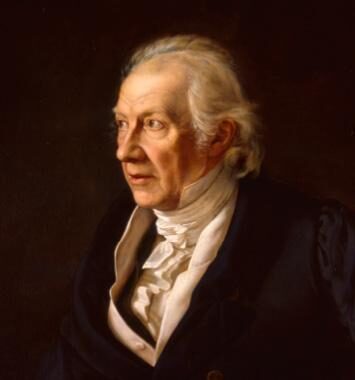
Carl Friedrich Zelter
Carl Friedrich Zelter was a German composer. Born December 11, 1758, in Berlin. Died May 15, 1832, in Berlin.
Facts
18 facts · 2 confirmed by two sources · 8 cited · 8 from one source
Where this comes from
Papalocal keeps its own record. It started from these sources; what each one said is kept here as it was copied, so a change on their side never changes this page by itself. Tap one to read its version.
What Wikidata says · copied November 16, 2026 · revision 2568904571
- Described as
- German composer (1758-1832)
- Born
- December 11, 1758 · 10 references
- Died
- May 15, 1832 · 9 references
- Born in
- Berlin · 3 references
- Died in
- Berlin · 3 references
- Buried in
- Sophienkirche
- Citizen of
- Kingdom of Prussia
- Occupation
- composer · 1 reference; music educator; conductor · 1 reference; independent publisher · 1 reference; master builder · 1 reference; music teacher · 1 reference; musician · 1 reference
- Worked for
- Humboldt-Universität zu Berlin
- Member of
- Academy of Arts, Berlin
- Genre
- classical music
- Spouse
- Julie Pappritz (1796–) · 1 reference; Johanna Sophia Eleonora Kappel · 1 reference
- Wikipedias with a page
- 29
Wikidata item Q58857 (wikidata.org/wiki/Q58857), public domain (CC0). Copied November 16, 2026.
What Wikipedia says · copied November 16, 2026 · revision 1367417881
Carl Friedrich Zelter (11 December 1758 – 15 May 1832) was a German composer, conductor and teacher of music. Working in his father's bricklaying business, Zelter attained mastership in that profession, and was a musical autodidact.
Zelter was born and died in Berlin. He became friendly with Johann Wolfgang von Goethe, and his works include settings of Goethe's poems. During his career, he composed about two hundred lieder, as well as cantatas, a viola concerto (performed as early as 1779) and piano music.
Amongst Zelter's pupils (at different times) were Felix Mendelssohn, Fanny Mendelssohn, Giacomo Meyerbeer, Eduard Grell, Otto Nicolai, Johann Friedrich Naue, and Heinrich Dorn. Felix Mendelssohn was perhaps Zelter's favorite pupil and Zelter wrote to Goethe boasting of the 12-year old's abilities. Zelter communicated his strong love of the music of J. S. Bach to Mendelssohn, one consequence of which was Mendelssohn's 1829 revival of Bach's St Matthew Passion at the Sing-Akademie under Zelter's auspices. This epochal event sparked a general re-evaluation and revival of Bach's works, which were then largely forgotten and regarded as old-fashioned and beyond resuscitation. Mendelssohn had hoped to succeed Zelter on the latter's death as leader of the Singakademie, but the post went instead to Carl Friedrich Rungenhagen.Zelter was married to Julie Pappritz in 1796, one year after his first wife, Sophie Eleonora Flöricke, née Kappel, had died. Pappritz was a well-known singer at the Berlin Opera. Zelter is buried at the Sophienkirche in Berlin. The violinist Daniel Hope (born 1973) is a direct descendant of Zelter.[1]
Zelter was the author of a biography of Carl Friedrich Christian Fasch, first published in 1801 by J.F. Unger in Berlin. He was a mentor and friend of French harpist and composer Marie Nicole Simonin Pollet. The novelist Elizabeth Sara Sheppard portrayed Zelter as the character Aronach in her 1853 novel Charles Auchester.
- Born, in its opening lines
- December 11, 1758
- Died, in its opening lines
- May 15, 1832
From the Wikipedia article “Carl Friedrich Zelter” (en.wikipedia.org/wiki/Carl_Friedrich_Zelter), by its contributors, under CC BY-SA 4.0 (creativecommons.org/licenses/by-sa/4.0/). Copied November 16, 2026; not changed.
Confirmed Two sources agree. Cited One source, and it names where it got it. One source One source, without a reference of its own. Sources disagree The sources disagree. We show the best-supported value and keep theirs below.
