
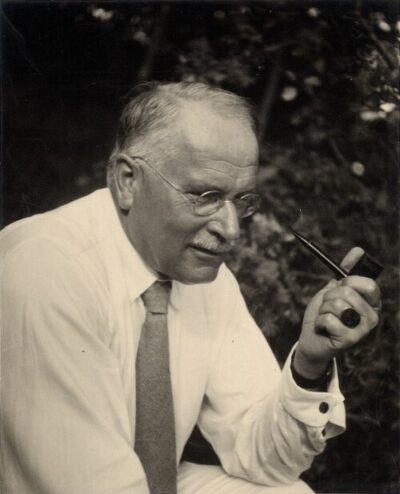
Carl Jung
Carl Jung was a Swiss psychiatrist and psychotherapist. Born July 26, 1875, in Kesswil. Died June 6, 1961, in Küsnacht. Known for Symbols of Transformation, Psychological Types and Synchronicity: An Acausal Connecting Principle. Educated at Gymnasium am Münsterplatz and University of Basel. Awards include honorary doctor of the University of Calcutta, honorary doctor of the Clark University and Honorary Fellow of the British Psychological Society.
Facts
48 facts · 2 confirmed by two sources · 16 cited · 30 from one source
Where this comes from
Papalocal keeps its own record. It started from these sources; what each one said is kept here as it was copied, so a change on their side never changes this page by itself. Tap one to read its version.
What Wikidata says · copied November 16, 2026 · revision 2566147093
- Described as
- Swiss psychiatrist and psychotherapist (1875–1961)
- Other names
- C.G. Jung, Karl Gustav Jung, C. G. Yungu, Jung, Carl Gustav Jung, C. G. Jung
- Born
- July 26, 1875 · 22 references
- Died
- June 6, 1961 · 21 references
- Born in
- Kesswil · 4 references
- Died in
- Küsnacht · 4 references
- Buried in
- Küsnacht Cemetery
- Cause of death
- stroke · 1 reference
- Name at birth
- Carl Gustav Jung
- Citizen of
- Switzerland · 1 reference
- Occupation
- psychotherapist · 2 references; psychologist · 2 references; psychiatrist · 2 references; essayist; painter · 1 reference; university teacher · 1 reference
- Worked for
- University of Basel; University of Zurich; ETH Zurich · 1 reference
- Education
- Gymnasium am Münsterplatz (1886–1895) · 1 reference; University of Basel (1895–1900) · 1 reference; Wilhelmsgymnasium
- Member of
- Zofingia; German Academy of Sciences Leopoldina; Eranos; C. G. Jung Institute Zürich
- Known for
- Symbols of Transformation; Psychological Types; Synchronicity: An Acausal Connecting Principle; Archetypes and the Collective Unconscious; Ein moderner Mythus. Von Dingen die am Himmel gesehen werden; Psychology and Alchemy; Mysterium Coniunctionis; Man and His Symbols; Memories, Dreams, Reflections
- Awards
- honorary doctor of the University of Calcutta; honorary doctor of the Clark University (1909) · 1 reference; Honorary Fellow of the British Psychological Society
- Field
- psychiatry; psychology; analytical psychology; psychotherapy; comparative mythology; anthropology
- Spouse
- Emma Jung (1903–1955)
- Children
- Helene Hoerni-Jung · 1 reference
- Father
- Johann Paul Achilles Jung · 1 reference
- Mother
- Emilie Preiswerk · 1 reference
- Religion
- reformed · 1 reference
- Lived in
- Switzerland · 1 reference
- Wikipedias with a page
- 153
Wikidata item Q41532 (wikidata.org/wiki/Q41532), public domain (CC0). Copied November 16, 2026.
What Wikipedia says · copied November 16, 2026 · revision 1383783078
Carl Gustav Jung ( YUUNG; Swiss Standard German: [ˈkarl ˈjʊŋ]; 26 July 1875 – 6 June 1961) was a Swiss psychiatrist, psychotherapist, and psychologist who founded the school of analytical psychology. He was a prolific author of over twenty books, illustrator, correspondent, and academic, best known for his concept of archetypes. Widely considered one of the most influential psychologists of all time, Jung's work has fostered not only scholarship, but also popular interest. His work has been influential in the fields of psychiatry, anthropology, archaeology, literature, philosophy, psychology, and religious studies.
Jung worked as a research scientist at the Burghölzli psychiatric hospital in Zurich, under Eugen Bleuler. He established himself as an influential mind, developing a friendship with Sigmund Freud, the founder of psychoanalysis, and conducting a lengthy correspondence regarding their joint vision of human psychology. Freud saw the younger Jung not only as the heir he had been seeking to take forward his "new science" of psychoanalysis, but as a means to legitimise his own work: Freud and other contemporary psychoanalysts were Jews facing rising antisemitism in Europe, while Jung was raised as Christian, although he did not strictly adhere to traditional Christian doctrine, seeing religion, including Christianity, as a powerful expression of the human psyche and its search for meaning. Freud secured Jung's appointment as president of Freud's newly founded International Psychoanalytical Association. Jung's research and personal vision, however, made it difficult to follow his older colleague's doctrine, and they parted ways. This division was painful for Jung and resulted in the establishment of Jung's analytical psychology as a comprehensive system separate from psychoanalysis.
Among the central concepts of analytical psychology is individuation—the lifelong psychological process of differentiation of the self out of each individual's conscious and unconscious elements. Jung considered it to be the main task of human development. He created some of the best-known psychological concepts, including synchronicity, archetypal phenomena, the collective unconscious, the psychological complex, and extraversion and introversion. His treatment of American businessman and politician Rowland Hazard in 1926 with his conviction that alcoholics may recover if they have a "vital spiritual (or religious) experience" played a crucial role in the chain of events that led to the formation of Alcoholics Anonymous. Jung was an artist, craftsman, builder, and prolific writer. Many of his works were not published until after his death, and some remain unpublished.
- Born, in its opening lines
- July 26, 1875
- Died, in its opening lines
- June 6, 1961
From the Wikipedia article “Carl Jung” (en.wikipedia.org/wiki/Carl_Jung), by its contributors, under CC BY-SA 4.0 (creativecommons.org/licenses/by-sa/4.0/). Copied November 16, 2026; not changed.
Confirmed Two sources agree. Cited One source, and it names where it got it. One source One source, without a reference of its own. Sources disagree The sources disagree. We show the best-supported value and keep theirs below.
