
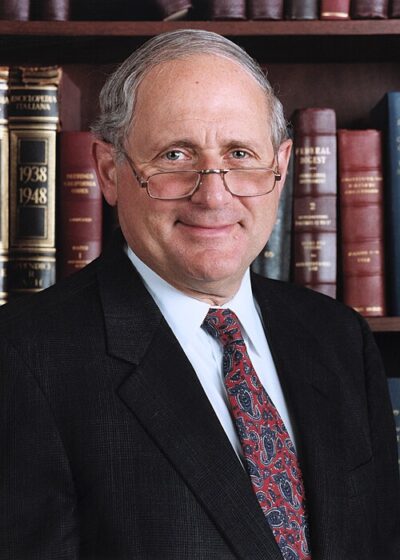
Carl Levin
Carl Levin was an American politician. Born June 28, 1934, in Detroit. Died July 29, 2021, in Henry Ford Hospital. Positions held include attorney general (1964–1967), city council (1969–1977) and United States senator (1979–2015). Educated at Swarthmore College and Harvard Law School. Awards include Four Freedoms Award – Freedom Medal and Order of the Three Stars, 2nd Class.
Facts
22 facts · 2 confirmed by two sources · 11 cited · 9 from one source
Where this comes from
Papalocal keeps its own record. It started from these sources; what each one said is kept here as it was copied, so a change on their side never changes this page by itself. Tap one to read its version.
What Wikidata says · copied November 15, 2026 · revision 2567410370
- Described as
- American politician (1934–2021)
- Other names
- Carl Milton Levin
- Born
- June 28, 1934 · 1 reference
- Died
- July 29, 2021 · 1 reference
- Born in
- Detroit · 1 reference
- Died in
- Henry Ford Hospital · 1 reference
- Name at birth
- Carl Milton Levin
- Citizen of
- United States
- Occupation
- politician · 1 reference; lawyer · 1 reference
- Positions held
- attorney general (1964–1967) · 1 reference; city council (1969–1977) · 1 reference; United States senator (1979–2015) · 1 reference
- Political party
- Democratic Party
- Education
- Swarthmore College (–1956) · 1 reference; Harvard Law School (–1959) · 1 reference; primary school · 1 reference; Central High School (Detroit) · 1 reference; Oakland University
- Awards
- Four Freedoms Award – Freedom Medal (2007) · 1 reference; Order of the Three Stars, 2nd Class (2016)
- Field
- gun control
- Siblings
- Sander Levin
- Religion
- Judaism
- Wikipedias with a page
- 32
Wikidata item Q444652 (wikidata.org/wiki/Q444652), public domain (CC0). Copied November 15, 2026.
What Wikipedia says · copied November 15, 2026 · revision 1385900427
Carl Milton Levin (June 28, 1934 – July 29, 2021) was an American attorney and politician who served as a United States senator from Michigan from 1979 to 2015. A member of the Democratic Party, he was the chair of the Senate Armed Services Committee from 2001 to 2003 and again from 2007 to 2015.
Born in Detroit, Levin graduated from Swarthmore College and Harvard Law School. He worked as the general counsel of the Michigan Civil Rights Commission from 1964 to 1967, and as a special assistant attorney general for the Michigan Attorney General's Office. Levin was a member of the Detroit City Council from 1969 to 1977, serving as the council's president for the last four of those years.
In 1978, Levin ran for the United States Senate, defeating Republican incumbent Robert P. Griffin. Levin was re-elected in 1984, 1990, 1996, 2002, and 2008. On March 7, 2013, Levin announced that he would not seek a seventh term. On March 9, 2015, Levin announced he was joining the Detroit-based law firm Honigman Miller Schwartz and Cohn LLP. At the same time, he founded the Levin Center at Wayne State University Law School, dedicated to "strengthening the integrity, transparency, and accountability of public and private institutions by promoting and supporting bipartisan, fact-based oversight; advancing good governance, particularly with respect to the legislative process; and promoting civil discourse on current issues of public policy".
Levin became Michigan's senior senator in 1995, and he was the longest-serving senator in the state's history. At the time of his retirement Levin was the fourth longest-serving incumbent in the U.S. Senate. He released his memoir, Getting to the Heart of the Matter: My 36 Years in the Senate, in March 2021. It was published by Wayne State University Press.
- Born, in its opening lines
- June 28, 1934
- Died, in its opening lines
- July 29, 2021
From the Wikipedia article “Carl Levin” (en.wikipedia.org/wiki/Carl_Levin), by its contributors, under CC BY-SA 4.0 (creativecommons.org/licenses/by-sa/4.0/). Copied November 15, 2026; not changed.
Confirmed Two sources agree. Cited One source, and it names where it got it. One source One source, without a reference of its own. Sources disagree The sources disagree. We show the best-supported value and keep theirs below.
