
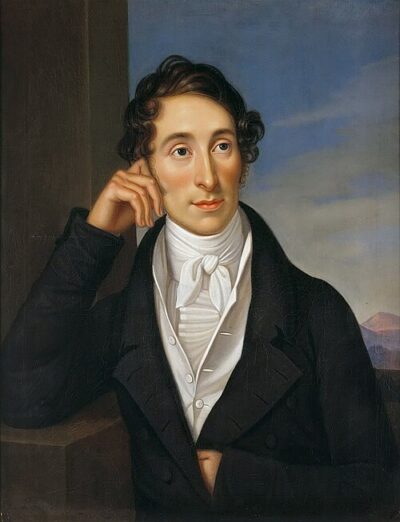
Carl Maria von Weber
Carl Maria von Weber was a German Romantic composer. Born November 1786, in Eutin. Died June 5, 1826, in London. Known for Der Freischütz and Oberon. Educated at University of Music and Performing Arts Vienna. Awards include Honorary Member of the Royal Philharmonic Society.
Facts
35 facts · 2 confirmed by two sources · 20 cited · 13 from one source
What’s different
- Born: we show November 1786 (Confirmed). Wikidata also lists December 18, 1786 and November 18, 1786
Where this comes from
Papalocal keeps its own record. It started from these sources; what each one said is kept here as it was copied, so a change on their side never changes this page by itself. Tap one to read its version.
What Wikidata says · copied November 16, 2026 · revision 2568743668
- Described as
- German Romantic composer (1786–1826)
- Other names
- Carl Maria Friedrich Ernst von Weber, Karl Maria von Weber
- Born
- December 18, 1786 · 3 references; November 1786 · 1 reference; November 18, 1786 · 2 references
- Died
- June 5, 1826 · 14 references
- Born in
- Eutin · 2 references
- Died in
- London · 5 references
- Buried in
- Alter Katholischer Friedhof
- Cause of death
- tuberculosis
- Citizen of
- Prince-Bishopric of Lübeck
- Occupation
- composer · 2 references; conductor · 2 references; pianist · 1 reference; guitarist; classical guitarist; music critic · 2 references; opera director · 1 reference; writer · 1 reference
- Education
- University of Music and Performing Arts Vienna
- Member of
- Ludlamshöhle · 1 reference
- Genre
- classical music; opera
- Instrument
- guitar; piano
- Known for
- Der Freischütz; Oberon
- Awards
- Honorary Member of the Royal Philharmonic Society (1826) · 1 reference
- Field
- music · 1 reference; music criticism · 1 reference
- Spouse
- Caroline Weber · 1 reference
- Children
- Max Maria von Weber · 1 reference; Alexander von Weber · 1 reference
- Father
- Franz Anton von Weber · 1 reference
- Mother
- Genovefa von Weber · 1 reference
- Siblings
- Maria Antonia Weber · 1 reference; Edmund Weber · 1 reference; Fridolin Weber · 1 reference
- Religion
- Catholicism · 1 reference
- Wikipedias with a page
- 82
Wikidata item Q154812 (wikidata.org/wiki/Q154812), public domain (CC0). Copied November 16, 2026.
What Wikipedia says · copied November 16, 2026 · revision 1384503203
Carl Maria Friedrich Ernst von Weber (18/19 November 1786 – 5 June 1826) was a German composer, conductor, virtuoso pianist, guitarist, and critic in the late Classical and early Romantic eras. Best known for his operas, he was a crucial figure in the development of German Romantische Oper (German Romantic opera).
Throughout his youth, his father, Franz Anton, relentlessly moved the family between Hamburg, Salzburg, Freiberg, Augsburg and Vienna. Consequently, he studied with many teachers—his father, Johann Peter Heuschkel, Michael Haydn, Giovanni Valesi, Johann Nepomuk Kalcher, and Georg Joseph Vogler—under whose supervision he composed four operas, none of which survive complete. He had a modest output of non-operatic music, which includes two symphonies, two concertos and a concertino for clarinet and orchestra, a bassoon concerto, a horn concertino, two concertos and a Konzertstück for piano and orchestra, piano pieces such as Invitation to the Dance; and many pieces that featured the clarinet, usually written for the virtuoso clarinetist Heinrich Baermann.
His mature operas—Silvana (1810), Abu Hassan (1811), Der Freischütz (1821), Die drei Pintos (comp. 1820–21), Euryanthe (1823), Oberon (1826)—had a major impact on subsequent German composers including Marschner, Meyerbeer, and Wagner; his compositions for piano influenced those of Mendelssohn, Chopin and Liszt. His best known work, Der Freischütz, remains among the most significant German operas.
- Born, in its opening lines
- November 19, 1786
- Died, in its opening lines
- June 5, 1826
From the Wikipedia article “Carl Maria von Weber” (en.wikipedia.org/wiki/Carl_Maria_von_Weber), by its contributors, under CC BY-SA 4.0 (creativecommons.org/licenses/by-sa/4.0/). Copied November 16, 2026; not changed.
Confirmed Two sources agree. Cited One source, and it names where it got it. One source One source, without a reference of its own. Sources disagree The sources disagree. We show the best-supported value and keep theirs below.
