
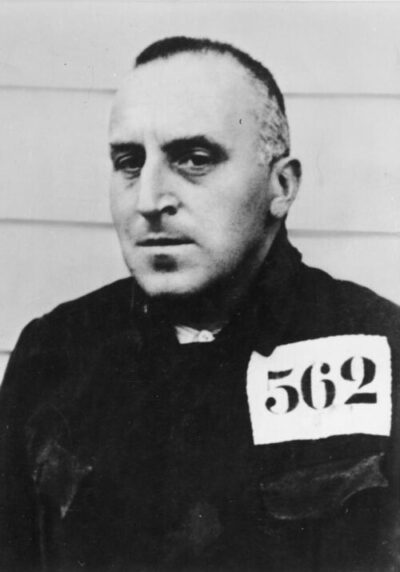
Carl von Ossietzky
Carl von Ossietzky was a German journalist, author, pacifist and recipient of the 1935 Nobel Peace Prize. Born October 3, 1889, in Hamburg. Died May 4, 1938, in Berlin. Awards include Nobel Peace Prize.
Facts
25 facts · 2 confirmed by two sources · 14 cited · 9 from one source
Where this comes from
Papalocal keeps its own record. It started from these sources; what each one said is kept here as it was copied, so a change on their side never changes this page by itself. Tap one to read its version.
What Wikidata says · copied November 16, 2026 · revision 2563980853
- Described as
- German journalist, author, pacifist and recipient of the 1935 Nobel Peace Prize (1889–1938)
- Born
- October 3, 1889 · 9 references
- Died
- May 4, 1938 · 10 references
- Born in
- Hamburg · 3 references
- Died in
- Berlin · 4 references
- Buried in
- Cemetery Pankow IV · 1 reference
- Cause of death
- tuberculosis
- Name at birth
- Carl von Ossietzky
- Citizen of
- German Reich; Germany · 1 reference
- Occupation
- journalist; writer · 1 reference; opinion journalist · 3 references; editor · 1 reference; Nobel Prize winner · 1 reference; editing staff · 3 references
- Political party
- Republican Party of Germany
- Member of
- Freemasonry · 2 references
- Awards
- Nobel Peace Prize (1935) · 2 references
- Field
- journalism; activism
- Spouse
- Maud von Ossietzky
- Children
- Rosalinde von Ossietzky-Palm · 1 reference
- Father
- Carl Ignatius von Ossietzky · 1 reference
- Mother
- Rosalie von Ossietzky · 1 reference
- Religion
- Christianity
- Wikipedias with a page
- 68
Wikidata item Q76358 (wikidata.org/wiki/Q76358), public domain (CC0). Copied November 16, 2026.
What Wikipedia says · copied November 16, 2026 · revision 1381961997
Carl von Ossietzky (German: [ˈkaʁl fɔn ɔˈsi̯ɛtskiː] ; 3 October 1889 – 4 May 1938) was a German journalist and pacifist. He was the recipient of the 1935 Nobel Peace Prize for his work in exposing the clandestine German rearmament.
As editor-in-chief of the magazine Die Weltbühne, Ossietzky published a series of exposés in the late 1920s detailing Germany's violation of the Treaty of Versailles by rebuilding an air force (the predecessor of the Luftwaffe) and training pilots in the Soviet Union. He was convicted of treason and espionage in 1931 and sentenced to eighteen months in prison, but was granted amnesty in December 1932.
Ossietzky continued to be a vocal critic of German militarism after the Nazis' rise to power. Following the 1933 Reichstag fire, Ossietzky was again arrested and sent to the Esterwegen concentration camp near Oldenburg. His brutal torture after his arrest was documented by the International Red Cross. He was awarded the 1935 Nobel Peace Prize in 1936, but was forbidden from travelling to Norway to accept it. After enduring five years of mistreatment in Nazi concentration camps, Ossietzky died of tuberculosis in a Berlin hospital in 1938.
- Born, in its opening lines
- October 3, 1889
- Died, in its opening lines
- May 4, 1938
From the Wikipedia article “Carl von Ossietzky” (en.wikipedia.org/wiki/Carl_von_Ossietzky), by its contributors, under CC BY-SA 4.0 (creativecommons.org/licenses/by-sa/4.0/). Copied November 16, 2026; not changed.
Confirmed Two sources agree. Cited One source, and it names where it got it. One source One source, without a reference of its own. Sources disagree The sources disagree. We show the best-supported value and keep theirs below.
