
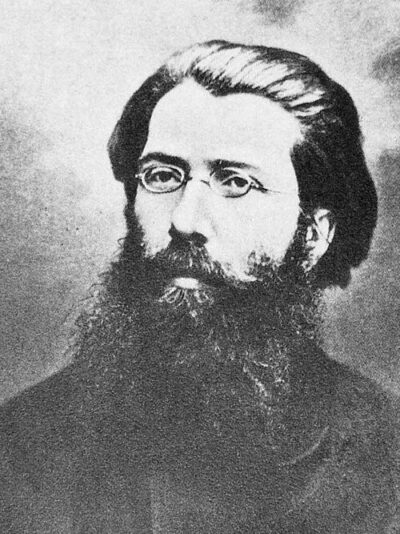
Carlo Cafiero
Carlo Cafiero was an Italian anarchist. Born September 1, 1846, in Barletta. Died July 17, 1892, in Nocera Inferiore. Known for A Compendium of Das Kapital. Educated at University of Naples Federico II.
Facts
23 facts · 2 confirmed by two sources · 8 cited · 13 from one source
Where this comes from
Papalocal keeps its own record. It started from these sources; what each one said is kept here as it was copied, so a change on their side never changes this page by itself. Tap one to read its version.
What Wikidata says · copied November 17, 2026 · revision 2539058150
- Described as
- Italian anarchist (1846-1892)
- Born
- September 1, 1846 · 2 references
- Died
- July 17, 1892
- Born in
- Barletta · 1 reference
- Died in
- Nocera Inferiore
- Cause of death
- extrapulmonary tuberculosis · 1 reference
- Citizen of
- Kingdom of Italy (1861–)
- Occupation
- revolutionary · 2 references; philosopher · 2 references; journalist · 2 references; anarchist · 1 reference; jurist · 1 reference; activist · 1 reference; writer · 1 reference
- Education
- University of Naples Federico II · 2 references
- Member of
- International Workingmen's Association
- Known for
- A Compendium of Das Kapital
- Field
- philosophy · 1 reference; anarchism · 1 reference
- Spouse
- Olimpia Kutuzova · 1 reference
- Siblings
- Pietro Antonio Cafiero
- Lived in
- London · 1 reference; Florence · 1 reference; Imola · 1 reference
- Wikipedias with a page
- 25
Wikidata item Q563138 (wikidata.org/wiki/Q563138), public domain (CC0). Copied November 17, 2026.
What Wikipedia says · copied November 17, 2026 · revision 1372250913
Carlo Cafiero (1 September 1846 – 17 July 1892) was an Italian anarchist that led the Italian section of the International Workingmen's Association (IWA). An early leader of the Marxist and then anarchist movements in Italy, he was a key influence in the development of both currents.
Born into a noble family in Apulia, he came to dislike the institutions of the Catholic Church and the monarchy, which drew him towards republicanism and revolutionary socialism. After moving to London, he fell under the influence of Karl Marx and Friedrich Engels, for whom he acted as an agent after returning to Italy. In Naples, he became a leader of the local internationalist movement, which consisted largely of anarchists. This caused friction between him and Engels, who saw anarchism as a threat to Marxism.
As Marx and Engels consolidated control over the IWA, Cafiero gravitated closer to anarchism, culminated with his meeting with Mikhail Bakunin. He then presided over the affiliation of the IWA's Italian section with Bakunin's Anti-Authoritarian International and its reorganization along anarchist lines and was a key participant to the Saint-Imier Congress. As a central figure in the Italian anarchist movement, Cafiero plotted the 1874 Bologna insurrection and led the 1877 Benevento insurrection, for which he was imprisoned. Cafiero then turned his attentions to writing. He penned a summary of Das Kapital, Volume I, a theoretical synthesis of anarchist communism and a series of articles about social revolution.
A committed insurrectionary anarchist, Cafiero clashed with the reformist Andrea Costa over their respective tactical outlooks. But following a period of extreme intransigence, isolation and mental decline, Cafiero himself moved towards social democracy and endorsed Costa's candidacy in the 1882 Italian general election. In the months after the election, Cafiero succumbed to his mental illness and was committed to a mental asylum. After a long battle with his condition, he died in an asylum from gastrointestinal tuberculosis.
Cafiero left a large legacy as an influential figure in the formation of the Italian anarchist and socialist movements. His figure was a source of inspiration for future generations of Italian activists and artists, and his works are still being studied into the 21st century.
- Born, in its opening lines
- September 1, 1846
- Died, in its opening lines
- July 17, 1892
From the Wikipedia article “Carlo Cafiero” (en.wikipedia.org/wiki/Carlo_Cafiero), by its contributors, under CC BY-SA 4.0 (creativecommons.org/licenses/by-sa/4.0/). Copied November 17, 2026; not changed.
Confirmed Two sources agree. Cited One source, and it names where it got it. One source One source, without a reference of its own. Sources disagree The sources disagree. We show the best-supported value and keep theirs below.
