
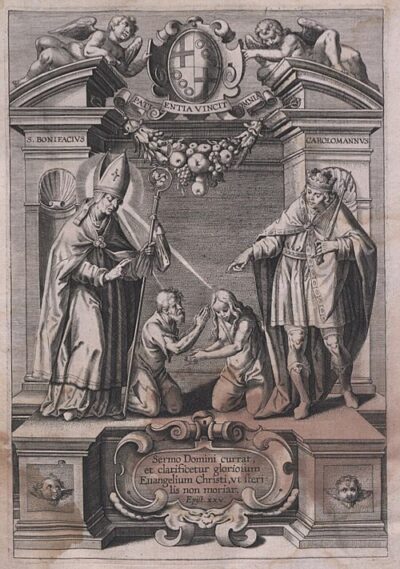
Carloman
Carloman was a Mayor of the Palace of Austrasia. Born 710, in Vienne. Died August 17, 754, in Vienne. Positions held include Mayor of the Palace (741–747).
Facts
21 facts · 0 confirmed by two sources · 15 cited · 5 from one source · 1 where the sources disagree
What’s different
- Died: we show August 17, 754 (Sources disagree). Wikidata also lists December 4, 754
Where this comes from
Papalocal keeps its own record. It started from these sources; what each one said is kept here as it was copied, so a change on their side never changes this page by itself. Tap one to read its version.
What Wikidata says · copied November 16, 2026 · revision 2568056608
- Described as
- Mayor of the Palace of Austrasia (710-754)
- Other names
- Karlmann
- Born
- 710 · 1 reference
- Died
- August 17, 754 · 1 reference; December 4, 754 · 1 reference
- Born in
- Vienne
- Died in
- Vienne · 2 references
- Buried in
- Abbey of Monte Cassino
- Cause of death
- disease
- Citizen of
- Francia
- Occupation
- politician · 1 reference
- Positions held
- Mayor of the Palace (741–747) · 1 reference
- Children
- Drogo · 1 reference; Chrothrudis
- Father
- Charles Martel · 2 references
- Mother
- Rotrude of Trier · 1 reference
- Siblings
- Bernard, son of Charles Martel · 1 reference; Grifo · 1 reference; Pepin the Short · 1 reference; Remigius of Rouen · 1 reference; Hieronymus · 1 reference; Hiltrud · 1 reference; Auda of France · 1 reference; Landrada · 1 reference
- Wikipedias with a page
- 39
Wikidata item Q310440 (wikidata.org/wiki/Q310440), public domain (CC0). Copied November 16, 2026.
What Wikipedia says · copied November 16, 2026 · revision 1378255330
Carloman (between 706 and 716 – 17 August 754) was the eldest son of Charles Martel, mayor of the palace and duke of the Franks, and his wife Chrotrud of Treves. On Charles's death (741), Carloman and his brother Pepin the Short succeeded to their father's legal positions, Carloman in Austrasia, and Pepin in Neustria. He was a member of the family later called the Carolingians and it can be argued that he was instrumental in consolidating their power at the expense of the ruling Merovingian kings of the Franks. He withdrew from public life in 747 to take up the monastic habit, "the first of a new type of saintly king", according to Norman Cantor, "more interested in religious devotion than royal power, who frequently appeared in the following three centuries and who was an indication of the growing impact of Christian piety on Germanic society".
From the Wikipedia article “Carloman (mayor of the palace)” (en.wikipedia.org/wiki/Carloman_(mayor_of_the_palace)), by its contributors, under CC BY-SA 4.0 (creativecommons.org/licenses/by-sa/4.0/). Copied November 16, 2026; not changed.
Confirmed Two sources agree. Cited One source, and it names where it got it. One source One source, without a reference of its own. Sources disagree The sources disagree. We show the best-supported value and keep theirs below.
