
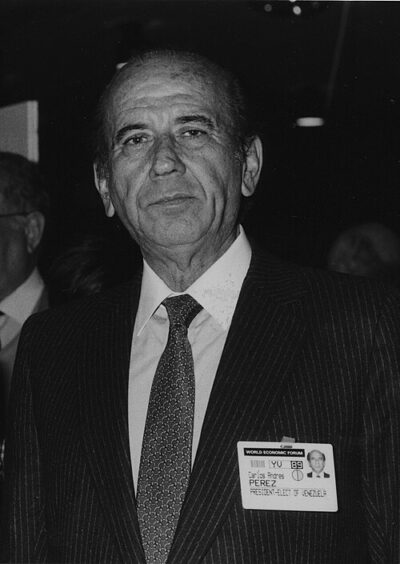
Carlos Andrés Pérez
Carlos Andrés Pérez was a President of Venezuela. Born October 27, 1922, in Rubio. Died December 25, 2010, in Miami. Positions held include member of the Chamber of Deputies of Venezuela (1964–1968), President of Venezuela (2 times) (1974–1993) and senator of Venezuela (1999). Educated at Central University of Venezuela and Libre University of Colombia. Awards include Collar of the Order of Isabella the Catholic, Order of the Liberator and Order of Francisco de Miranda.
Facts
29 facts · 2 confirmed by two sources · 5 cited · 22 from one source
Where this comes from
Papalocal keeps its own record. It started from these sources; what each one said is kept here as it was copied, so a change on their side never changes this page by itself. Tap one to read its version.
What Wikidata says · copied November 16, 2026 · revision 2569741961
- Described as
- President of Venezuela (1922-2010)
- Other names
- Carlos Andres Perez, CAP
- Born
- October 27, 1922 · 4 references
- Died
- December 25, 2010 · 4 references
- Born in
- Rubio
- Died in
- Miami · 2 references
- Buried in
- East Cemetery
- Cause of death
- myocardial infarction
- Name at birth
- Carlos Andrés Pérez Rodríguez
- Citizen of
- Venezuela
- Occupation
- politician · 1 reference
- Positions held
- member of the Chamber of Deputies of Venezuela (1964–1968); President of Venezuela (2 times) (1974–1993); senator of Venezuela (1999); minister of interior of Venezuela
- Political party
- Democratic Action
- Education
- Central University of Venezuela (1944–1946); Libre University of Colombia (1949–1950); University of Costa Rica
- Awards
- Collar of the Order of Isabella the Catholic (1977) · 1 reference; Order of the Liberator; Order of Francisco de Miranda; Knight Grand Cross with Collar of the Order of Merit of the Italian Republic (1976) · 1 reference; Grand Collar of the Military Order of Saint James of the Sword (1977) · 1 reference; Order of Jamaica · 1 reference; Collar of the Order of Charles III (1978) · 1 reference
- Field
- association football player · 1 reference; public administration · 1 reference
- Spouse
- Blanca Rodríguez de Pérez (1948–)
- Religion
- Roman Catholic; Catholic Church · 1 reference
- Wikipedias with a page
- 43
Wikidata item Q295790 (wikidata.org/wiki/Q295790), public domain (CC0). Copied November 16, 2026.
What Wikipedia says · copied November 16, 2026 · revision 1382822024
Carlos Andrés Pérez Rodríguez (27 October 1922 – 25 December 2010), also known by his initials CAP and often referred to as El Gocho (due to his Andean origins), was a Venezuelan politician who served as the 47th and 50th president of Venezuela from 1974 to 1979 and again from 1989 to 1993. He was one of the founders of Acción Democrática, the dominant political party in Venezuela during the second half of the twentieth century.
After the fall of dictator Marcos Pérez Jiménez and returning from exile, Pérez served as the interior affairs minister for Rómulo Betancourt between 1959 and 1964, when he became known for his tough response against guerrillas. His first presidency was known as the Saudi Venezuela due to its economic and social prosperity thanks to enormous income from petroleum exportation. However, his second presidency saw a continuation of the economic crisis of the 1980s, a series of social crises, widespread riots known as the Caracazo and two coup attempts in 1992. In May 1993 he became the first Venezuelan president to be impeached by the Supreme Court on charges for the embezzlement of 250 million bolívars (roughly 2.7 million US dollars) belonging to a presidential discretionary fund, whose money was used to interfere in the 1990 Nicaraguan general election and hire bodyguards for President Violeta Chamorro.
- Born, in its opening lines
- October 27, 1922
- Died, in its opening lines
- December 25, 2010
From the Wikipedia article “Carlos Andrés Pérez” (en.wikipedia.org/wiki/Carlos_Andrés_Pérez), by its contributors, under CC BY-SA 4.0 (creativecommons.org/licenses/by-sa/4.0/). Copied November 16, 2026; not changed.
Confirmed Two sources agree. Cited One source, and it names where it got it. One source One source, without a reference of its own. Sources disagree The sources disagree. We show the best-supported value and keep theirs below.
