
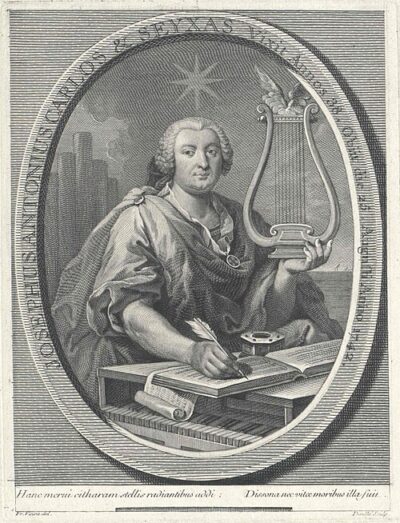
Carlos de Seixas was a Portuguese composer. Born June 11, 1704, in Coimbra. Died August 25, 1742, in Lisbon.
Facts
10 facts · 2 confirmed by two sources · 5 cited · 3 from one source
Where this comes from
Papalocal keeps its own record. It started from these sources; what each one said is kept here as it was copied, so a change on their side never changes this page by itself. Tap one to read its version.
What Wikidata says · copied November 18, 2026 · revision 2569731071
- Described as
- Portuguese composer
- Other names
- José António Carlos de Seixas, Jose Antonio Carlos de Seixas
- Born
- June 11, 1704 · 1 reference
- Died
- August 25, 1742 · 5 references
- Born in
- Coimbra · 1 reference
- Died in
- Lisbon · 1 reference
- Citizen of
- Kingdom of Portugal
- Occupation
- organist · 1 reference; harpsichordist; composer · 2 references; musician · 1 reference
- Instrument
- organ
- Wikipedias with a page
- 21
Wikidata item Q537355 (wikidata.org/wiki/Q537355), public domain (CC0). Copied November 18, 2026.
What Wikipedia says · copied November 18, 2026 · revision 1380580497
José António Carlos de Seixas (Portuguese: [ˈkaɾluʃ ˈsɐjʃɐʃ]; 11 June 1704 – 25 August 1742) was a Portuguese composer of the 18th century. An accomplished virtuoso of both the organ and the harpsichord, Seixas succeeded his father as the organist for Coimbra Cathedral at the age of fourteen. In 1720, he departed for the capital, Lisbon, where he was to serve as the organist for the royal chapel, one of the highest offices for a musician in Portugal, a position which earned him a knighthood. Much of Seixas' music rests in an ambiguous transitional period from the learned style of the 17th century to the galant style of the 18th century.
- Born, in its opening lines
- June 11, 1704
- Died, in its opening lines
- August 25, 1742
From the Wikipedia article “Carlos Seixas” (en.wikipedia.org/wiki/Carlos_Seixas), by its contributors, under CC BY-SA 4.0 (creativecommons.org/licenses/by-sa/4.0/). Copied November 18, 2026; not changed.
Confirmed Two sources agree. Cited One source, and it names where it got it. One source One source, without a reference of its own. Sources disagree The sources disagree. We show the best-supported value and keep theirs below.
