
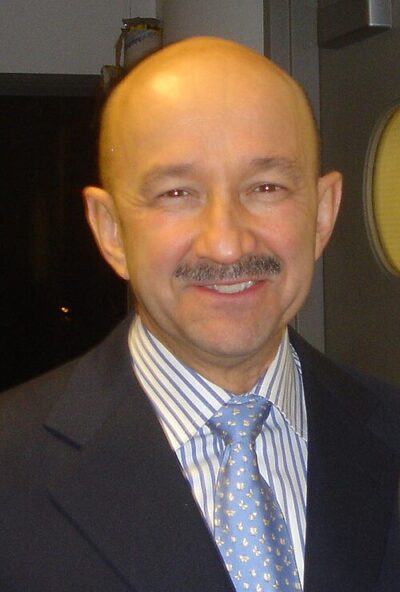
Carlos Salinas de Gortari
Carlos Salinas de Gortari is the 60th President of Mexico. Born April 3, 1948, in Mexico City. Positions held include President of Mexico (1988–1994), Mexico presidential candidate for the Revolutionary Institutional Party and minister. Educated at National Autonomous University of Mexico and John F. Kennedy School of Government. Awards include Collar of the Order of Isabella the Catholic, Francis Boyer Award and Order of Belize.
Facts
24 facts · 1 confirmed by two sources · 7 cited · 16 from one source
Where this comes from
Papalocal keeps its own record. It started from these sources; what each one said is kept here as it was copied, so a change on their side never changes this page by itself. Tap one to read its version.
What Wikidata says · copied November 16, 2026 · revision 2565847553
- Described as
- 60th President of Mexico
- Other names
- Carlos Salinas
- Born
- April 3, 1948 · 3 references
- Born in
- Mexico City · 1 reference
- Citizen of
- Mexico · 1 reference; Spain (2021–) · 1 reference
- Occupation
- economist; politician · 1 reference
- Positions held
- President of Mexico (1988–1994); Mexico presidential candidate for the Revolutionary Institutional Party; minister
- Political party
- Institutional Revolutionary Party
- Worked for
- National Autonomous University of Mexico
- Education
- National Autonomous University of Mexico (1966–1969); John F. Kennedy School of Government; Liceo Mexicano Japonés
- Awards
- Collar of the Order of Isabella the Catholic (1990) · 1 reference; Francis Boyer Award (1994) · 1 reference; Order of Belize; Order of Jamaica; Medal of the Oriental Republic of Uruguay (1993) · 1 reference; Gold Olympic Order (1992)
- Field
- politician · 1 reference
- Children
- Emiliano Salinas · 1 reference
- Father
- Raúl Salinas
- Siblings
- Raúl Salinas de Gortari · 1 reference
- Wikipedias with a page
- 50
Wikidata item Q315633 (wikidata.org/wiki/Q315633), public domain (CC0). Copied November 16, 2026.
What Wikipedia says · copied November 16, 2026 · revision 1385087024
Carlos Salinas de Gortari (Spanish pronunciation: [ˈkaɾlos saˈlinas ðe ɣoɾˈtaɾi]; born 3 April 1948) is a Mexican economist and former politician who served as the 60th president of Mexico from 1988 to 1994. He is considered the frontman of Mexican neoliberalism, and was responsible for formulating, promoting, signing, and implementing the North American Free Trade Agreement (NAFTA). Affiliated with the Institutional Revolutionary Party (PRI), earlier in his career he worked in the Secretariat of Programming and Budget, eventually becoming Secretary. He secured the party's nomination for the 1988 general election and was elected amid widespread accusations of electoral fraud.
An economist, Salinas de Gortari was the first Mexican president since 1946 who was not a law graduate. His presidency was characterized by the entrenchment of the neoliberal, free trade economic policies initiated by his predecessor Miguel de la Madrid in observance of the Washington Consensus, mass privatizations of state-run companies and the reprivatization of the banks, Mexico's entry into NAFTA, negotiations with the right-wing opposition party PAN to recognize their victories in state and local elections in exchange for supporting Salinas' policies, normalization of relations with the Catholic clergy, and the adoption of a new currency. From the beginning of his administration, Salinas de Gortari was criticized by the Mexican left, who considered him an illegitimate president whose neoliberal policies led to higher unemployment and were perceived as giving away the wealth of the nation to foreign ownership, whereas he was praised by the right wing and the international community, who considered him a leading figure of globalization and credited him with modernizing the country. Salinas was also backed by the United States government in his bid for Director-General of the newly created World Trade Organization (WTO).
After years of economic recovery during his presidency, a series of mismanagement and corruption scandals during his last year in office crumbled his public image domestically and internationally. These events included the Zapatista uprising and the assassinations of Luis Donaldo Colosio (Salinas's hand-picked successor and PRI candidate for the 1994 presidential election) and José Francisco Ruiz Massieu (Salinas's brother-in-law and PRI Secretary-General). This surge of political violence led to economic uncertainty. Facing pressures to devalue the peso, Salinas refused, opting for a strategy he believed would help his candidacy to be the inaugural president of the WTO. As a consequence, less than a month after Salinas left office, his successor Ernesto Zedillo was forced to devalue the peso and Mexico entered into one of the worst economic crises of its history. Shortly after, his brother Raúl Salinas de Gortari was arrested for ordering the assassination of Ruiz Massieu and was subsequently indicted on charges of drug trafficking. Salinas then left the country, returning in 1999.
Salinas is often referred to as the most unpopular former president of Mexico. A 2005 nationwide poll conducted by Parametría found that 73% of the respondents had a negative image of him, while only 9% stated that they had a positive image of the former president. He has been regarded as the most influential and controversial Mexican politician since the 1990s.
- Born, in its opening lines
- April 3, 1948
From the Wikipedia article “Carlos Salinas de Gortari” (en.wikipedia.org/wiki/Carlos_Salinas_de_Gortari), by its contributors, under CC BY-SA 4.0 (creativecommons.org/licenses/by-sa/4.0/). Copied November 16, 2026; not changed.
Confirmed Two sources agree. Cited One source, and it names where it got it. One source One source, without a reference of its own. Sources disagree The sources disagree. We show the best-supported value and keep theirs below.
