
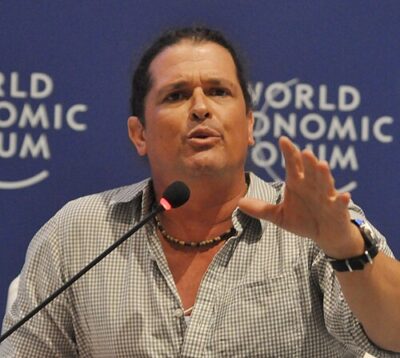
Carlos Vives
Carlos Vives is a Colombian singer. Born August 7, 1961, in Santa Marta. Awards include Latin Grammy Award for Song of the Year (2 times), Latin Grammy Award for Record of the Year and Lo Nuestro Excellence Award.
Facts
40 facts · 1 confirmed by two sources · 11 cited · 28 from one source
Where this comes from
Papalocal keeps its own record. It started from these sources; what each one said is kept here as it was copied, so a change on their side never changes this page by itself. Tap one to read its version.
What Wikidata says · copied November 16, 2026 · revision 2551550555
- Described as
- Colombian singer
- Other names
- Carlos Alberto Vives Restrepo, Carlos Alberto Vives Delano
- Born
- August 7, 1961 · 1 reference
- Born in
- Santa Marta · 1 reference
- Name at birth
- Carlos Alberto Vives Restrepo
- Citizen of
- Colombia · 1 reference
- Occupation
- singer · 1 reference; composer; actor; songwriter · 2 references; musician · 1 reference
- Genre
- salsa; reggaeton; Vallenato; pop music; rock music; cumbia
- Instrument
- voice; guitar; piano; harmonica
- Record label
- Sony BMG Music Entertainment, Inc.; Sony Music; Philips Records; Mercury Records; Virgin Records
- Awards
- Latin Grammy Award for Song of the Year (2 times) (2013, 2016); Latin Grammy Award for Record of the Year (2016); Lo Nuestro Excellence Award (2016); Latin Songwriters Hall of Fame (2017); Grammy Award for Best Tropical Latin Album (2 times) (2002, 2015); Billboard Latin Music Hall of Fame (2020); Latin Grammy Award for Best Contemporary Tropical Album (2 times) (2020, 2022) · 1 reference; Latin Grammy Award for Best Tropical Song (2020) · 1 reference; Latin Grammy Award for Best Long Form Music Video (2020) · 1 reference; Billboard Spirit of Hope Award (2014); Latin Grammy Award for Best Pop/Rock Song (2022) · 1 reference; Latin Grammy Award for Best Cumbia/Vallenato Album (2023) · 1 reference; Latin Recording Academy Person of the Year (2024) · 1 reference
- Spouse
- Claudia Elena Vásquez (2008–); Margarita Rosa de Francisco (1988–1990)
- Website
- https://www.carlosvives.com/
- Wikipedias with a page
- 30
Wikidata item Q965888 (wikidata.org/wiki/Q965888), public domain (CC0). Copied November 16, 2026.
What Wikipedia says · copied November 16, 2026 · revision 1378904283
Carlos Alberto Vives Restrepo (born 7 August 1961) is a Colombian singer, songwriter and actor.
One of the best-selling Latin music artists ever, with over 20 million records sold worldwide, Vives is regarded as one of the most influential artists in the world as he has progressively helped vallenato gain popularity globally and for his interpretation of traditional music styles, such as cumbia, champeta, bambuco and porro, with Latin pop, rock, reggaeton, dance-pop and tropical music.
Through his career he was honored with two Grammy Awards and eighteen Latin Grammy Awards, being awarded with the Latin Recording Academy Person of the Year in 2024. Vives has been honored with several accolades for his songwriting and producer contribution including the BMI President’s Award, the ASCAP Founders Award, and an induction into the Billboard Latin Music Hall of Fame. In 2019, Vives was selected as number 45 on both the Greatest of All Time Latin Artists and Top Latin Artists 2010s by Billboard.
He worked with some of the most influential artists in the Latin music scene, including Juan Luis Guerra, Ricky Martin, Shakira, Wisin, Daddy Yankee, Alejandro Sanz, Camilo, Sebastián Yatra, Mau y Ricky, Michel Teló, Gente de Zona, Carlos Rivera, Silvestre Dangond and Juanes.
Vives is also a successful actor. His roles as the titular character in the soap opera Gallito Ramírez and as Rafael Escalona in Escalona, a story about the famous Colombian composer of the same name, are among his most important and well-remembered appearances.
- Born, in its opening lines
- August 7, 1961
From the Wikipedia article “Carlos Vives” (en.wikipedia.org/wiki/Carlos_Vives), by its contributors, under CC BY-SA 4.0 (creativecommons.org/licenses/by-sa/4.0/). Copied November 16, 2026; not changed.
Confirmed Two sources agree. Cited One source, and it names where it got it. One source One source, without a reference of its own. Sources disagree The sources disagree. We show the best-supported value and keep theirs below.
