
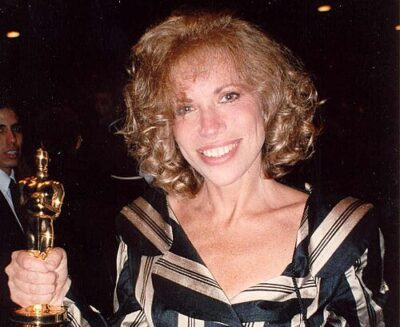
Carly Simon
Carly Simon is an American musician. Born June 25, 1943, in The Bronx. Known for You're So Vain. Educated at Sarah Lawrence College and Riverdale Country School. Awards include Grammy Award for Best New Artist, Rock and Roll Hall of Fame and Academy Award for Best Original Song.
Facts
36 facts · 1 confirmed by two sources · 8 cited · 27 from one source
Where this comes from
Papalocal keeps its own record. It started from these sources; what each one said is kept here as it was copied, so a change on their side never changes this page by itself. Tap one to read its version.
What Wikidata says · copied November 13, 2026 · revision 2568510999
- Described as
- American musician (born 1943)
- Other names
- Carly Elisabeth Simon, Carly E. Simon
- Born
- June 25, 1943 · 6 references
- Born in
- The Bronx
- Name at birth
- Carly Elisabeth Simon
- Citizen of
- United States
- Occupation
- singer · 1 reference; composer · 1 reference; songwriter; guitarist; pianist; recording artist; musician · 1 reference
- Political party
- Democratic Party
- Education
- Sarah Lawrence College; Riverdale Country School · 1 reference
- Member of
- Taylor-Simon
- Genre
- pop music
- Instrument
- guitar; piano; voice
- Record label
- Arista Records; Warner Bros. Records; Elektra; Epic Records
- Known for
- You're So Vain
- Awards
- Grammy Award for Best New Artist (1972) · 1 reference; Rock and Roll Hall of Fame (2022) · 1 reference; Academy Award for Best Original Song (1989) · 1 reference
- Field
- music composing
- Spouse
- James Taylor (1972–1983) · 1 reference
- Children
- Sally Taylor; Ben Taylor · 1 reference
- Father
- Richard L. Simon · 1 reference
- Mother
- Andrea Heinemann Simon
- Siblings
- Joanna Simon; Lucy Simon
- Website
- https://www.carlysimon.com/ (2024)
- Wikipedias with a page
- 46
Wikidata item Q181683 (wikidata.org/wiki/Q181683), public domain (CC0). Copied November 13, 2026.
What Wikipedia says · copied November 13, 2026 · revision 1382855534
Carly Elisabeth Simon (born June 25, 1943) is an American musician, singer, songwriter, and author. She rose to fame in the 1970s with a string of hit records; her 13 top 40 U.S. hits include "That's the Way I've Always Heard It Should Be" (No. 10), "Anticipation" (No. 13), "The Right Thing to Do" (No. 17), "Haven't Got Time for the Pain" (No. 14), "You Belong to Me" (No. 6), "Coming Around Again" (No. 18), and her four Gold-certified singles "You're So Vain" (No. 1), "Mockingbird" (No. 5, a duet with James Taylor), "Nobody Does It Better" (No. 2) from the 1977 James Bond film The Spy Who Loved Me, and "Jesse" (No. 11). She has authored two memoirs and five children's books.
In 1963, Simon began performing with her sister Lucy Simon in the Simon Sisters. Their debut album, Meet the Simon Sisters, featured the song "Winkin', Blinkin' and Nod", based on the poem by Eugene Field and put to music by Lucy. The song became a minor hit and reached No. 73 on the Billboard Hot 100. The duo would release two more albums: Cuddlebug (1966) and The Simon Sisters Sing for Children (1969). After Lucy left the group, Carly found great success as a solo artist with her 1971 self-titled debut album, which won her the Grammy Award for Best New Artist and spawned her first top 10 single "That's the Way I've Always Heard It Should Be", which earned her a Grammy Award nomination for Best Female Pop Vocal Performance. Simon's second album, Anticipation, followed later that year and became an even greater success; it spawned the successful singles "Anticipation" and "Legend in Your Own Time", earned her another Grammy nomination, and became her first album to be certified Gold by the RIAA.
Simon achieved international fame with her third album, No Secrets (1972), which sat at No. 1 on the Billboard 200 for five weeks and was certified Platinum. The album spawned the worldwide hit "You're So Vain", which sat at No. 1 on the Billboard Hot 100 for three weeks, and earned Simon three Grammy nominations, including Record of the Year and Song of the Year. The second single "The Right Thing to Do", as well as its B-side "We Have No Secrets", were also successful. Her fourth album, Hotcakes (1974), soon followed and became an instant success; it reached No. 3 on the Billboard 200, went Gold within two weeks of release, and spawned the hit singles "Mockingbird" and "Haven't Got Time for the Pain". In 1975, Simon's fifth album, Playing Possum, and the compilation, The Best of Carly Simon, both appeared; the former hit the top 10 on the Billboard 200 chart and spawned the hit single "Attitude Dancing" (No. 21), and the latter eventually went 3× Platinum, becoming Simon's best-selling release.
In 1977, Simon recorded "Nobody Does It Better" as the theme song to the Bond film The Spy Who Loved Me, and it became a worldwide hit. The song garnered her another Grammy nomination, and was the No. 1 Adult Contemporary hit of 1977. Retrospectively, it has been ranked one of the greatest Bond themes. Simon began recording more songs for films in the 1980s, including "Coming Around Again" for the film Heartburn (1986). The song became a major Adult Contemporary hit, and the Coming Around Again album appeared the following year, to further critical and commercial success. The album earned Simon two Grammy nominations, went Platinum, and spawned three more top 10 Adult Contemporary hit singles: "Give Me All Night", "The Stuff That Dreams Are Made Of", and "All I Want Is You". With her 1988 hit "Let the River Run", from the film Working Girl, Simon became the first artist to win a Grammy Award, an Academy Award, and a Golden Globe Award for a song composed and written, as well as performed, entirely by a single artist.
One of the most popular of the confessional singer/songwriters who emerged in the early 1970s, Simon has 24 Billboard Hot 100-charting singles and 28 Billboard Adult Contemporary charting singles. Among her various accolades, she has won two Grammy Awards (from 14 nominations), and was inducted into the Grammy Hall of Fame for "You're So Vain" in 2004. AllMusic called her "one of the quintessential singer-songwriters of the '70s". She has a contralto vocal range, and cited Odetta as a significant influence. Simon was inducted into the Songwriters Hall of Fame in 1994. She was honored with the Boston Music Awards Lifetime Achievement in 1995, and received a Berklee College of Music Honorary Doctor of Music Degree in 1998. In 2005, Simon was nominated for a star on the Hollywood Walk of Fame, but she has yet to claim her star. In 2012, she was honored with the Founders Award from the American Society of Composers, Authors and Publishers. In 2022, Simon was inducted into the Rock and Roll Hall of Fame.
- Born, in its opening lines
- June 25, 1943
From the Wikipedia article “Carly Simon” (en.wikipedia.org/wiki/Carly_Simon), by its contributors, under CC BY-SA 4.0 (creativecommons.org/licenses/by-sa/4.0/). Copied November 13, 2026; not changed.
Confirmed Two sources agree. Cited One source, and it names where it got it. One source One source, without a reference of its own. Sources disagree The sources disagree. We show the best-supported value and keep theirs below.
