
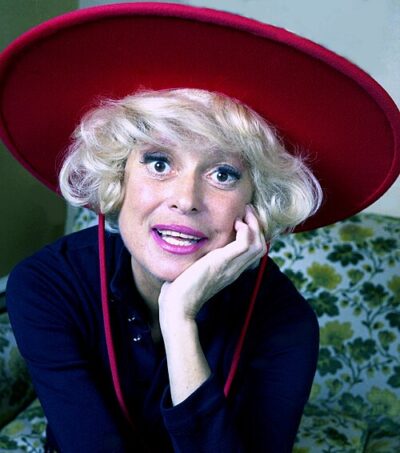
Carol Channing
Carol Channing was an American actress. Born January 31, 1921, in Seattle. Died January 15, 2019, in Rancho Mirage. Educated at Bennington College and Lowell High School. Awards include Tony Award for Best Actress in a Musical, Golden Globe Award for Best Supporting Actress – Motion Picture and Special Tony Award.
Facts
30 facts · 2 confirmed by two sources · 5 cited · 23 from one source
Where this comes from
Papalocal keeps its own record. It started from these sources; what each one said is kept here as it was copied, so a change on their side never changes this page by itself. Tap one to read its version.
What Wikidata says · copied November 13, 2026 · revision 2551183851
- Described as
- American actress (1921–2019)
- Other names
- Carol Elaine Channing
- Born
- January 31, 1921 · 2 references
- Died
- January 15, 2019 · 3 references
- Born in
- Seattle
- Died in
- Rancho Mirage
- Cause of death
- cerebrovascular disease
- Name at birth
- Carol Elaine Channing
- Citizen of
- United States
- Occupation
- singer · 1 reference; voice actor; comedian; stage actor; entertainer · 1 reference; musical theatre actor · 1 reference; actor · 1 reference; musician · 1 reference
- Political party
- Democratic Party
- Education
- Bennington College (1942); Lowell High School (1938); Neighborhood Playhouse School of the Theatre
- Instrument
- voice
- Record label
- RCA Records; RCA Victor
- Awards
- Tony Award for Best Actress in a Musical (1964); Golden Globe Award for Best Supporting Actress – Motion Picture (1968); Special Tony Award (1968); Theatre World Award (1949); star on Hollywood Walk of Fame · 1 reference; Hasty Pudding Woman of the Year (1971)
- Spouse
- Alex Carson (–1956)
- Religion
- Christian Science
- Wikipedias with a page
- 48
Wikidata item Q237287 (wikidata.org/wiki/Q237287), public domain (CC0). Copied November 13, 2026.
What Wikipedia says · copied November 13, 2026 · revision 1378834969
Carol Elaine Channing (January 31, 1921 – January 15, 2019) was an American actress, comedian, singer and dancer who starred in Broadway and film musicals. Each of her characters typically possessed a fervent expressiveness and an easily identifiable voice.
Channing originated the lead roles in Gentlemen Prefer Blondes in 1949 and Hello, Dolly! in 1964, winning the Tony Award for Best Actress in a Musical for the latter. She revived both roles several times throughout her career, playing Dolly on Broadway for the final time in 1995. She was nominated for her first Tony Award in 1956 for The Vamp, followed by a nomination in 1961 for Show Girl. She received her fourth Tony Award nomination for the musical Lorelei in 1974.
As a film actress, she won the Golden Globe Award and was nominated for the Academy Award for Best Supporting Actress for her performance as Muzzy in Thoroughly Modern Millie (1967). Her other film appearances include The First Traveling Saleslady (1956) and Skidoo (1968). On television, she appeared as an entertainer on variety shows. She performed The White Queen in the TV production of Alice in Wonderland (1985), and she had the first of many TV specials in 1966, titled An Evening with Carol Channing.
Channing was inducted into the American Theater Hall of Fame in 1981 and received a Lifetime Achievement Tony Award in 1995. She continued to perform and make appearances well into her 90s, singing songs from her repertoire and sharing stories with fans, cabaret-style. She was one of the "legends" interviewed in the award-winning documentary Broadway: The Golden Age, by the Legends Who Were There. She released her autobiography, Just Lucky I Guess, in 2002, and Larger Than Life—a documentary film about her life and career—was released in 2012.
- Born, in its opening lines
- January 31, 1921
- Died, in its opening lines
- January 15, 2019
From the Wikipedia article “Carol Channing” (en.wikipedia.org/wiki/Carol_Channing), by its contributors, under CC BY-SA 4.0 (creativecommons.org/licenses/by-sa/4.0/). Copied November 13, 2026; not changed.
Confirmed Two sources agree. Cited One source, and it names where it got it. One source One source, without a reference of its own. Sources disagree The sources disagree. We show the best-supported value and keep theirs below.
