
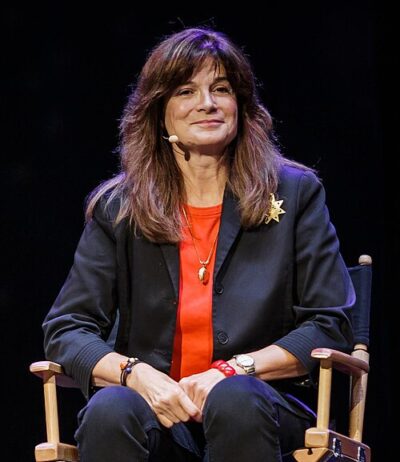
Carolyn Porco
Carolyn Porco is an American planetary scientist. Born March 6, 1953, in The Bronx. Educated at California Institute of Technology and Stony Brook University. Awards include Lennart Nilsson Award, Carl Sagan Medal for Excellence in Public Communication in Planetary Science and Isaac Asimov Science Award.
Facts
20 facts · 1 confirmed by two sources · 4 cited · 15 from one source
Where this comes from
Papalocal keeps its own record. It started from these sources; what each one said is kept here as it was copied, so a change on their side never changes this page by itself. Tap one to read its version.
What Wikidata says · copied November 14, 2026 · revision 2563855792
- Described as
- American planetary scientist
- Other names
- Carolyn C. Porco, C. C. Porco
- Born
- March 6, 1953
- Born in
- The Bronx
- Citizen of
- United States
- Occupation
- astronomer; photographer; planetary scientist
- Worked for
- University of Arizona; University of Colorado Boulder; Space Science Institute
- Education
- California Institute of Technology (–1983) · 1 reference; Stony Brook University (–1974) · 1 reference; Cardinal Spellman High School
- Member of
- International Astronomical Union · 1 reference
- Awards
- Lennart Nilsson Award (2009); Carl Sagan Medal for Excellence in Public Communication in Planetary Science (2010) · 1 reference; Isaac Asimov Science Award; Leif Erikson Award (2019) · 1 reference
- Field
- planetary science
- Religion
- atheism
- Website
- http://carolynporco.com/
- Wikipedias with a page
- 40
Wikidata item Q257420 (wikidata.org/wiki/Q257420), public domain (CC0). Copied November 14, 2026.
What Wikipedia says · copied November 14, 2026 · revision 1383226181
Carolyn C. Porco (born March 6, 1953) is an American planetary scientist who explores the outer Solar System, beginning with her imaging work on the Voyager missions to Jupiter, Saturn, Uranus and Neptune in the 1980s. She led the imaging science team on the Cassini mission in orbit around Saturn. She is an expert on planetary rings and the Saturnian moon, Enceladus.
She has co-authored more than 110 scientific papers on subjects ranging from the spectroscopy of Uranus and Neptune, the interstellar medium, the photometry of planetary rings, satellite/ring interactions, computer simulations of planetary rings, the thermal balance of Triton's polar caps, heat flow in the interior of Jupiter, and a suite of results on the atmosphere, satellites, and rings of Saturn from the Cassini imaging experiment. In 2013, Cassini data confirmed a 1993 prediction by Porco and Mark Marley that acoustic oscillations within the body of Saturn are responsible for creating particular features in the rings of Saturn.
Porco was founder of The Day the Earth Smiled. She was also responsible for the epitaph and proposal to honor the renowned planetary geologist Eugene Shoemaker by sending his cremains to the Moon aboard the Lunar Prospector spacecraft in 1998.
A frequent public speaker, Porco has given two popular lectures at TED as well as the opening speech for Pangea Day, a May 2008 global broadcast coordinated from six cities around the world, in which she described the cosmic context for human existence. Porco has also won a number of awards and honors for her contributions to science and the public sphere; for instance, in 2009, New Statesman named her as one of 'The 50 People Who Matter Today.'
In 2010, Porco was awarded the Carl Sagan Medal, presented by the American Astronomical Society for Excellence in the Communication of Science to the Public. In 2012, she was named one of the 25 most influential people in space by Time magazine.
- Born, in its opening lines
- March 6, 1953
From the Wikipedia article “Carolyn Porco” (en.wikipedia.org/wiki/Carolyn_Porco), by its contributors, under CC BY-SA 4.0 (creativecommons.org/licenses/by-sa/4.0/). Copied November 14, 2026; not changed.
Confirmed Two sources agree. Cited One source, and it names where it got it. One source One source, without a reference of its own. Sources disagree The sources disagree. We show the best-supported value and keep theirs below.
