
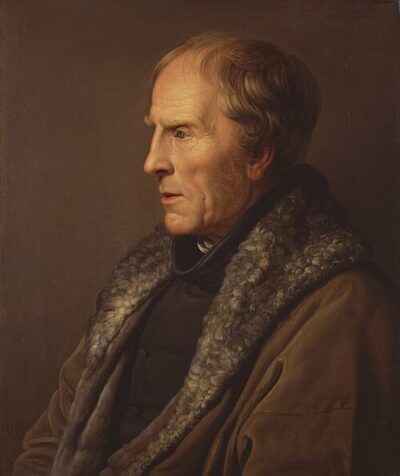
Caspar David Friedrich
Caspar David Friedrich was a German Romantic landscape painter. Born September 5, 1774, in Greifswald. Died May 7, 1840, in Dresden. Known for The Sea of Ice, Two men contemplating the Moon and The Tree of Crows. Educated at University of Greifswald and Royal Danish Academy of Fine Arts.
Facts
41 facts · 2 confirmed by two sources · 23 cited · 16 from one source
Where this comes from
Papalocal keeps its own record. It started from these sources; what each one said is kept here as it was copied, so a change on their side never changes this page by itself. Tap one to read its version.
What Wikidata says · copied November 16, 2026 · revision 2566064654
- Described as
- German Romantic landscape painter (1774–1840)
- Other names
- Kaspar David Fridrikh, C. D. Friedrich, kaspar david friedrich, c. d. friedrich, Friedrich Caspar David
- Born
- September 5, 1774 · 19 references
- Died
- May 7, 1840 · 19 references
- Born in
- Greifswald · 5 references
- Died in
- Dresden · 2 references
- Buried in
- Trinitatis Cemetery · 1 reference
- Citizen of
- Kingdom of Prussia (1815–) · 1 reference; Sweden (1774–1815) · 1 reference
- Occupation
- painter · 2 references; sculptor · 1 reference; architectural drafter · 1 reference; watercolorist · 1 reference; printmaker · 3 references; draftsperson · 2 references; landscape painter · 1 reference; etcher · 1 reference
- Worked for
- Dresden Academy of Fine Arts
- Education
- University of Greifswald (1790–); Royal Danish Academy of Fine Arts
- Genre
- landscape painting · 1 reference; genre painting · 1 reference; portrait · 1 reference
- Known for
- The Sea of Ice; Two men contemplating the Moon; The Tree of Crows; The Monk by the Sea; The Abbey in the Oakwood; Wanderer above the Sea younes non non non ci je ne le connais plus je t envoie moi; Chalk Cliffs on Rügen
- Field
- painting · 1 reference; art of drawing · 1 reference; landscape painting · 1 reference; Romanticism · 1 reference
- Spouse
- Caroline Friedrich · 1 reference
- Children
- Adolf Friedrich · 1 reference
- Father
- Adolph Gottlieb Friedrich · 1 reference
- Mother
- Sophia Dorothea Bechly
- Siblings
- Joachim Christian Adolf Friedrich · 1 reference; Johann Heinrich Friedrich; Johann Samuel Friedrich; Adolf Friedrich · 1 reference
- Religion
- Lutheranism
- Wikipedias with a page
- 91
Wikidata item Q104884 (wikidata.org/wiki/Q104884), public domain (CC0). Copied November 16, 2026.
What Wikipedia says · copied November 16, 2026 · revision 1382218605
Caspar David Friedrich (German: [ˌkaspaʁ ˌdaːvɪt ˈfʁiːdʁɪç] ; 5 September 1774 – 7 May 1840) was a German Romantic landscape painter, generally considered the most important German artist of his generation, whose often symbolic, and anti-classical work, conveys a subjective, emotional response to the natural world. Friedrich's paintings often set contemplative human figures silhouetted against night skies, morning mists, barren trees or Gothic ruins. Art historian Christopher John Murray described their presence, in diminished perspective, amid expansive landscapes, as reducing the figures to a scale that directs "the viewer's gaze towards their metaphysical dimension".
Friedrich was born in the town of Greifswald on the Baltic Sea in what was at the time Swedish Pomerania. He studied in Copenhagen from 1794 to 1798, before settling in Dresden. He came of age during a period when, across Europe, a growing disillusionment with materialistic society was giving rise to a new appreciation of spirituality. This shift was often expressed through a reevaluation of the natural world, as artists such as Friedrich, J. M. W. Turner and John Constable sought to depict nature as a "divine creation, to be set against the artifice of human civilization".
Friedrich's work brought him renown early in his career. Contemporaries such as the French sculptor David d'Angers spoke of him as having discovered "the tragedy of landscape". His work nevertheless fell from favour during his later years, and he died in obscurity. As Germany moved towards modernisation in the late 19th century, a new sense of urgency characterised its art, and Friedrich's contemplative depictions of stillness came to be seen as products of a bygone age.
The early 20th century brought a renewed appreciation of his art, beginning in 1906 with an exhibition of thirty-two of his paintings in Berlin. His work influenced Expressionist artists and later Surrealists and Existentialists. The rise of Nazism in the early 1930s saw a resurgence in Friedrich's popularity, but this was followed by a sharp decline as his paintings were, by association with the Nazi movement, considered to be promoting German nationalism. Since the 1970s, Friedrich has experienced a major international revival and is regarded as one of the most important artists of German Romanticism and a national cultural icon.
- Born, in its opening lines
- September 5, 1774
- Died, in its opening lines
- May 7, 1840
From the Wikipedia article “Caspar David Friedrich” (en.wikipedia.org/wiki/Caspar_David_Friedrich), by its contributors, under CC BY-SA 4.0 (creativecommons.org/licenses/by-sa/4.0/). Copied November 16, 2026; not changed.
Confirmed Two sources agree. Cited One source, and it names where it got it. One source One source, without a reference of its own. Sources disagree The sources disagree. We show the best-supported value and keep theirs below.
