
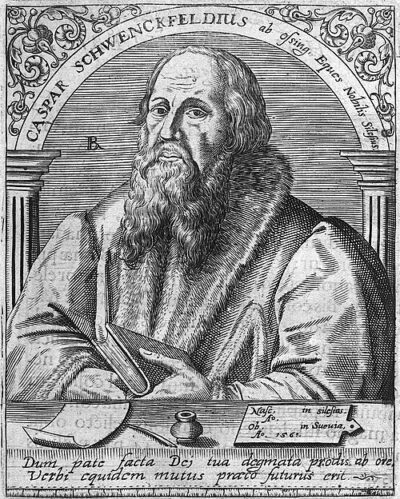
Caspar Schwenckfeld
Caspar Schwenckfeld was a German theologian. Born 1489, in Osiek, Silesian Voivodeship. Died December 10, 1561, in Ulm. Educated at University of Frankfurt an der Oder and University of Cologne.
Facts
19 facts · 0 confirmed by two sources · 11 cited · 7 from one source · 1 where the sources disagree
What’s different
- Born in: we show Osiek, Silesian Voivodeship (Sources disagree). Wikidata also lists Osiek, Lubin County
Where this comes from
Papalocal keeps its own record. It started from these sources; what each one said is kept here as it was copied, so a change on their side never changes this page by itself. Tap one to read its version.
What Wikidata says · copied November 18, 2026 · revision 2569026225
- Described as
- German theologian (1489-1561)
- Other names
- Caspar von Schwenckfeld
- Born
- 1489 · 1 reference
- Died
- December 10, 1561
- Born in
- Osiek, Lubin County; Osiek, Silesian Voivodeship · 1 reference
- Died in
- Ulm · 1 reference
- Cause of death
- dysentery
- Citizen of
- Holy Roman Empire
- Occupation
- theologian · 1 reference; philosopher · 1 reference; Protestant reformer · 1 reference; mystic · 1 reference; writer · 1 reference; reformer · 1 reference
- Education
- University of Frankfurt an der Oder; University of Cologne
- Field
- theology · 1 reference; Protestant Reformation · 1 reference; mysticism · 1 reference; religious literature · 2 references
- Religion
- Lutheranism
- Wikipedias with a page
- 23
Wikidata item Q64137 (wikidata.org/wiki/Q64137), public domain (CC0). Copied November 18, 2026.
What Wikipedia says · copied November 18, 2026 · revision 1379222353
Caspar (or Kaspar) Schwenckfeld (or Schwenkfeld) von Ossig (; 1489 or 1490 – 10 December 1561) was a German court adviser, theologian, writer, and preacher who became a Protestant Reformer and spiritualist. He was one of the earliest promoters of the Protestant Reformation in Silesia.
Schwenckfeld came to Reformation principles through Thomas Müntzer and Andreas Karlstadt. However, he developed his own principles and fell out with Martin Luther over the eucharistic controversy (1524). He had his own views on the sacraments, known as the Heavenly Flesh doctrine, that were developed in close association with Valentin Crautwald, his humanist colleague. His followers became a new sect, which was outlawed in Germany. Its ideas were influenced by Anabaptism, in Europe, and Puritanism in England.
Many of his followers were persecuted in Europe and thus forced to either convert or flee. Because of this, there are Schwenkfelder Church congregations in the United States, which was then the Thirteen Colonies of British America until American independence was achieved following the American Revolutionary War.
From the Wikipedia article “Caspar Schwenckfeld” (en.wikipedia.org/wiki/Caspar_Schwenckfeld), by its contributors, under CC BY-SA 4.0 (creativecommons.org/licenses/by-sa/4.0/). Copied November 18, 2026; not changed.
Confirmed Two sources agree. Cited One source, and it names where it got it. One source One source, without a reference of its own. Sources disagree The sources disagree. We show the best-supported value and keep theirs below.
