
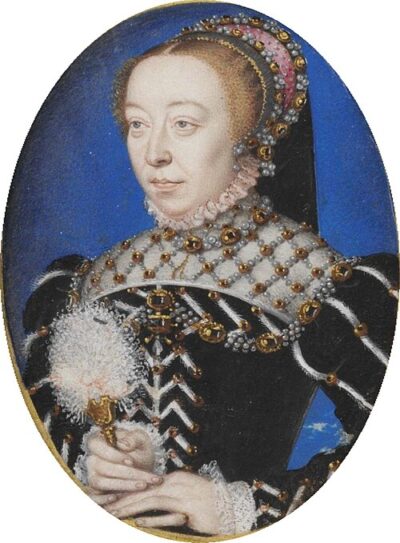
Catherine de' Medici
Catherine de' Medici was a queen-consort and regent of France. Born April 13, 1519, in Florence. Died January 5, 1589, in Château de Blois. Positions held include regent and Queen Consort of France (1547–1559). Awards include Golden Rose.
Facts
27 facts · 2 confirmed by two sources · 9 cited · 16 from one source
Where this comes from
Papalocal keeps its own record. It started from these sources; what each one said is kept here as it was copied, so a change on their side never changes this page by itself. Tap one to read its version.
What Wikidata says · copied November 16, 2026 · revision 2558080650
- Described as
- queen-consort and regent of France (1519–1589)
- Other names
- Queen, consort of Henry II, King of France Catherine de Médicis, Catherine of Medici Ji, Queen, consort of Henry II Ekaterina Medichi, Queen consort of Henry II Catherine de Médicis, Catharine de' Medici, Queen, consort of Henry II, King of France Catharine de' Medici, Catherine de, Queen, consort of Henry II, King of France Medici, Catherine de Medicis, Catherine de Médicis, Catherine de, Queen, consort of Henry II, King of France Médicis, Queen Catherine de Médicis consort of Henry II King of France, Catherine, Queen, consort of Henry II, King of France De Médicis
- Born
- April 13, 1519 · 2 references
- Died
- January 5, 1589 · 8 references
- Born in
- Florence · 4 references
- Died in
- Château de Blois
- Buried in
- Basilica of Saint-Denis
- Cause of death
- pneumonia
- Citizen of
- France
- Occupation
- regent
- Positions held
- regent; Queen Consort of France (1547–1559)
- Awards
- Golden Rose · 1 reference
- Spouse
- Henry II of France (1533–1559) · 4 references
- Children
- Francis II of France · 3 references; Elisabeth of Valois · 1 reference; Claude of Valois; Louis of Valois; Charles IX of France · 1 reference; Henry III of France · 1 reference; Margaret of Valois · 2 references; Francis, Duke of Anjou; Victoria of Valois; Joan of Valois
- Father
- Lorenzo de' Medici, Duke of Urbino · 3 references
- Mother
- Madeleine de La Tour d'Auvergne · 1 reference
- Siblings
- Alessandro de' Medici; Antonio de' Medici · 1 reference
- Religion
- Catholic Church
- Wikipedias with a page
- 90
Wikidata item Q131552 (wikidata.org/wiki/Q131552), public domain (CC0). Copied November 16, 2026.
What Wikipedia says · copied November 16, 2026 · revision 1385937186
Catherine de' Medici (13 April 1519 – 5 January 1589) was Queen of France from 1547 to 1559 by marriage to King Henry II. She was the mother of French kings Francis II, Charles IX, and Henry III, and the cousin of Pope Clement VII. The years during which her sons reigned have been called "the age of Catherine de' Medici" since she had extensive, albeit at times varying, influence on French politics.
Catherine was born to the Medici family in Florence to Lorenzo de' Medici, Duke of Urbino, and Madeleine de La Tour d'Auvergne. In 1533, at the age of 14, she married Henry, the second son of King Francis I and Queen Claude of France, who would become Dauphin of France (heir to the throne) upon the death of his elder brother Francis in 1536. Catherine's marriage was arranged by Clement VII. Henry largely excluded Catherine from state affairs during his reign, instead showering favours on his chief mistress, Diane de Poitiers, who wielded significant influence in the court. Henry's sudden accidental death in 1559 thrust Catherine into the political arena as mother of the frail 15-year-old Francis II. When Francis II died the next year, she became regent on behalf of her 10-year-old son Charles IX and thus gained sweeping powers. After Charles died in 1574, Catherine played a key role in the reign of her third son, Henry III. He dispensed with her advice only in the last months of her life but outlived her by just seven months.
Catherine's three sons reigned in an age of almost constant civil and religious war in France. The Catholic Guise faction tried to displace her sons in its attempt to establish its own dynasty to rule over France. Catherine also tried to think of ways to weaken the Guise Faction, which treated her scornfully. The problems facing the monarchy were complex and daunting. However, Catherine kept the monarchy and state institutions functioning, if at a minimal level. At first, Catherine compromised and made concessions to the rebelling Calvinist Protestants known as Huguenots. However, she failed to fully grasp the theological issues that drove their movement. Later, she resorted in frustration and anger to hardline policies against them, also pleasing the hardline Catholic party. In return, she was blamed for the persecutions carried out under her sons' rule, in particular the St. Bartholomew's Day massacre of 1572, during which thousands of Huguenots were killed in France.
Some historians have excused Catherine from blame for the worst decisions of the crown, but evidence for her ruthlessness can be found in her letters. In practice, her authority was limited by the effects of the civil wars, and she suffers in comparison to what might have been had her husband the king lived to take responsibility or stabilise the country. Therefore, her policies may be seen as desperate measures to keep the House of Valois on the throne at all costs and her patronage of the arts as an attempt to glorify a monarchy whose prestige was in steep decline. Without Catherine, it is unlikely that her sons would have remained in power. Catherine has been called "the most important woman in Europe" in the 16th century.
- Born, in its opening lines
- April 13, 1519
- Died, in its opening lines
- January 5, 1589
From the Wikipedia article “Catherine de' Medici” (en.wikipedia.org/wiki/Catherine_de'_Medici), by its contributors, under CC BY-SA 4.0 (creativecommons.org/licenses/by-sa/4.0/). Copied November 16, 2026; not changed.
Confirmed Two sources agree. Cited One source, and it names where it got it. One source One source, without a reference of its own. Sources disagree The sources disagree. We show the best-supported value and keep theirs below.
