
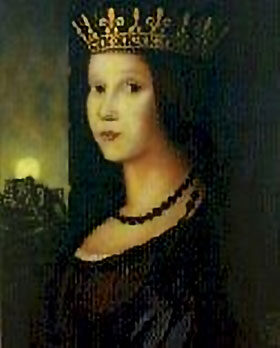
Catherine of Bosnia
Catherine of Bosnia was a Bosnian queen. Born December 20, 1425, in Blagaj, Mostar. Died October 25, 1478, in Rome.
Facts
18 facts · 0 confirmed by two sources · 1 cited · 16 from one source · 1 where the sources disagree
What’s different
- Buried in: we show Santa Maria in Aracoeli (Sources disagree). Wikidata also lists Tomb of Queen Catherine of Bosnia
Where this comes from
Papalocal keeps its own record. It started from these sources; what each one said is kept here as it was copied, so a change on their side never changes this page by itself. Tap one to read its version.
What Wikidata says · copied November 18, 2026 · revision 2542247128
- Described as
- Bosnian queen
- Other names
- Katarina Kosača-Kotromanić, Katarina Kosača, Katarina Vukčić Kosača
- Born
- December 20, 1425 · 1 reference
- Died
- October 25, 1478
- Born in
- Blagaj, Mostar
- Died in
- Rome
- Buried in
- Santa Maria in Aracoeli · 1 reference; Tomb of Queen Catherine of Bosnia · 1 reference
- Citizen of
- Kingdom of Bosnia
- Occupation
- queen consort
- Spouse
- Stephen Thomas of Bosnia
- Children
- Ishak-bey Kraloglu · 1 reference; Catherine of Bosnia · 1 reference
- Father
- Stjepan Vukčić Kosača
- Mother
- Jelena Balšić Kosača
- Siblings
- Vladislav Hercegović; Hersekzade Ahmed Pasha; Balša III; Vlatko Hercegović
- Religion
- Catholic Church; Bosnian Church
- Wikipedias with a page
- 24
Wikidata item Q452680 (wikidata.org/wiki/Q452680), public domain (CC0). Copied November 18, 2026.
What Wikipedia says · copied November 18, 2026 · revision 1381618252
Catherine of Bosnia (Serbo-Croatian: Katarina Kosača/Катарина Косача; 1424/1425 – 25 October 1478) was Queen of Bosnia as the wife of King Thomas, the penultimate Bosnian sovereign. She was born into the powerful House of Kosača, staunch supporters of the Bosnian Church. Her marriage in 1446 was arranged to bring peace between the King and her father, Stjepan Vukčić. The queenship of Catherine, who at that point converted to Roman Catholicism, was marked by an energetic construction of churches throughout the country.
Following her husband's death in 1461, Catherine's role receded to that of queen dowager at the court of her stepson, King Stephen Tomašević. Two years later, forces of the Ottoman Empire led by Mehmed the Conqueror invaded Bosnia and put an end to the independent kingdom. Catherine's stepson was executed, while Sigismund and Catherine, her son and daughter by Thomas, were captured and taken to Constantinople, where they converted to Islam. Queen Catherine escaped, taking refuge in Dubrovnik and eventually settling in Rome, where she received a pension from the papacy. From Rome she strove to be reunited with her children. Her efforts to negotiate and offer a ransom proved futile. She died a Franciscan tertiary in Rome, having named the papacy guardians of Bosnia and her children heirs to the throne, should they ever return to Christianity.
Queen Catherine remains one of the most important figures in the folk tradition and history of Bosnia and Herzegovina. She has long been venerated by the Catholics of Bosnia and Herzegovina, and is increasingly seen as an important transethnic state symbol.
From the Wikipedia article “Catherine of Bosnia” (en.wikipedia.org/wiki/Catherine_of_Bosnia), by its contributors, under CC BY-SA 4.0 (creativecommons.org/licenses/by-sa/4.0/). Copied November 18, 2026; not changed.
Confirmed Two sources agree. Cited One source, and it names where it got it. One source One source, without a reference of its own. Sources disagree The sources disagree. We show the best-supported value and keep theirs below.
