
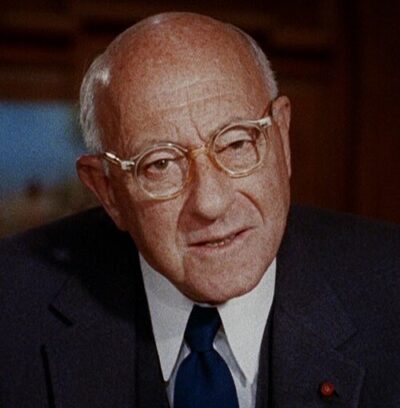
Cecil B. DeMille
Cecil B. DeMille was an American film director, producer and actor. Born August 12, 1881, in Ashfield. Died January 21, 1959, in Hollywood. Educated at American Academy of Dramatic Arts and Widener University. Awards include Academy Award for Best Picture, Golden Globe Cecil B. DeMille Award and star on Hollywood Walk of Fame.
Facts
30 facts · 2 confirmed by two sources · 7 cited · 21 from one source
Where this comes from
Papalocal keeps its own record. It started from these sources; what each one said is kept here as it was copied, so a change on their side never changes this page by itself. Tap one to read its version.
What Wikipedia says · copied November 13, 2026 · revision 1385227856
Cecil Blount DeMille (; August 12, 1881 – January 21, 1959) was an American movie producer, director and actor. Between 1914 and 1958, he created 70 features including silent and sound films. He is acknowledged as a founding father of American cinema and the most commercially successful producer-director in film history, with many films dominating the box office three or four at a time. His films were distinguished by their epic scale and by his cinematic showmanship. His silent films included social dramas, comedies, Westerns, farces, morality plays, and historical pageants.
Born in Ashfield, Massachusetts, and raised in New York City, DeMille began his career as a stage actor in 1900. He later began to write and direct stage plays, a few with his older brother William de Mille, and some with Jesse L. Lasky, who was then a vaudeville producer. DeMille's first film, The Squaw Man (1914), was the first full-length feature film shot in Hollywood. Its interracial love story was commercially successful, and the film marked Hollywood as the new home of the U.S. film industry. Based on continued film successes, DeMille founded Famous Players-Lasky, which was later reverse merged into Paramount Pictures with Lasky and Adolph Zukor. His first biblical epic, The Ten Commandments (1923), was both a critical and commercial success; it held the Paramount revenue record for 25 years.
DeMille directed The King of Kings (1927), a biography of Jesus, which gained approval for its sensitivity and reached more than 800 million viewers. The Sign of the Cross (1932) is said to be the first sound film to integrate all aspects of cinematic technique. Cleopatra (1934) was his first film to be nominated for the Academy Award for Best Picture. After more than 30 years in film production, DeMille reached a pinnacle in his career with Samson and Delilah (1949), a biblical epic that became the highest-grossing film of 1950. Along with biblical and historical narratives, he also directed films oriented toward "neo-naturalism", which focused on portraying the laws of man fighting the forces of nature.
DeMille received his first nomination for the Academy Award for Best Director for his circus drama The Greatest Show on Earth (1952), which won both the Academy Award for Best Picture and the Golden Globe Award for Best Motion Picture — Drama. His 1956 remake of The Ten Commandments became his final and best-known film; also, a Best Picture Academy Award nominee, it is the eighth highest-grossing film of all time, adjusted for inflation. In addition to his Best Picture Awards, DeMille received an Academy Honorary Award for his film contributions, the Palme d'Or (posthumously) for Union Pacific (1939), a DGA Award for Lifetime Achievement, and the Irving G. Thalberg Memorial Award. He was the first recipient of the Golden Globe Cecil B. DeMille Award, which was named in his honor. DeMille's reputation had a renaissance in the 2010s, and his work has influenced numerous other films and directors.
- Born, in its opening lines
- August 12, 1881
- Died, in its opening lines
- January 21, 1959
From the Wikipedia article “Cecil B. DeMille” (en.wikipedia.org/wiki/Cecil_B._DeMille), by its contributors, under CC BY-SA 4.0 (creativecommons.org/licenses/by-sa/4.0/). Copied November 13, 2026; not changed.
What Wikidata says · copied November 14, 2026 · revision 2569041535
- Described as
- American film director, producer and actor (1881–1959)
- Other names
- Cecil B. De Mille, Cecil B. de Mille, Cecil Blount DeMille, Cecil B DeMille, Cecil De Mille
- Born
- August 12, 1881 · 16 references
- Died
- January 21, 1959 · 16 references
- Born in
- Ashfield · 1 reference
- Died in
- Hollywood · 1 reference
- Buried in
- Hollywood Forever Cemetery
- Cause of death
- heart failure
- Citizen of
- United States
- Occupation
- film producer · 2 references; film director · 3 references; film editor; screenwriter; playwright; actor · 1 reference; stage actor; radio personality
- Political party
- Republican Party
- Education
- American Academy of Dramatic Arts (–1900) · 1 reference; Widener University
- Awards
- Academy Award for Best Picture (1953) · 1 reference; Golden Globe Cecil B. DeMille Award (1952); star on Hollywood Walk of Fame · 1 reference; Academy Honorary Award
- Spouse
- Constance Adams DeMille (1902–1959)
- Children
- Katherine DeMille; Richard de Mille; Cecilia Hoyt DeMille
- Father
- Henry C. De Mille
- Mother
- Beatrice DeMille · 1 reference
- Siblings
- William Churchill deMille
- Website
- https://www.cecilbdemille.com
- Wikipedias with a page
- 69
Wikidata item Q72267 (wikidata.org/wiki/Q72267), public domain (CC0). Copied November 14, 2026.
Confirmed Two sources agree. Cited One source, and it names where it got it. One source One source, without a reference of its own. Sources disagree The sources disagree. We show the best-supported value and keep theirs below.
