
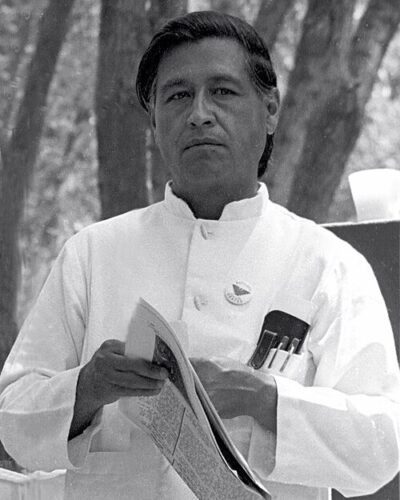
Cesar Chavez
Cesar Chavez was a Mexican-American farm worker, labor leader, and civil rights activist. Born March 31, 1927, in Yuma. Died April 23, 1993, in San Luis. Awards include Presidential Medal of Freedom, Pacem in Terris Award and Labor Hall of Honor.
Facts
19 facts · 2 confirmed by two sources · 5 cited · 12 from one source
Where this comes from
Papalocal keeps its own record. It started from these sources; what each one said is kept here as it was copied, so a change on their side never changes this page by itself. Tap one to read its version.
What Wikidata says · copied November 13, 2026 · revision 2562021558
- Described as
- Mexican-American farm worker, labor leader, and civil rights activist (1927–1993)
- Other names
- Cesario Estrada Chavez, Césario Estrada Chávez, Cesar Estrada Chavez, César Estrada Chávez
- Born
- March 31, 1927 · 6 references
- Died
- April 23, 1993 · 6 references
- Born in
- Yuma · 1 reference
- Died in
- San Luis · 2 references
- Buried in
- Cesar E. Chavez National Monument · 1 reference
- Citizen of
- United States
- Occupation
- trade unionist; laborer; politician · 1 reference; human rights defender · 1 reference
- Awards
- Presidential Medal of Freedom (1994) · 1 reference; Pacem in Terris Award; Labor Hall of Honor (1998) · 1 reference; Gandhi Peace Award (1989); Greatest Public Service Benefiting the Disadvantaged (1973); California Hall of Fame (2006)
- Spouse
- Helen Fabela Chávez
- Religion
- Catholic Church
- Military branch
- United States Navy
- Wikipedias with a page
- 48
Wikidata item Q355425 (wikidata.org/wiki/Q355425), public domain (CC0). Copied November 13, 2026.
What Wikipedia says · copied November 13, 2026 · revision 1385528079
Cesario Estrada "Cesar" Chavez (March 31, 1927 – April 23, 1993) was an American labor unionist and political activist. Along with Dolores Huerta and Gilbert Padilla, he co-founded the National Farm Workers Association (NFWA), which later merged with the Agricultural Workers Organizing Committee (AWOC) to become the United Farm Workers (UFW). Ideologically, his worldview combined leftist approaches with Catholic social teaching.
Born in Yuma, Arizona, to a Mexican American family, Chavez began his working life as a manual laborer before spending two years in the US Navy. Relocating to California, where he married, he got involved in the Community Service Organization (CSO), through which he helped laborers register to vote. In 1959, he became the CSO's national director, a position based in Los Angeles. In 1962, he left the CSO to co-found the NFWA, based in Delano, California, through which he launched an insurance scheme, a credit union, and the El Malcriado newspaper for farmworkers. Later that decade, he began organizing strikes among farmworkers, most notably the successful Delano grape strike of 1965–1970. Amid the grape strike, his NFWA merged with Larry Itliong's AWOC to form the UFW in 1967. Influenced by the Indian independence leader Mahatma Gandhi, Chavez emphasized direct nonviolent resistance, including picketing and boycotting, to pressure farm owners into granting strikers' demands. He imbued his campaigns with Catholic symbolism, including public processions, Masses, and fasts. He received much support from labor and leftist groups but was monitored by the Federal Bureau of Investigation (FBI).
In the early 1970s, Chavez sought to expand the UFW's influence outside California by opening branches in other states. Viewing illegal immigrants as a major source of strikebreakers, he also pushed a campaign against illegal immigration into the US, which generated violence along the Mexico–United States border and caused schisms with many of the UFW's allies. Interested in cooperatives as a form of organization, he established a remote commune in Keene, California. His increased isolation and emphasis on unrelenting campaigning alienated many California farmworkers who had previously supported him, and by 1973 the UFW had lost most of the contracts and membership it won during the late 1960s. His alliance with California governor Jerry Brown helped ensure the passing of the California Agricultural Labor Relations Act of 1975, although the UFW's campaign to get its measures enshrined in the Constitution of California failed. Influenced by the Synanon religious organization, Chavez re-emphasized communal living and purged perceived opponents. Membership of the UFW dwindled in the 1980s, with Chavez refocusing on anti-pesticide campaigns and moving into real-estate development, generating controversy for his use of non-unionized laborers.
Posthumously, Chavez became both a revered and controversial figure. He became a "folk saint" among Mexican Americans, and an icon for organized labor and leftist groups in the US. His birthday was proclaimed a federal commemorative holiday in 2014 and is a state holiday in multiple states, many places are named after him, and he posthumously received the Presidential Medal of Freedom in 1994. UFW critics raised concerns about his autocratic control of the union, the purges of those he deemed disloyal, and the personality cult built around him, while farm owners considered him a communist subversive. In 2026, allegations surfaced that he sexually abused Huerta, other women, and minors, resulting in honorary tributes and celebrations being removed, renamed, or canceled.
- Born, in its opening lines
- March 31, 1927
- Died, in its opening lines
- April 23, 1993
From the Wikipedia article “Cesar Chavez” (en.wikipedia.org/wiki/Cesar_Chavez), by its contributors, under CC BY-SA 4.0 (creativecommons.org/licenses/by-sa/4.0/). Copied November 13, 2026; not changed.
Confirmed Two sources agree. Cited One source, and it names where it got it. One source One source, without a reference of its own. Sources disagree The sources disagree. We show the best-supported value and keep theirs below.
