
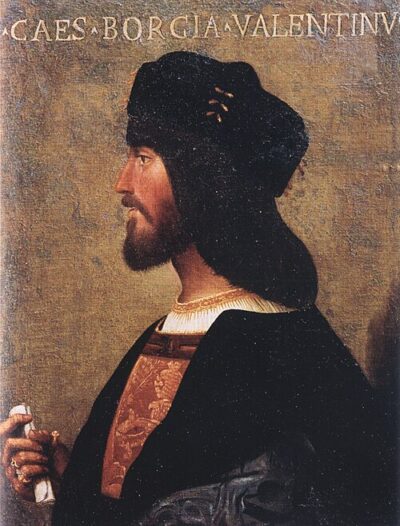
Cesare Borgia
Cesare Borgia was a Duke of Romagna and former Catholic cardinal. Born September 13, 1475, in Subiaco. Died March 12, 1507, in Viana. Positions held include cardinal-deacon (1493–1498), Gonfalonier of the Church (1500–1503) and Roman Catholic Bishop of Pamplona (1491–1492). Educated at University of Pisa and University of Perugia. Awards include Order of Saint Michael and Peerage of France.
Facts
31 facts · 2 confirmed by two sources · 8 cited · 21 from one source
Where this comes from
Papalocal keeps its own record. It started from these sources; what each one said is kept here as it was copied, so a change on their side never changes this page by itself. Tap one to read its version.
What Wikidata says · copied November 16, 2026 · revision 2565528728
- Described as
- Duke of Romagna and former Catholic cardinal
- Other names
- Borgia, Cesare, 1476?-1507, César de Borja, Cæsar Borgia, Caesar Borgia
- Born
- September 13, 1475
- Died
- March 12, 1507 · 4 references
- Born in
- Subiaco
- Died in
- Viana · 1 reference
- Buried in
- Viana
- Cause of death
- bleeding
- Citizen of
- Papal States
- Occupation
- condottiero; Catholic deacon (1494–) · 1 reference
- Positions held
- cardinal-deacon (1493–1498) · 1 reference; Gonfalonier of the Church (1500–1503) · 1 reference; Roman Catholic Bishop of Pamplona (1491–1492) · 1 reference; Roman Catholic Archbishop of Valencia (1492–1499) · 1 reference; apostolic administrator (1493–1499); Captain General of the Church (1497–1503); abbot of Cuixá (1494–1499)
- Education
- University of Pisa; University of Perugia · 1 reference
- Awards
- Order of Saint Michael · 1 reference; Peerage of France
- Spouse
- Charlotte of Albret
- Children
- Louise Borgia, Duchess of Valentinois
- Father
- Alexander VI · 1 reference
- Mother
- Vannozza dei Cattanei · 1 reference
- Siblings
- Lucrezia Borgia · 1 reference; Pier Luigi de Borgia; Giovanni Borgia, 2nd Duke of Gandia; Gioffre Borgia
- Religion
- Catholic Church · 1 reference
- Military branch
- Vatican Army · 1 reference
- Military rank
- generalissimo
- Wikipedias with a page
- 65
Wikidata item Q187998 (wikidata.org/wiki/Q187998), public domain (CC0). Copied November 16, 2026.
What Wikipedia says · copied November 16, 2026 · revision 1385559468
Cesare Borgia (13 September 1475 – 12 March 1507) was an Italian-Spanish cardinal deacon and condottiero from the House of Borgia. He was the illegitimate son of Pope Alexander VI and sibling to Lucrezia Borgia.
After initially entering the Church and becoming a cardinal on his father's election to the papacy, he resigned his diaconal profession after his brother was murdered in 1497. He was employed as a condottiero for King Louis XII of France around 1500, and occupied both Milan and Naples during the Italian Wars. At the same time, he carved out a state for himself in Central Italy, but he was unable to retain power for long after his father's death. His quest for political power was famously documented in the treatise The Prince by the Florentine political philosopher and historian, Niccolò Machiavelli.
- Born, in its opening lines
- September 13, 1475
- Died, in its opening lines
- March 12, 1507
From the Wikipedia article “Cesare Borgia” (en.wikipedia.org/wiki/Cesare_Borgia), by its contributors, under CC BY-SA 4.0 (creativecommons.org/licenses/by-sa/4.0/). Copied November 16, 2026; not changed.
Confirmed Two sources agree. Cited One source, and it names where it got it. One source One source, without a reference of its own. Sources disagree The sources disagree. We show the best-supported value and keep theirs below.
