
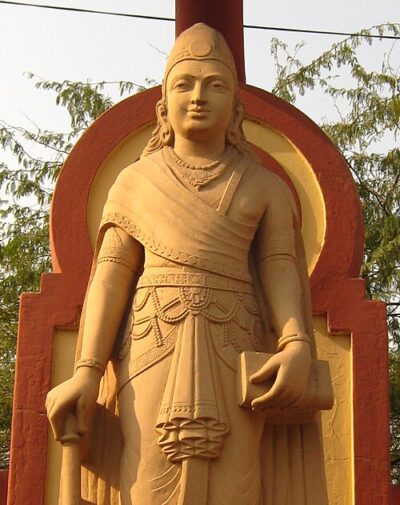
Chandragupta Maurya
Chandragupta Maurya was a founder of the Maurya Empire (350–295 BCE). Born 340 BC, in Pataliputra. Died 297 BC, in Shravanabelagola. Positions held include Mauryan Emperor (-321–-297). Educated at Taxila.
Facts
13 facts · 0 confirmed by two sources · 7 cited · 6 from one source
Where this comes from
Papalocal keeps its own record. It started from these sources; what each one said is kept here as it was copied, so a change on their side never changes this page by itself. Tap one to read its version.
What Wikidata says · copied November 16, 2026 · revision 2570005655
- Described as
- founder of the Maurya Empire (350–295 BCE)
- Other names
- Sandracottos, Androkottos, Chandragupta
- Born
- 340 BC
- Died
- 297 BC · 2 references
- Born in
- Pataliputra · 1 reference
- Died in
- Shravanabelagola · 2 references
- Buried in
- Karnataka · 1 reference
- Citizen of
- Maurya empire
- Occupation
- sovereign
- Positions held
- Mauryan Emperor (-321–-297) · 1 reference
- Education
- Taxila
- Spouse
- Durdhara (–-319) · 1 reference; Berenice
- Children
- Bindusara · 1 reference
- Religion
- Jainism · 1 reference
- Wikipedias with a page
- 85
Wikidata item Q188541 (wikidata.org/wiki/Q188541), public domain (CC0). Copied November 16, 2026.
What Wikipedia says · copied November 16, 2026 · revision 1383157158
Chandragupta Maurya (reigned c. 320 BCE – c. 298 BCE) was the founder and the first emperor of the Maurya Empire, based in Magadha (present-day Bihar) in the Indian subcontinent.
His rise to power began in the period of unrest and local warfare that arose after Alexander the Great's Indian campaign and early death in 323 BCE, although the exact chronology and sequence of events remains subject to debate among historians. He started a war against the unpopular Nanda dynasty in Magadha on the Ganges Valley, defeated them and established his own dynasty. In addition, he raised an army to resist the Greeks, defeated them, and took control of the eastern Indus Valley. His conquest of Magadha is generally dated to c. 322–319 BCE, and his expansion to Punjab subsequently at c. 317–312 BCE, but some scholars have speculated that he might have initially consolidated his power base in Punjab, before conquering Magadha; an alternative chronology places these events all in the period c. 311–305 BCE. According to the play Mudrarakshasa, Chandragupta was assisted by his mentor Chanakya, who later became his minister. He expanded his reach subsequently into parts of the western Indus Valley and possibly eastern Afghanistan through a dynastic marriage alliance with Seleucus I Nicator c. 305–303 BCE. His empire also included Gujarat and a geographically extensive network of cities and trade-routes.
There are no historical facts about Chandragupta's origins and early life, only legends, while the narrative of his reign is mainly deduced from a few fragments in Greek and Roman sources, and a few Indian religious texts, all written centuries after his death. The prevailing levels of technology and infrastructure limited the extent of Chandragupta's rule, and the administration was decentralised, with provinces and local governments, and large autonomous regions within its limits. Chandragupta's reign, and the Maurya Empire, which reached its peak under his grandson Ashoka the Great, began an era of economic prosperity, reforms, infrastructure expansions. Buddhism, Jainism and Ājīvika prevailed over the non-Maghadian Vedic and Brahmanistic traditions, initiating, under Ashoka, the expansion of Buddhism, and the synthesis of Brahmanic and non-Brahmanic religious traditions which converged in Hinduism. His legend still inspires visions of an undivided Indian nation.
From the Wikipedia article “Chandragupta Maurya” (en.wikipedia.org/wiki/Chandragupta_Maurya), by its contributors, under CC BY-SA 4.0 (creativecommons.org/licenses/by-sa/4.0/). Copied November 16, 2026; not changed.
Confirmed Two sources agree. Cited One source, and it names where it got it. One source One source, without a reference of its own. Sources disagree The sources disagree. We show the best-supported value and keep theirs below.
