
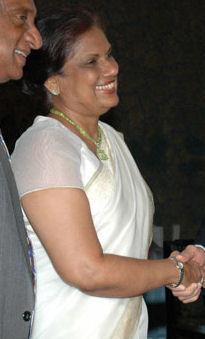
Chandrika Kumaratunga
Chandrika Kumaratunga is a President of Sri Lanka from 1994 to 2005. Born June 29, 1945, in Colombo. Positions held include President of Sri Lanka (1994–2005), Member of the Parliament of Sri Lanka and Prime Minister of Sri Lanka (1994). Educated at Paris Institute of Political Studies and Sciences Po Aix-en-Provence. Awards include Commander of the Legion of Honour.
Facts
21 facts · 1 confirmed by two sources · 1 cited · 19 from one source
Where this comes from
Papalocal keeps its own record. It started from these sources; what each one said is kept here as it was copied, so a change on their side never changes this page by itself. Tap one to read its version.
What Wikidata says · copied November 16, 2026 · revision 2563069776
- Described as
- President of Sri Lanka from 1994 to 2005
- Other names
- Chandrika Bandaranaike Kumaratunga, Candrikā Baṇḍāranāyaka Kumāratuṅga, 1945-, Kumaratunge, Chandrika Bandaranaike, 1945-, Kumāratuṅga, Candrikā Baṇḍāranāyaka, 1945-, Chandrika Kumaratunga, 1945-, CBK, 1945-, Chandrika Bandaranaike Kumaratunga, 1945-
- Born
- June 29, 1945 · 7 references
- Born in
- Colombo · 1 reference
- Citizen of
- Sri Lanka
- Occupation
- politician
- Positions held
- President of Sri Lanka (1994–2005); Member of the Parliament of Sri Lanka; Prime Minister of Sri Lanka (1994); Minister of Finance of Sri Lanka (1994–2001); Minister of Defence (2 times) (1994–2005) · 1 reference
- Political party
- Sri Lanka Freedom Party
- Worked for
- United Nations
- Education
- Paris Institute of Political Studies; Sciences Po Aix-en-Provence
- Awards
- Commander of the Legion of Honour · 1 reference
- Spouse
- Vijaya Kumaranatunga
- Children
- Yasodhara Kumaratunga; Vimukthi Kumaratunga
- Father
- S. W. R. D. Bandaranaike
- Mother
- Sirimavo Bandaranaike
- Religion
- Buddhism
- Lived in
- Horagolla Walauwa
- Wikipedias with a page
- 66
Wikidata item Q207432 (wikidata.org/wiki/Q207432), public domain (CC0). Copied November 16, 2026.
What Wikipedia says · copied November 16, 2026 · revision 1384692486
Chandrika Bandaranaike Kumaratunga (Sinhala: චන්ද්රිකා බණ්ඩාරනායක කුමාරතුංග; Tamil: சந்திரிகா பண்டாரநாயக்க குமாரதுங்க; née Bandaranaike; born 29 June 1945), commonly referred to by her initials CBK, is a Sri Lankan stateswoman who served as the fifth president of Sri Lanka from 1994 to 2005. She is the longest-serving president in Sri Lankan history. She led the Sri Lanka Freedom Party (SLFP) from 1994 to 2006.
Born in 1945 into a prominent Sri Lankan political family, she is the younger daughter of two former prime ministers, Solomon Bandaranaike and Sirimavo Bandaranaike. Kumaratunga entered politics in the 1970s, initially focusing on social welfare and rural development. After spending several years in exile following the assassination of her husband, Vijaya Kumaratunga, she returned to Sri Lanka in the late 1980s. In 1993, she was elected Chief Minister of the Western Province. The following year, after becoming the leader of the Sri Lanka Freedom Party, she formed the People's Alliance and led her coalition to victory in the 1994 parliamentary elections. In the presidential election held later that year, she was elected as the first female president of Sri Lanka, defeating UNP candidate Srima Dissanayake in the largest landslide victory in Sri Lankan history, securing almost 62% of the votes. In the 1999 election, Kumaratunga survived an assassination attempt during her re-election campaign and went on to win a second term, defeating UNP candidate and Leader of the Opposition, Ranil Wickremesinghe.
She was responsible for the modernisation of the SLFP and the broader Sri Lankan left under the banner of “capitalism with a human face.” This marked a decisive shift from the inward-looking, state-controlled economic policies of earlier SLFP administrations ran by her parents. Kumaratunga’s approach maintained a market-oriented economy while emphasising equity and social protection, contributing to improved economic performance and broadening the appeal of her party.
She also played a key role in restoring a degree of normalcy to public life following the turbulence of the late 1980s and early 1990s, a period marked by political violence, state repression, and widespread insecurity during and after the Ranasinghe Premadasa presidency. Her administration focused on re-establishing democratic norms and reducing extra-judicial violence to bring on greater political stability. During her presidency, Kumaratunga pursued peace negotiations with the Liberation Tigers of Tamil Eelam (LTTE) in an effort to resolve the country’s long-running civil war. After the collapse of peace negotiations, Kumaratunga launched a military campaign known as the “War for Peace” during the Eelam III phase of the Sri Lankan Civil War - one of the conflict’s most intense and brutal periods of fighting. As part of a broader strategy to simultaneously isolate the LTTE politically and financially while pursuing a military solution, she succeeded in securing the group’s international isolation: many major states formally designated the LTTE a terrorist organization, cutting off key sources of funding and delivering a significant blow to its global propaganda network.
Her administration also introduced a major package of constitutional reforms, the "2000 Constitution", aimed at abolishing the executive presidency and devolving power to the Tamil people. However, the proposed reforms were never implemented due to the withdrawal of support from the opposition. Her tenure was marred by criticism of her use of presidential powers and by allegations of corruption within her administration.
- Born, in its opening lines
- June 29, 1945
From the Wikipedia article “Chandrika Kumaratunga” (en.wikipedia.org/wiki/Chandrika_Kumaratunga), by its contributors, under CC BY-SA 4.0 (creativecommons.org/licenses/by-sa/4.0/). Copied November 16, 2026; not changed.
Confirmed Two sources agree. Cited One source, and it names where it got it. One source One source, without a reference of its own. Sources disagree The sources disagree. We show the best-supported value and keep theirs below.
