
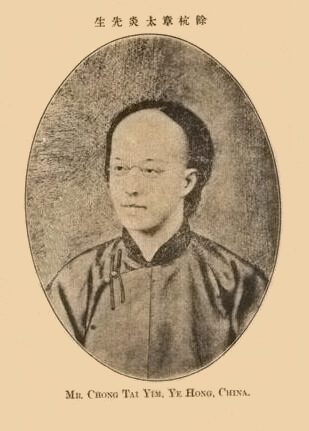
Chang Ping-lin
Chang Ping-lin was a Chinese linguist. Born December 25, 1868, in Yuhang District. Died June 14, 1936, in Suzhou. Positions held include editor-in-chief.
Facts
28 facts · 1 confirmed by two sources · 3 cited · 23 from one source · 1 where the sources disagree
What’s different
- Born: we show December 25, 1868 (Sources disagree). Wikipedia says January 12, 1869
Where this comes from
Papalocal keeps its own record. It started from these sources; what each one said is kept here as it was copied, so a change on their side never changes this page by itself. Tap one to read its version.
What Wikidata says · copied November 18, 2026 · revision 2567372503
- Described as
- Chinese linguist (1868-1936)
- Other names
- Meishu, Taiyan, Chang T'ai-yen, Zhang Binglin
- Born
- December 25, 1868
- Died
- June 14, 1936
- Born in
- Yuhang District
- Died in
- Suzhou · 1 reference
- Buried in
- Tomb of Zhang Binglin
- Name at birth
- 學乘
- Citizen of
- Qing dynasty; Republic of China
- Occupation
- linguist; professor; philosopher; sociologist; politician · 1 reference; writer · 1 reference; revolutionary; thinker
- Positions held
- editor-in-chief
- Political party
- Tongmenghui (1906–); Guangfuhui (1904–)
- Field
- philosophy; traditional Chinese philology; history; politics; philology · 1 reference; political activity · 1 reference
- Spouse
- Tang Guoli
- Children
- Zhang Dao
- Religion
- Confucianism
- Wikipedias with a page
- 22
Wikidata item Q197162 (wikidata.org/wiki/Q197162), public domain (CC0). Copied November 18, 2026.
What Wikipedia says · copied November 18, 2026 · revision 1366378282
Zhang Binglin (January 12, 1869 – June 14, 1936), also known by his art name Zhang Taiyan, was a Chinese philologist, textual critic, philosopher, and revolutionary.
His philological works include Chinese: 文始; pinyin: Wen Shi; trans. "The Origin of Writing", the first systematic work of Chinese etymology. He also made contributions to historical Chinese phonology, proposing that "the niang (娘) and ri (日) initials [in Middle Chinese] come from the ni (泥) initial [in Old Chinese]' (known as niang ri gui ni 娘日歸泥). He developed a system of shorthand based on the seal script, called jiyin zimu (記音字母), later adopted as the basis of zhuyin. Though innovative in many ways, he was skeptical of new archaeological findings, regarding the oracle bones as forgery.
An activist as well as a scholar, he produced many political works. Because of his outspoken character, he was jailed for three years by the Qing Empire and put under house arrest for another three by Yuan Shikai.
- Born, in its opening lines
- January 12, 1869
- Died, in its opening lines
- June 14, 1936
From the Wikipedia article “Zhang Binglin” (en.wikipedia.org/wiki/Zhang_Binglin), by its contributors, under CC BY-SA 4.0 (creativecommons.org/licenses/by-sa/4.0/). Copied November 18, 2026; not changed.
Confirmed Two sources agree. Cited One source, and it names where it got it. One source One source, without a reference of its own. Sources disagree The sources disagree. We show the best-supported value and keep theirs below.
