
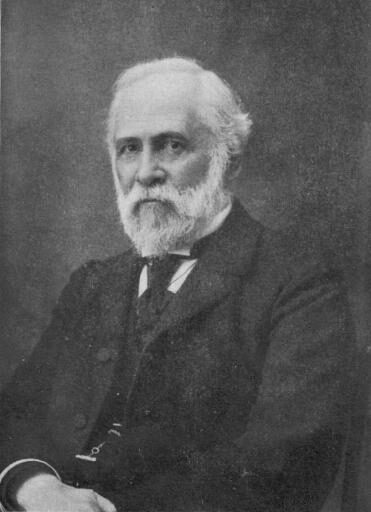
Charles Augustus Young
Charles Augustus Young was an American astronomer. Born December 15, 1834, in Hanover. Died January 3, 1908, in Hanover. Educated at Dartmouth College. Awards include Janssen Medal.
Facts
19 facts · 1 confirmed by two sources · 4 cited · 13 from one source · 1 where the sources disagree
What’s different
- Died: we show January 3, 1908 (Sources disagree). Wikipedia says January 4, 1908
Where this comes from
Papalocal keeps its own record. It started from these sources; what each one said is kept here as it was copied, so a change on their side never changes this page by itself. Tap one to read its version.
What Wikidata says · copied November 16, 2026 · revision 2541344215
- Described as
- American astronomer (1834–1908)
- Other names
- Charles A. Young, Chas. A. Young, C. A. Young, Charles Young, YOUNG, C. A.
- Born
- December 15, 1834 · 4 references
- Died
- January 3, 1908 · 4 references
- Born in
- Hanover
- Died in
- Hanover
- Buried in
- Arlington National Cemetery
- Cause of death
- pneumonia
- Citizen of
- United States
- Occupation
- astronomer · 1 reference; physicist; university teacher; meteorological observer · 1 reference
- Worked for
- Princeton University; Case Western Reserve University · 1 reference
- Education
- Dartmouth College
- Member of
- American Academy of Arts and Sciences; National Academy of Sciences
- Awards
- Janssen Medal (1890)
- Field
- astronomy · 1 reference; solar astronomy · 1 reference
- Wikipedias with a page
- 23
Wikidata item Q728434 (wikidata.org/wiki/Q728434), public domain (CC0). Copied November 16, 2026.
What Wikipedia says · copied November 16, 2026 · revision 1371979096
Charles Augustus Young (December 15, 1834 – January 4, 1908) one of the foremost solar spectroscopist astronomers in the United States. He observed solar eclipses and worked on spectroscopy of the Sun. He observed a solar flare with a spectroscope on 3 August 1872, and also noted that it coincided with a magnetic storm on Earth.
Young graduated from Dartmouth College in 1853. For two years, he taught classes at Phillips Academy in Andover, Massachusetts. The following year, he studied at the theological seminary in Andover, while also continuing to teach.
In 1857, he became the Professor of Mathematics and Natural Philosophy at Western Reserve College, now known as Case Western Reserve University, devoting nine years. Young's name is inscribed on the Loomis Observatory, which is the oldest observatory in the United States still remaining in its original location.
In 1862, he served in the 85th Regiment of Ohio during the Civil War.
He was elected as a member to the American Philosophical Society in 1874.
in 1865, he became a professor at his alma mater, Dartmouth, remaining until 1877 when he went to teach at Princeton University.
He was a successful educator who wrote a popular and widely used series of astronomy textbooks, including Manual of Astronomy. In 1927, when Henry Norris Russell, Raymond Smith Dugan and John Quincy Stewart wrote their own two-volume textbook, they entitled it Astronomy: A Revision of Young's Manual of Astronomy.
Young died of pneumonia after a brief illness, at his home in Hanover, New Hampshire, on 4 January 1908.
Mount Young in Sequoia National Park, California was named in his honor in 1909.
- Born, in its opening lines
- December 15, 1834
- Died, in its opening lines
- January 4, 1908
From the Wikipedia article “Charles Augustus Young” (en.wikipedia.org/wiki/Charles_Augustus_Young), by its contributors, under CC BY-SA 4.0 (creativecommons.org/licenses/by-sa/4.0/). Copied November 16, 2026; not changed.
Confirmed Two sources agree. Cited One source, and it names where it got it. One source One source, without a reference of its own. Sources disagree The sources disagree. We show the best-supported value and keep theirs below.
