
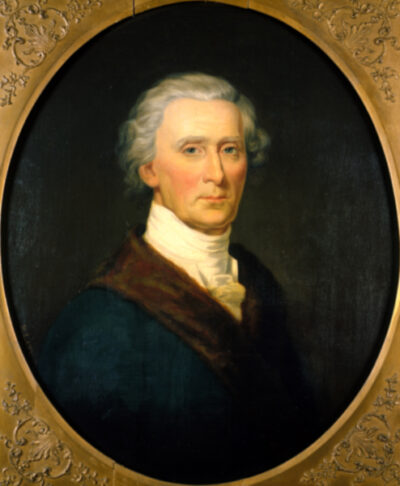
Charles Carroll of Carrollton
Charles Carroll of Carrollton was an American planter and signatory of the Declaration of Independence. Born September 19, 1737, in Annapolis. Died November 14, 1832, in Baltimore. Positions held include United States senator (1789–1792), President of the Maryland Senate (1783) and chairperson (1827–). Educated at Lycée Louis-le-Grand and Stonyhurst College.
Facts
24 facts · 2 confirmed by two sources · 10 cited · 12 from one source
Where this comes from
Papalocal keeps its own record. It started from these sources; what each one said is kept here as it was copied, so a change on their side never changes this page by itself. Tap one to read its version.
What Wikidata says · copied November 15, 2026 · revision 2558949483
- Described as
- American planter and signatory of the Declaration of Independence (1737-1832)
- Other names
- Charles Carroll
- Born
- September 19, 1737 · 3 references
- Died
- November 14, 1832 · 3 references
- Born in
- Annapolis · 1 reference
- Died in
- Baltimore · 1 reference
- Buried in
- Maryland
- Citizen of
- United States
- Occupation
- politician · 3 references
- Positions held
- United States senator (1789–1792) · 1 reference; President of the Maryland Senate (1783); chairperson (1827–); member of the State Senate of Maryland (1781–1800)
- Political party
- Federalist Party
- Education
- Lycée Louis-le-Grand; Stonyhurst College; Colleges of St Omer, Bruges and Liège
- Member of
- American Antiquarian Society
- Spouse
- Mary Darnall Carroll · 1 reference
- Children
- Charles Carroll of Homewood; Polly Carroll Caton · 2 references; Catharine Carroll Harper
- Father
- Charles Carroll of Annapolis · 1 reference
- Mother
- Elizabeth Brooke Carroll · 1 reference
- Religion
- Catholicism · 1 reference
- Lived in
- Dumbarton House (1813–1815) · 3 references
- Wikipedias with a page
- 30
Wikidata item Q466009 (wikidata.org/wiki/Q466009), public domain (CC0). Copied November 15, 2026.
What Wikipedia says · copied November 15, 2026 · revision 1379665504
Charles Carroll (September 19, 1737 – November 14, 1832), known as Charles Carroll of Carrollton or Charles Carroll III, was an American politician, planter, and signatory of the Declaration of Independence. He was the only Catholic signatory of the Declaration as well as the last surviving and longest-lived, dying 56 years after its signing at the age of 95.
A Founding Father of the United States, Carroll was known contemporaneously as the "First Citizen" of the American colonies, a consequence of signing articles in the Maryland Gazette with that pen name. He served as a delegate to the Continental Congress and Confederation Congress. Carroll later served as the first United States Senator for Maryland. Of all of the signers of the Declaration of Independence, Carroll was one of the wealthiest and most formally educated. A product of his 17-year Jesuit education in France, Carroll spoke five languages fluently.
Born in Annapolis, Maryland, Carroll inherited vast agricultural estates and was regarded as the wealthiest man in the American colonies when the American Revolution commenced in 1775. His personal fortune at this time was reputed to be 2,100,000 pounds sterling, the equivalent to £293,304,979 in 2025 (US$375 million). In addition, Carroll presided over his manor in Maryland, a 10,000-acre estate, and claimed as his property approximately 300 slaves. Though barred from holding office in Maryland because of his religion, Carroll emerged as a leader of the state's movement for independence. He was a delegate to the Annapolis Convention and was selected as a delegate to the Continental Congress in 1776. He was part of an unsuccessful diplomatic mission, which also included Benjamin Franklin and Samuel Chase, that Congress sent to Quebec in hopes of winning the support of French Canadians.
Carroll served in the Maryland Senate from 1781 to 1800. He was elected as one of Maryland's inaugural representatives in the United States Senate but resigned his seat in 1792 after Maryland passed a law barring individuals from simultaneously serving in both state and federal office. After retiring from public service, he helped establish the Baltimore and Ohio Railroad by purchasing $40,000 of state-backed securities and serving on its first board of directors.
- Born, in its opening lines
- September 19, 1737
- Died, in its opening lines
- November 14, 1832
From the Wikipedia article “Charles Carroll of Carrollton” (en.wikipedia.org/wiki/Charles_Carroll_of_Carrollton), by its contributors, under CC BY-SA 4.0 (creativecommons.org/licenses/by-sa/4.0/). Copied November 15, 2026; not changed.
Confirmed Two sources agree. Cited One source, and it names where it got it. One source One source, without a reference of its own. Sources disagree The sources disagree. We show the best-supported value and keep theirs below.
