
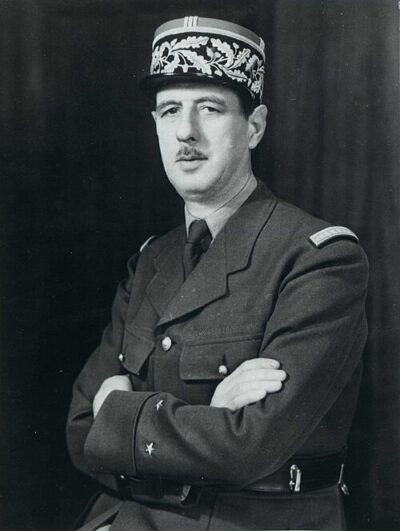
Charles de Gaulle
Charles de Gaulle was a French general and statesman. Born November 22, 1890, in Lille. Died November 9, 1970, in Colombey-les-Deux-Églises. Positions held include President of the French Republic (1959–1969), President of the Council (1958–1959) and president of the Provisional Government of the French Republic (1944–1946). Known for Mémoires de guerre. Educated at École Spéciale Militaire de Saint-Cyr and Collège Stanislas de Paris. Awards include Grand Cross of the National Order of Merit, Grand Cross of the Legion of Honour and Knight Grand Cross with Collar of the Order of Merit of the Italian Republic.



Facts
60 facts · 2 confirmed by two sources · 16 cited · 42 from one source
Where this comes from
Papalocal keeps its own record. It started from these sources; what each one said is kept here as it was copied, so a change on their side never changes this page by itself. Tap one to read its version.
What Wikidata says · copied November 16, 2026 · revision 2566173701
- Described as
- French general and statesman (1890–1970)
- Other names
- General Charles de Gaulle, Charles André Joseph Marie de Gaulle, Charles Andre Joseph Marie de Gaulle, général de Gaulle
- Born
- November 22, 1890 · 17 references
- Died
- November 9, 1970 · 15 references
- Born in
- Lille · 7 references
- Died in
- Colombey-les-Deux-Églises · 7 references
- Buried in
- grave of Charles de Gaulle
- Cause of death
- aneurysm · 2 references
- Name at birth
- Charles André Joseph Marie de Gaulle · 1 reference
- Citizen of
- France
- Occupation
- statesperson; memoirist; military theorist; military officer · 2 references; politician · 1 reference; author · 1 reference
- Positions held
- President of the French Republic (1959–1969); President of the Council (1958–1959); president of the Provisional Government of the French Republic (1944–1946); French co-prince of Andorra (2 times) (1944–1969); president (1940–1944) · 1 reference; Minister of National Defence (1958–1959); Prime Minister of France (1959)
- Political party
- Union of Democrats for the Republic; Rally of the French People
- Education
- École Spéciale Militaire de Saint-Cyr; Collège Stanislas de Paris; École supérieure de guerre
- Member of
- Ordre Nouveau · 1 reference
- Known for
- Mémoires de guerre
- Awards
- Grand Cross of the National Order of Merit; Grand Cross of the Legion of Honour; Knight Grand Cross with Collar of the Order of Merit of the Italian Republic (1959) · 1 reference; Knight Grand Cross of the Royal Victorian Order; Companion of the Liberation (1940); Godfather promotion of Special Military School of Saint-Cyr; Royal Order of Cambodia; Order of the Dragon of Annam; Royal Victorian Chain (1960); Knight of the Order of the Elephant (1965) · 1 reference; Order of the Royal House of Chakri; Croix de guerre 1939–1945; Croix de guerre 1914–1918 (1915); Grand Cordon of the National Order of the Cedar; Grand Master of the Legion of Honour
- Field
- politics
- Spouse
- Yvonne de Gaulle (1921–1970) · 1 reference
- Children
- Anne de Gaulle · 1 reference; Philippe de Gaulle · 1 reference; Élisabeth de Gaulle
- Father
- Henri de Gaulle
- Mother
- Jeanne Maillot
- Siblings
- Marie-Agnès de Gaulle · 1 reference; Jacques de Gaulle; Xavier de Gaulle; Pierre de Gaulle · 1 reference
- Religion
- Catholicism
- Military branch
- French Army; Free France
- Military rank
- brigadier general; general · 1 reference
- Lived in
- Élysée Palace
- Wikipedias with a page
- 222
Wikidata item Q2042 (wikidata.org/wiki/Q2042), public domain (CC0). Copied November 16, 2026.
What Wikipedia says · copied November 16, 2026 · revision 1384959429
Charles André Joseph Marie de Gaulle (22 November 1890 – 9 November 1970) was a French general and statesman who led the Free French Forces against Nazi Germany and its puppet state of Vichy France in World War II and chaired the Provisional Government of the French Republic from 1944 to 1946 to restore democracy in France. Following the 1958 Algiers putsch, he came out of retirement at the request of President René Coty, who appointed him Prime Minister. He commissioned a new 1958 French constitution which was approved by voters in a swift majority, during a referendum, establishing the French Fifth Republic. He was subsequently elected the President of France later that year, a position he held until his resignation in 1969.
Born in Lille, he was a decorated officer of World War I, wounded several times and was taken prisoner of war by the German Empire. During the 1918–1939 interwar period, he advocated mobile armoured divisions. During the German invasion of May 1940, he led an armoured division that counterattacked the Nazi German invaders; he was then appointed Undersecretary for War. Refusing to accept his government's armistice with Germany, de Gaulle fled to Britain and exhorted the French to continue the fight in his Appeal of 18 June. He led the Free French Forces and later headed the French National Liberation Committee and emerged as the undisputed leader of Free France. He became head of the Provisional Government of the French Republic in June 1944, the interim government of France following its liberation. As early as 1944, de Gaulle introduced a dirigiste economic policy, which included substantial state-directed control over a capitalist economy, which was followed by 30 years of unprecedented growth, known as the Trente Glorieuses. He resigned in 1946, but continued to be politically active as founder of the Rally of the French People. He retired in the early 1950s and wrote his War Memoirs, which became a staple of modern French literature.
When the Algerian War threatened to bring the unstable French Fourth Republic to collapse, the National Assembly brought him back to power during the May 1958 crisis. He founded the French Fifth Republic with a strong presidency; he was elected with 78% of the vote to continue in that role. He managed to keep France together while taking steps to end the war, much to the anger of the pieds-noirs (ethnic French and other Europeans born and raised in Algeria) and the French Armed Forces. He oversaw the independence to Algeria, alongside most of France's other colonies in Africa. In the context of the Cold War, de Gaulle initiated his "politics of grandeur", asserting that France as a major power should not rely on other countries, such as the United States, for its national security and prosperity. To this end, he pursued a policy of "national independence" which led him to withdraw from NATO's integrated military command and to launch an independent nuclear strike force, which made France the world's fourth nuclear power. He restored the France–Germany relations with Chancellor Konrad Adenauer to create a European counterweight between the Anglo-American and Soviet Union spheres of influence through the signing of the Élysée Treaty on 22 January 1963.
De Gaulle opposed any development of a supranational Europe, favouring Europe as a continent of sovereign nations. He also openly criticised the US intervention in Vietnam and the exorbitant privilege of the US dollar. In his later years, his use of the slogan "Vive le Québec libre" at a speech in Montreal, Canada and his two vetoes over Great Britain's entry into the European Economic Community generated considerable controversy in both the Americas and Europe. Although he was reelected to the presidency in 1965, he faced widespread protests by students and workers in May 68; however, he had the French Army's support and won the 1968 early elections with an increased majority in the National Assembly. De Gaulle resigned in late April 1969 after losing a referendum in which he proposed more decentralization. He died a year and a half later at the age of 79, leaving his presidential memoirs unfinished. French political parties and leaders claim a Gaullist legacy; streets and monuments in France and other parts of the world were dedicated in honour of him after his death, such as the Paris Charles de Gaulle Airport in Paris, France.
- Born, in its opening lines
- November 22, 1890
- Died, in its opening lines
- November 9, 1970
From the Wikipedia article “Charles de Gaulle” (en.wikipedia.org/wiki/Charles_de_Gaulle), by its contributors, under CC BY-SA 4.0 (creativecommons.org/licenses/by-sa/4.0/). Copied November 16, 2026; not changed.
Confirmed Two sources agree. Cited One source, and it names where it got it. One source One source, without a reference of its own. Sources disagree The sources disagree. We show the best-supported value and keep theirs below.
