Free France
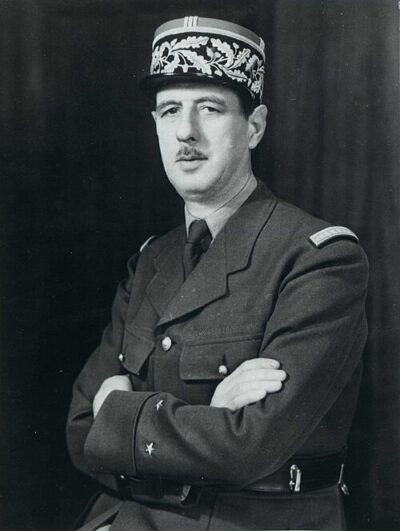
Free France is a 1940–1944 government-in-exile led by Charles de Gaulle during WWII.
- Founded
- June 18, 1940
All 4 facts, and where they come from
Facts
4 facts · 0 confirmed by two sources · 0 cited · 4 from one source
Where this comes from
Papalocal keeps its own record. It started from these sources; what each one said is kept here as it was copied, so a change on their side never changes this page by itself. Tap one to read its version.
What Wikidata says · copied November 17, 2026 · revision 2525138016
- Described as
- 1940–1944 government-in-exile led by Charles de Gaulle during WWII
- Other names
- Free French
- What it is
- government-in-exile; provisional government
- Founded
- June 18, 1940
- Ended
- June 3, 1943
- Wikipedias with a page
- 50
Wikidata item Q152582 (wikidata.org/wiki/Q152582), public domain (CC0). Copied 2026-11-17.
What Wikipedia says · copied November 17, 2026 · revision 1377744917
Free France (French: France libre) was a resistance government claiming to be the legitimate government of France following the dissolution of the Third Republic during World War II. Led by General Charles de Gaulle, Free France was established as a government-in-exile in London in June 1940 after the Fall of France to Nazi Germany. It joined the Allied nations in fighting Axis forces with the (Forces françaises libres) ("Free French Forces"; FFF), supported the Resistance in Nazi-occupied France, known as the French Forces of the Interior, and gained strategic footholds in several French colonies in Africa.
Following the defeat of the Third Republic by Nazi Germany, Marshal Philippe Pétain negotiated an armistice and established a German client state known as Vichy France. Opposed to the idea of an armistice, de Gaulle fled to Britain and from there broadcast the Appeal of 18 June (Appel du 18 juin) exhorting the French people to resist the Nazis and join the Free French Forces. On 27 October 1940, the Empire Defense Council (Conseil de défense de l'Empire)—later the French National Committee (Comité national français or CNF)—formed to govern French territories in central Africa, Asia, and Oceania that had heeded the 18 June call.
Initially, with the exception of French possessions in the Pacific, India, and Equatorial Africa, all the territories of the French colonial empire rejected de Gaulle's appeal and declared their loyalty to Marshal Pétain and the Vichy government. It was only progressively, often with the decisive military intervention of the Allies, that Free France took over more Vichy possessions, securing the majority of colonies after November 1942.
The Free French fought both Axis and Vichy troops and served in several major campaigns, from North Africa to Indochina. The Free French Navy operated as an auxiliary force to the Royal Navy and, in the North Atlantic, to the Royal Canadian Navy. Free French detachments also served in the Royal Air Force, the Soviet Air Force, and the British Special Air Service. Later, larger commands were established directly under the control of the government-in-exile. On 13 July 1942, "Free France" was officially renamed Fighting France (France combattante) to mark the struggle against the Axis both externally and within occupied France.
Exile officially ended after the reconquest of North Africa, when the Free French government relocated from London to Algiers. From there, the French Committee of National Liberation (Comité français de Libération nationale, CFLN) was formed as the provisional government of all French, uniting the disparate forces that opposed the Axis and their collaborators. On 1 August 1943, Free French Forces united with the Army of Africa (L'Armée d'Afrique) to form the French Liberation Army (Armée française de la Libération, AFL). By June 1944, the AFL numbered more than 500,000, and the CFLN was succeeded by the Provisional Government of the French Republic (Gouvernement Provisoire de la République française, GPRF), which was established in anticipation of the liberation of France. The AFL participated in the Normandy landings and the invasion of southern France, ultimately leading the liberation of Paris in August 1944, which ushered in the provisional government on French soil.
The AFL took part in the Allied advance through France and subsequent invasion of Germany, and by end of the war totaled over 1.3 million troops—the fourth-largest Allied army in Europe. The provisional government ruled France until the establishment of the Fourth Republic in October 1946, having preempted the country's occupation by Allied forces and secured its status as a major power.
From the Wikipedia article “Free France” (en.wikipedia.org/wiki/Free_France), by its contributors, under CC BY-SA 4.0 (creativecommons.org/licenses/by-sa/4.0/). Copied 2026-11-17; not changed.
Confirmed Two sources agree. Cited One source, and it names where it got it. One source One source, without a reference of its own. Sources disagree The sources disagree. We show the best-supported value and keep theirs below.