
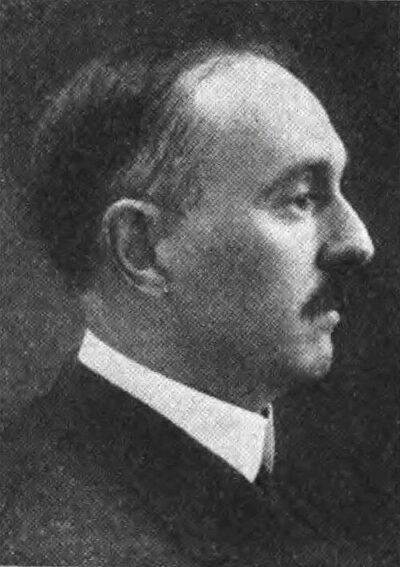
Charles-Edward Amory Winslow
Charles-Edward Amory Winslow was an American bacteriologist. Born February 4, 1877, in Boston. Died January 8, 1957, in New Haven. Educated at Massachusetts Institute of Technology. Awards include Léon Bernard Foundation Prize.
Facts
16 facts · 2 confirmed by two sources · 2 cited · 12 from one source
Where this comes from
Papalocal keeps its own record. It started from these sources; what each one said is kept here as it was copied, so a change on their side never changes this page by itself. Tap one to read its version.
What Wikidata says · copied November 19, 2026 · revision 2569139407
- Described as
- American bacteriologist (1877-1957)
- Other names
- C.-E. A. Winslow
- Born
- February 4, 1877 · 1 reference
- Died
- January 8, 1957 · 1 reference
- Born in
- Boston
- Died in
- New Haven
- Citizen of
- United States
- Occupation
- botanist; university teacher; physician · 1 reference; microbiologist · 1 reference; mycologist · 1 reference
- Worked for
- Yale University
- Education
- Massachusetts Institute of Technology
- Member of
- American Public Health Association
- Awards
- Léon Bernard Foundation Prize (1952)
- Father
- Erving Winslow · 1 reference
- Mother
- Catherine Mary Reignolds · 1 reference
- Wikipedias with a page
- 11
Wikidata item Q45641 (wikidata.org/wiki/Q45641), public domain (CC0). Copied November 19, 2026.
What Wikipedia says · copied November 19, 2026 · revision 1385960014
Charles-Edward Amory Winslow (February 4, 1877 – January 8, 1957) was an American bacteriologist and public health expert who was, according to the Encyclopedia of Public Health, "a seminal figure in public health, not only in his own country, the United States, but in the wider Western world."
Winslow was born in Boston, Massachusetts and attended Massachusetts Institute of Technology (M.I.T.), obtaining a B.S. in 1898 and an M.S. in 1910.
He began his career as a bacteriologist. He met Anne Fuller Rogers when they were students in William T. Sedgwick's laboratory at M.I.T., and married her in 1907. He taught at the Massachusetts Institute of Technology while heading the sewage experiment station from 1908 to 1910, then taught at the College of the City of New York from 1910 to 1914.
He was the youngest charter member of the Society of American Bacteriologists when that organization was founded in 1899. With Samuel Cate Prescott he published the first American textbook on the elements of water bacteriology.
In 1915 he founded the Yale Department of Public Health within the Yale Medical School, and he was professor and chairman of the Department until he retired in 1945. (The Department became the Yale School of Public Health after accreditation was introduced in 1947.) During a time dominated by discoveries in bacteriology, he emphasized a broader perspective on causation, adopting a more holistic perspective. The department under his direction was a catalyst for health reform in Connecticut. He was the first director of Yale's J.B. Pierce Laboratory, serving from 1932 to 1957. Winslow was also instrumental in founding the Yale School of Nursing.
He was the first Editor-in-Chief of the Journal of Bacteriology, serving in that position from 1916 to 1944. He was also the editor of the American Journal of Public Health from 1944 to 1954. He was the curator of public health at the American Museum of Natural History from 1910 to 1922. In 1926 he became president of the American Public Health Association, and in the 1950s was a consultant to the World Health Organization.
- Born, in its opening lines
- February 4, 1877
- Died, in its opening lines
- January 8, 1957
From the Wikipedia article “Charles-Edward Amory Winslow” (en.wikipedia.org/wiki/Charles-Edward_Amory_Winslow), by its contributors, under CC BY-SA 4.0 (creativecommons.org/licenses/by-sa/4.0/). Copied November 19, 2026; not changed.
Confirmed Two sources agree. Cited One source, and it names where it got it. One source One source, without a reference of its own. Sources disagree The sources disagree. We show the best-supported value and keep theirs below.
