
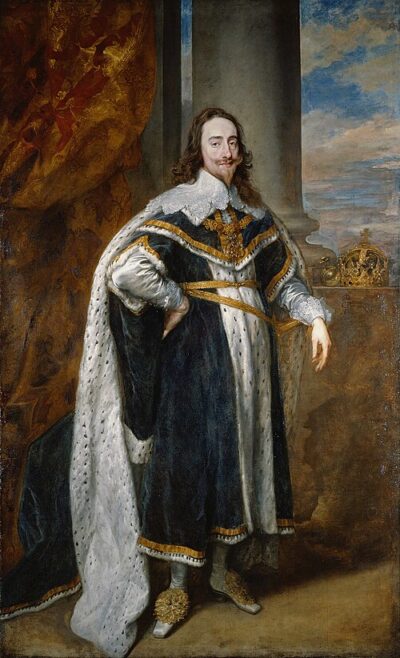
Charles I of England
Charles I of England was a King of England, Scotland, and Ireland from 1625 to 1649. Born November 19, 1600, in Dunfermline Palace. Died January 30, 1649, in Palace of Whitehall. Positions held include Monarch of England (1625–1649), Monarch of Scotland (1625–1649) and Duke of York (1605–1625). Awards include Knight of the Garter.
Facts
35 facts · 2 confirmed by two sources · 16 cited · 17 from one source
Where this comes from
Papalocal keeps its own record. It started from these sources; what each one said is kept here as it was copied, so a change on their side never changes this page by itself. Tap one to read its version.
What Wikidata says · copied November 16, 2026 · revision 2567829424
- Described as
- King of England, Scotland, and Ireland from 1625 to 1649 (1600–1649)
- Other names
- King Charles the Martyr, Charles the 1st, King Charles I, Charles I
- Born
- November 19, 1600 · 5 references
- Died
- January 30, 1649 · 5 references
- Born in
- Dunfermline Palace
- Died in
- Palace of Whitehall · 1 reference
- Buried in
- St George's Chapel, Windsor (1649–)
- Cause of death
- decapitation · 1 reference
- Citizen of
- Kingdom of England
- Occupation
- politician; art collector; monarch
- Positions held
- Monarch of England (1625–1649); Monarch of Scotland (1625–1649); Duke of York (1605–1625) · 1 reference; King of Ireland (1625–1649)
- Awards
- Knight of the Garter (1611–) · 1 reference
- Spouse
- Henrietta Maria of France (1625–) · 3 references
- Children
- Charles II of England · 2 references; Mary Henrietta, Princess Royal · 3 references; James II of England · 2 references; Princess Elizabeth of England; Princess Anne of England; Henry Stuart, Duke of Gloucester · 1 reference; Henrietta of England · 2 references; Charles James Stuart, Duke of Cornwall · 1 reference; Catherine Stuart · 1 reference
- Father
- James VI and I · 2 references
- Mother
- Anne of Denmark · 2 references
- Siblings
- Henry Frederick, Prince of Wales · 1 reference; Elizabeth Stuart, Queen of Bohemia · 1 reference; Margaret Stuart; Robert Stuart, Duke of Kintyre and Lorne; Mary Stuart; Sophia of England
- Religion
- Anglicanism; Catholic Church
- Wikipedias with a page
- 112
Wikidata item Q81506 (wikidata.org/wiki/Q81506), public domain (CC0). Copied November 16, 2026.
What Wikipedia says · copied November 16, 2026 · revision 1385104467
Charles I (19 November 1600 – 30 January 1649) was King of England, Scotland, and Ireland from 27 March 1625 until his execution in 1649.
Charles was born into the House of Stuart as the second son of King James VI of Scotland. After his father inherited the English throne in 1603, he moved to England, where he spent much of the rest of his life. He became heir apparent to the kingdoms of England, Scotland, and Ireland in 1612 upon the death of his elder brother, Henry Frederick, Prince of Wales. An unsuccessful and unpopular attempt to marry him to Infanta Maria Anna of Spain culminated in an eight-month visit to Spain in 1623, which demonstrated the futility of the marriage negotiations. Two years later, shortly after his accession, he married Henrietta Maria of France.
After his accession in 1625, Charles quarrelled with the English Parliament, which sought to curb his royal prerogative. He believed in the divine right of kings and was determined to govern according to his own conscience. Many of his subjects opposed his policies, in particular the levying of taxes without Parliamentary consent, and perceived his actions as those of a tyrannical absolute monarch. His religious policies, coupled with his marriage to a Catholic, generated antipathy and mistrust from Reformed religious groups such as the English Puritans and Scottish Covenanters, who thought his views too Catholic. He supported high church Anglican ecclesiastics and failed to aid continental Protestant forces successfully during the Thirty Years' War. His attempts to force the Church of Scotland to adopt high Anglican practices led to the Bishops' Wars, strengthened the position of the English and Scottish parliaments, and helped precipitate his own downfall.
From 1642, Charles fought the armies of the English and Scottish parliaments in the English Civil War. After his defeat in 1645 at the hands of the Parliamentarian New Model Army, he fled north from his base at Oxford. Charles surrendered to a Scottish force and, after lengthy negotiations between the English and Scottish parliaments, was handed over to the Long Parliament in London. Charles refused to accept his captors' demands for a constitutional monarchy, and temporarily escaped captivity in November 1647. Re-imprisoned on the Isle of Wight, he allied with Scotland, but by the end of 1648, the New Model Army had consolidated its control over England. Charles was tried, convicted, and executed for high treason in January 1649. The monarchy was abolished and the Commonwealth of England was established as a republic. The monarchy was restored in 1660, with Charles's son Charles II as king.
- Born, in its opening lines
- November 19, 1600
- Died, in its opening lines
- January 30, 1649
From the Wikipedia article “Charles I of England” (en.wikipedia.org/wiki/Charles_I_of_England), by its contributors, under CC BY-SA 4.0 (creativecommons.org/licenses/by-sa/4.0/). Copied November 16, 2026; not changed.
Confirmed Two sources agree. Cited One source, and it names where it got it. One source One source, without a reference of its own. Sources disagree The sources disagree. We show the best-supported value and keep theirs below.
