
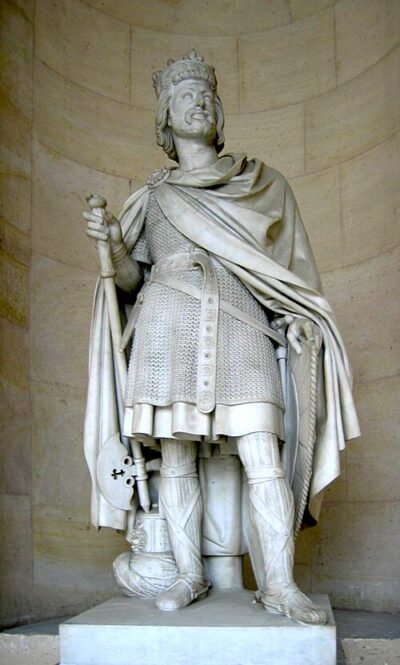
Charles Martel
Charles Martel was a Frankish military and political leader (c. 688–741). Born August 23, 688, in Herstal. Died October 22, 741, in Quierzy. Positions held include Mayor of the Palace (717–741).
Facts
25 facts · 2 confirmed by two sources · 16 cited · 6 from one source · 1 where the sources disagree
What’s different
- Mother: we show Alpaida (Sources disagree). Wikidata also lists Alpaïde
Where this comes from
Papalocal keeps its own record. It started from these sources; what each one said is kept here as it was copied, so a change on their side never changes this page by itself. Tap one to read its version.
What Wikidata says · copied November 16, 2026 · revision 2568842280
- Described as
- Frankish military and political leader (c. 688–741)
- Other names
- Charles the Hammer, Karl Martell, Carolus Martellus, Karl, the Hammer, Karl the Hammer
- Born
- August 23, 688 · 1 reference
- Died
- October 22, 741
- Born in
- Herstal · 1 reference
- Died in
- Quierzy · 1 reference
- Buried in
- Basilica of Saint-Denis
- Citizen of
- Francia
- Occupation
- statesperson; military leader
- Positions held
- Mayor of the Palace (717–741) · 1 reference
- Spouse
- Rotrude of Trier · 2 references; Ruodhaid; Swanachild · 1 reference
- Children
- Carloman · 2 references; Pepin the Short · 2 references; Hiltrud · 1 reference; Auda of France · 1 reference; Bernard, son of Charles Martel · 1 reference; Grifo · 1 reference; Hieronymus · 1 reference; Remigius of Rouen · 1 reference
- Father
- Pepin of Herstal · 1 reference
- Mother
- Alpaida · 1 reference; Alpaïde · 1 reference
- Siblings
- Drogo of Champagne · 1 reference; Grimoald the Younger · 1 reference; Childebrand I · 1 reference
- Wikipedias with a page
- 86
Wikidata item Q3301 (wikidata.org/wiki/Q3301), public domain (CC0). Copied November 16, 2026.
What Wikipedia says · copied November 16, 2026 · revision 1373993236
Charles Martel (; c. 688 – 22 October 741), Martel being an Old French sobriquet meaning "The Hammer", was a Frankish political and military leader who, as Duke and Prince of the Franks and Mayor of the Palace, was the de facto ruler of the Franks from 718 until his death. He was a son of the Frankish statesman Pepin of Herstal and a noblewoman named Alpaida. Charles successfully asserted his claims to power as successor to his father as the power behind the throne in Frankish politics. Continuing and building on his father's work, he restored centralized government in Francia and began a series of military campaigns that re-established the Franks as the undisputed masters of all Gaul. According to the contemporary Liber Historiae Francorum, Charles was "a warrior who was uncommonly ... effective in battle".
Charles gained a victory against an Umayyad invasion of Aquitaine at the Battle of Tours, and Charles is credited as an important factor in curtailing the spread of Islam in Western Europe. Alongside his military endeavours, Charles has been traditionally credited with an influential role in the development of the Frankish system of feudalism.
At the end of his reign, Charles divided Francia between his sons, Carloman and Pepin; Pepin became the first king of the Carolingian dynasty. Pepin's son Charlemagne, grandson of Charles, extended the Frankish realms and became the first emperor in the West since the Fall of the Western Roman Empire.
- Born, in its opening lines
- c. 688
- Died, in its opening lines
- October 22, 741
From the Wikipedia article “Charles Martel” (en.wikipedia.org/wiki/Charles_Martel), by its contributors, under CC BY-SA 4.0 (creativecommons.org/licenses/by-sa/4.0/). Copied November 16, 2026; not changed.
Confirmed Two sources agree. Cited One source, and it names where it got it. One source One source, without a reference of its own. Sources disagree The sources disagree. We show the best-supported value and keep theirs below.
