
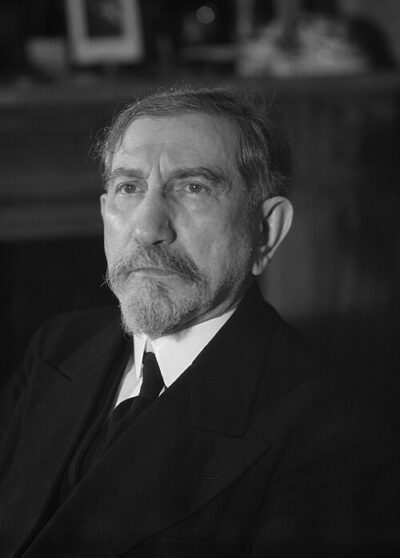
Charles Maurras
Charles Maurras was a French author, politician, poet, and critic. Born April 20, 1868, in Martigues. Died November 16, 1952, in Saint-Symphorien. Positions held include 'majoral' of the Félibrige (1941–1945) and Member of the Académie française (1938–1945). Known for Mes idées politiques, Enquête sur la monarchie and Anthinéa. Awards include Order of the Francisque.
Facts
33 facts · 2 confirmed by two sources · 14 cited · 17 from one source
Where this comes from
Papalocal keeps its own record. It started from these sources; what each one said is kept here as it was copied, so a change on their side never changes this page by itself. Tap one to read its version.
What Wikidata says · copied November 16, 2026 · revision 2568844941
- Described as
- French author, politician, poet, and critic (1868–1952)
- Other names
- maître de Martigues, Le Maître de Martigues, Octave Martin, Pierre Garnier, Léon Rameau, Le Martégal, Pellisson, Charles Marie Photius Maurras
- Born
- April 20, 1868 · 10 references
- Died
- November 16, 1952 · 10 references
- Born in
- Martigues · 4 references
- Died in
- Saint-Symphorien · 3 references
- Buried in
- Cimetière de Roquevaire
- Name at birth
- Charles Marie Photius Maurras · 1 reference
- Citizen of
- France
- Occupation
- journalist · 2 references; politician · 2 references; poet · 1 reference; writer · 3 references; philosopher · 1 reference; composer
- Positions held
- 'majoral' of the Félibrige (1941–1945) · 1 reference; Member of the Académie française (1938–1945) · 1 reference
- Political party
- Ligue de la Patrie Française (1899); Action Française (1899–1952) · 1 reference
- Member of
- Académie Française (1938–) · 1 reference; Société des félibres de Paris (1888–1892) · 1 reference
- Genre
- poetry · 1 reference; polemical lampoon; essay
- Known for
- Mes idées politiques (1937); Enquête sur la monarchie (1900); Anthinéa (1901); Kiel et Tanger (1910); L’Avenir de l’intelligence (1905)
- Awards
- Order of the Francisque (1943) · 1 reference
- Father
- Aristide Maurras
- Mother
- Marie-Pélagie Maurras
- Siblings
- Romain Maurras; Joseph Maurras
- Religion
- Catholicism
- Wikipedias with a page
- 52
Wikidata item Q3048 (wikidata.org/wiki/Q3048), public domain (CC0). Copied November 16, 2026.
What Wikipedia says · copied November 16, 2026 · revision 1380579326
Charles-Marie-Photius Maurras (; French: [ʃaʁl moʁas]; 20 April 1868 – 16 November 1952) was a French author, politician, poet and critic. He was an organiser and principal philosopher of Action Française, a political movement that was monarchist, medievalist, conservative, corporatist, integralist, nationalist and counter-revolutionary. Maurras was staunchly against capitalism, communism, Freemasonry, liberalism, Islam, Jews, Nazism and Protestantism. His ideas greatly influenced National Catholicism and integral nationalism, and led to the political doctrine of Maurrassisme.
While raised Roman Catholic, Maurras went deaf and became an agnostic in his youth, but remained anti-secularist and supported the Catholic Church solely for political reasons. An Orléanist, he began his career by writing literary criticism and became politically active as a leading anti-Dreyfusard. In 1926, Pope Pius XI issued a papal condemnation of Action Française. In 1927, several of Maurras's works were put in the Index of Forbidden Books, Action Française became the first newspaper ever to be placed on the Catholic Church's list of banned books, and AF members were forbidden from receiving the sacraments; the ban would later be lifted by Pope Pius XII in 1939.
In 1936, after voicing death threats against the socialist politician Léon Blum, Maurras was sentenced to eight months in La Santé. Maurras was elected to the Académie Française in 1938 and later expelled in 1945. During the World War II Maurras opposed Nazi Germany and Fascist Italy, but supported Vichy France, believing that Free France was a puppet state of the Soviet Union. He explained his support for Vichy, writing: "As a royalist I never lost sight of the necessity of monarchy. But to enthrone the royal heir, the heritage had to be saved." After Vichy's collapse he was arrested and accused of complicity with the enemy. Following a political trial he was convicted of incitement to murder, and received Indignité nationale and a life sentence. In 1951, after falling ill, he was transferred to a hospital and subsequently received a medical pardon. In his final days he reverted to Catholicism and received the last rites shortly before his death.
As a political theorist and major right-wing intellectual of 20th-century Europe, Maurras significantly influenced right-wing and far-right ideologies, anticipating some of the ideas of fascism. He has been described as the most important French conservative intellectual, and has directly influenced a large number of politicians, theorists, and writers on both the left and right. Maurras' legacy has remained controversial to this day. Critics have derided him as a "fascist icon", while supporters, including Georges Pompidou, have praised him as a prophet. Others, including Emmanuel Macron, have taken a nuanced approach, with Macron stating: "I fight all the antisemitic ideas of Maurras, but I find it absurd to say that Maurras must no longer exist."
- Born, in its opening lines
- April 20, 1868
- Died, in its opening lines
- November 16, 1952
From the Wikipedia article “Charles Maurras” (en.wikipedia.org/wiki/Charles_Maurras), by its contributors, under CC BY-SA 4.0 (creativecommons.org/licenses/by-sa/4.0/). Copied November 16, 2026; not changed.
Confirmed Two sources agree. Cited One source, and it names where it got it. One source One source, without a reference of its own. Sources disagree The sources disagree. We show the best-supported value and keep theirs below.
