
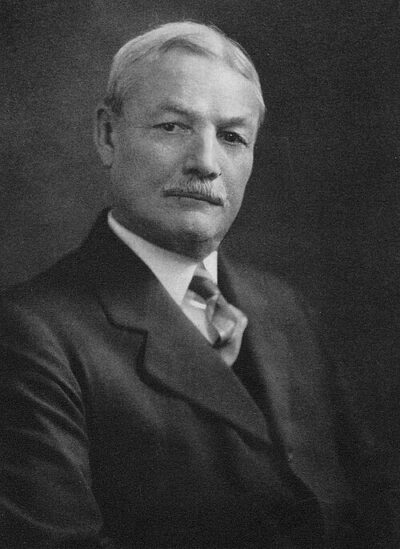
Charles McLean Andrews
Charles McLean Andrews was an American historian. Born February 22, 1863, in Wethersfield. Died September 9, 1943, in New Haven. Educated at Johns Hopkins University and Trinity College. Awards include Pulitzer Prize for History and Fellow of the American Academy of Arts and Sciences.
Facts
22 facts · 2 confirmed by two sources · 4 cited · 16 from one source
Where this comes from
Papalocal keeps its own record. It started from these sources; what each one said is kept here as it was copied, so a change on their side never changes this page by itself. Tap one to read its version.
What Wikidata says · copied November 18, 2026 · revision 2566854958
- Described as
- American historian (1863–1943)
- Other names
- Charles M. Andrews
- Born
- February 22, 1863 · 5 references
- Died
- September 9, 1943 · 5 references
- Born in
- Wethersfield
- Died in
- New Haven
- Citizen of
- United States
- Occupation
- historian · 1 reference; university teacher; writer · 1 reference
- Worked for
- Johns Hopkins University (1907–1910); Yale University (1910–1931); Bryn Mawr College (1889–1907)
- Education
- Johns Hopkins University (1889); Trinity College (1884)
- Member of
- American Academy of Arts and Sciences; American Academy of Arts and Letters; American Antiquarian Society (1907); American Philosophical Society (1924–) · 1 reference; American Historical Association
- Awards
- Pulitzer Prize for History (1935) · 1 reference; Fellow of the American Academy of Arts and Sciences
- Field
- history
- Father
- William Watson Andrews
- Wikipedias with a page
- 16
Wikidata item Q472498 (wikidata.org/wiki/Q472498), public domain (CC0). Copied November 18, 2026.
What Wikipedia says · copied November 18, 2026 · revision 1382342815
Charles McLean Andrews, Ph.D, L.H.D. (February 22, 1863 – September 9, 1943) was an American historian and professor at Yale University whose Colonial Period of American History, vol. 1 of 4, was awarded the Pulitzer Prize for history in 1935. Among his other books are British committees, commissions, and councils of trade and plantations, 1622-1675 (Johns Hopkins Press, 1908), co-author of the 1910 publication titled A bibliography of history for schools and libraries: with description and critical annotations, and The Colonial Period (1912).
He wrote 102 major scholarly articles and books, as well as over 360 book reviews, newspaper articles, and short items. He is especially known as a leader of the "Imperial school" of historians who studied, and generally admired, the efficiency of the British Empire in the 18th century. Kross argues:His intangible legacy is twofold. First is his insistence that all history be based on facts and that the evidence be found, organized, and weighed. Second is his injunction that colonial America can never be understood without taking into account England.
- Born, in its opening lines
- February 22, 1863
- Died, in its opening lines
- September 9, 1943
From the Wikipedia article “Charles McLean Andrews” (en.wikipedia.org/wiki/Charles_McLean_Andrews), by its contributors, under CC BY-SA 4.0 (creativecommons.org/licenses/by-sa/4.0/). Copied November 18, 2026; not changed.
Confirmed Two sources agree. Cited One source, and it names where it got it. One source One source, without a reference of its own. Sources disagree The sources disagree. We show the best-supported value and keep theirs below.
