
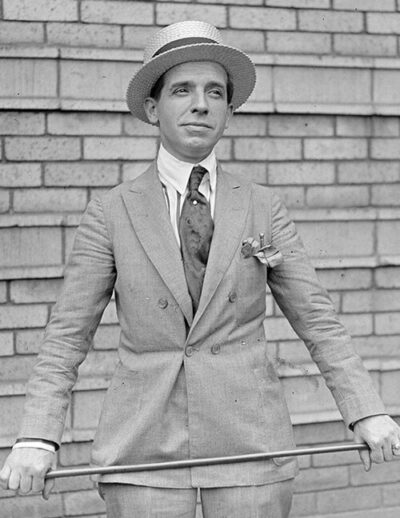
Charles Ponzi
Charles Ponzi was an Italian businessman and con artist. Born March 3, 1882, in Lugo. Died January 18, 1949, in Rio de Janeiro. Educated at Sapienza University of Rome.
Facts
19 facts · 2 confirmed by two sources · 7 cited · 10 from one source
Where this comes from
Papalocal keeps its own record. It started from these sources; what each one said is kept here as it was copied, so a change on their side never changes this page by itself. Tap one to read its version.
What Wikidata says · copied November 15, 2026 · revision 2567103006
- Described as
- Italian businessman and con artist (1882–1949)
- Other names
- Carlo Pietro Giovanni Guglielmo Tebaldo Ponzi, Carlo Ponzi, Ponzi
- Born
- March 3, 1882 · 3 references
- Died
- January 18, 1949 · 2 references
- Born in
- Lugo
- Died in
- Rio de Janeiro · 1 reference
- Buried in
- Rio de Janeiro
- Cause of death
- stroke
- Name at birth
- Carlo Ponzi · 1 reference
- Citizen of
- United States; Italy (1946–); Kingdom of Italy (–1946)
- Occupation
- criminal; banker; autobiographer · 1 reference; con artist · 1 reference; businessperson · 1 reference
- Education
- Sapienza University of Rome
- Field
- investment · 1 reference; fraud · 1 reference; property crime · 1 reference
- Wikipedias with a page
- 35
Wikidata item Q360145 (wikidata.org/wiki/Q360145), public domain (CC0). Copied November 15, 2026.
What Wikipedia says · copied November 15, 2026 · revision 1383984338
Charles Ponzi (; Italian: [ˈpontsi]; born Carlo Pietro Giovanni Guglielmo Tebaldo Ponzi; 3 March 1882 – 18 January 1949) was an Italian charlatan and con artist who operated in the United States and Canada. His aliases included Charles Ponci, Carlo, Benny Broncko and Charles P. Bianchi.
Born in Lugo, Italy, he became known in the early 1920s as a swindler in North America for his money-making scheme. He promised clients a 50% profit within 45 days or 100% profit within 90 days, by buying discounted postal reply coupons in other countries and redeeming them at face value in the U.S. as a form of arbitrage. In reality, Ponzi was paying earlier investors using the investments of later investors. While this type of fraudulent investment scheme was not invented by Ponzi, it became so identified with him that it now is referred to as a "Ponzi scheme". His scheme ran for over a year before it collapsed, costing his "investors" $20 million (equivalent to $243 million in 2025).
Ponzi may have been inspired by the scheme of William W. Miller (also known as "520% Miller"), a Brooklyn bookkeeper who in 1899 used a similar deception to take in $1 million (approximately $32.7 million in 2025).
- Born, in its opening lines
- March 3, 1882
- Died, in its opening lines
- January 18, 1949
From the Wikipedia article “Charles Ponzi” (en.wikipedia.org/wiki/Charles_Ponzi), by its contributors, under CC BY-SA 4.0 (creativecommons.org/licenses/by-sa/4.0/). Copied November 15, 2026; not changed.
Confirmed Two sources agree. Cited One source, and it names where it got it. One source One source, without a reference of its own. Sources disagree The sources disagree. We show the best-supported value and keep theirs below.
