
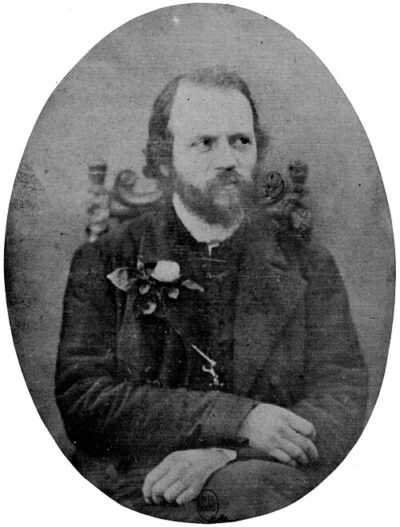
Charles-Valentin Alkan
Charles-Valentin Alkan was a French composer and pianist. Born November 30, 1813, in Paris. Died March 29, 1888, in Paris. Known for Grande sonate 'Les quatre âges', Le chemin de fer, Op. 27 and Trois morceaux dans le genre pathétique. Educated at Conservatoire de Paris.
Facts
32 facts · 2 confirmed by two sources · 4 cited · 26 from one source
Where this comes from
Papalocal keeps its own record. It started from these sources; what each one said is kept here as it was copied, so a change on their side never changes this page by itself. Tap one to read its version.
What Wikidata says · copied November 16, 2026 · revision 2570112084
- Described as
- French composer and pianist (1813–1888)
- Born
- November 30, 1813 · 8 references
- Died
- March 29, 1888 · 8 references
- Born in
- Paris · 1 reference
- Died in
- Paris · 1 reference
- Buried in
- Montmartre Cemetery · 2 references
- Name at birth
- Charles-Valentin Morhange
- Citizen of
- France
- Occupation
- composer · 2 references; pianist · 3 references; linguist; translator; music educator; Bible translator; organist · 1 reference; music arranger · 1 reference
- Education
- Conservatoire de Paris · 1 reference
- Genre
- classical music · 1 reference
- Instrument
- organ; piano
- Known for
- Grande sonate 'Les quatre âges'; Le chemin de fer, Op. 27; Trois morceaux dans le genre pathétique; Comme le vent; Trois grandes études; Preludes, Op. 31
- Children
- Élie-Miriam Delaborde
- Father
- Alkan Morhange · 1 reference
- Siblings
- Napoléon Alkan · 1 reference; Celeste Alkan Meyer Marix; Maxime Alkan; Gustave Alkan; Ernest Alkan · 1 reference
- Wikipedias with a page
- 44
Wikidata item Q217068 (wikidata.org/wiki/Q217068), public domain (CC0). Copied November 16, 2026.
What Wikipedia says · copied November 16, 2026 · revision 1382980709
Charles-Valentin Alkan (French: [ʃaʁl valɑ̃tɛ̃ alkɑ̃]; 30 November 1813 – 29 March 1888) was a French composer and virtuoso pianist. At the height of his fame in the 1830s and 1840s he was, alongside his friends and colleagues Frédéric Chopin and Franz Liszt, among the leading pianists in Paris, a city in which he spent virtually his entire life.
Alkan earned many awards at the Conservatoire de Paris, which he entered before he was six. His career in the salons and concert halls of Paris was marked by his occasional long withdrawals from public performance, for personal reasons. Although he had a wide circle of friends and acquaintances in the Parisian artistic world, including Eugène Delacroix and George Sand, from 1848 he began to adopt a reclusive life style, while continuing with his compositions – virtually all of which are for the keyboard. During this period he published, among other works, his collections of large-scale studies in all the major keys (Op. 35) and all the minor keys (Op. 39). The latter includes his Symphony for Solo Piano (Op. 39, nos. 4–7) and Concerto for Solo Piano (Op. 39, nos. 8–10), which are often considered among his masterpieces and are of great musical and technical complexity. Alkan emerged from self-imposed retirement in the 1870s to give a series of recitals that were attended by a new generation of French musicians.
Alkan's attachment to his Jewish origins is displayed both in his life and his work. He was the first composer to incorporate Jewish melodies in art music. Fluent in Hebrew and Greek, he devoted much time to a complete new translation of the Bible into French. This work, like many of his musical compositions, is now lost. Alkan never married, but his presumed son Élie-Miriam Delaborde was, like Alkan, a virtuoso performer on both the piano and the pedal piano, and edited a number of the elder composer's works.
Following his death (which according to persistent but unfounded legend was caused by a falling bookcase), Alkan's music became neglected, supported by only a few musicians including Ferruccio Busoni, Egon Petri and Kaikhosru Sorabji. From the late 1960s onwards, led by Raymond Lewenthal and Ronald Smith, many pianists have recorded his music and brought it back into the repertoire.
- Born, in its opening lines
- November 30, 1813
- Died, in its opening lines
- March 29, 1888
From the Wikipedia article “Charles-Valentin Alkan” (en.wikipedia.org/wiki/Charles-Valentin_Alkan), by its contributors, under CC BY-SA 4.0 (creativecommons.org/licenses/by-sa/4.0/). Copied November 16, 2026; not changed.
Confirmed Two sources agree. Cited One source, and it names where it got it. One source One source, without a reference of its own. Sources disagree The sources disagree. We show the best-supported value and keep theirs below.
