
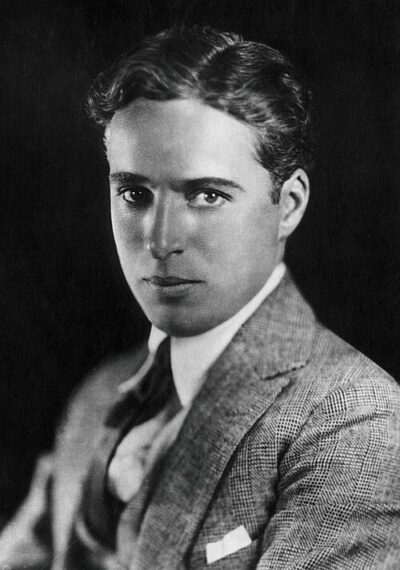
Charlie Chaplin
Charlie Chaplin was an English actor and filmmaker. Born April 16, 1889, in Walworth. Died December 25, 1977, in Corsier-sur-Vevey. Educated at Cuckoo Schools and Black-Foxe Military Institute. Awards include Commander of the Legion of Honour, Kinema Junpo Award and Academy Honorary Award (2 times).
Facts
70 facts · 2 confirmed by two sources · 23 cited · 44 from one source · 1 where the sources disagree
What’s different
- Cause of death: we show stroke (Sources disagree). Wikidata also lists cerebral hemorrhage
Where this comes from
Papalocal keeps its own record. It started from these sources; what each one said is kept here as it was copied, so a change on their side never changes this page by itself. Tap one to read its version.
What Wikidata says · copied November 16, 2026 · revision 2566709360
- Described as
- English actor and filmmaker (1889–1977)
- Other names
- The Tramp, Charles Spencer Chaplin Jr., Charles Chaplin Jr., Sir Charles Chaplin, Charlie Chaplin Jr., Sir Charlie Chaplin, Charles Spencer Chaplin, Chaplin, Charles Chaplin, Sir Charles Spencer Chaplin, Charlot
- Born
- April 16, 1889 · 22 references
- Died
- December 25, 1977 · 19 references
- Born in
- Walworth · 1 reference
- Died in
- Corsier-sur-Vevey · 2 references
- Buried in
- cemetery of Corsier-sur-Vevey
- Cause of death
- stroke; cerebral hemorrhage
- Name at birth
- Charles Spencer Chaplin
- Citizen of
- United Kingdom of Great Britain and Ireland (–1927); United Kingdom (1927–)
- Occupation
- film director · 2 references; composer · 2 references; film actor; screenwriter · 1 reference; film producer · 1 reference; comedian · 2 references; film editor; autobiographer
- Worked for
- Keystone Studios (1914); Essanay Studios (1914–1915); Mutual Film Corporation (1916–1917)
- Education
- Cuckoo Schools; Black-Foxe Military Institute
- Member of
- Academy of Arts, Berlin; Academy of Arts of the GDR; The Eight Lancashire Lads
- Genre
- silent film; comedy film; drama film; war film; action film; crime film
- Awards
- Commander of the Legion of Honour; Kinema Junpo Award; Academy Honorary Award (2 times) (1929, 1972) · 3 references; Bodil Honorary Award (1959) · 1 reference; Nastro d'argento for best non-Italian film; World Peace Council prizes; Jussi Awards; BAFTA Fellowship (1976); Erasmus Prize (1965) · 1 reference; Knight Commander of the Order of the British Empire (1975) · 1 reference; Academy Award for Best Original Dramatic Score (1973) · 1 reference; National Board of Review Award for Best Film; star on Hollywood Walk of Fame · 1 reference; Grand Officer of the Order of Merit of the Italian Republic (1952) · 1 reference; Golden Lion for Lifetime Achievement (1972) · 1 reference
- Spouse
- Mildred Harris (1918–1920); Lita Grey (1924–1927); Paulette Goddard (1936–1942); Oona O'Neill (1943–1977)
- Children
- Charles Chaplin · 1 reference; Geraldine Chaplin · 1 reference; Michael Chaplin · 1 reference; Josephine Chaplin · 1 reference; Victoria Chaplin · 1 reference; Eugene Chaplin · 1 reference; Christopher Chaplin · 1 reference; Jane Chaplin · 1 reference; Sydney Chaplin · 1 reference; Annette Emily Chaplin · 1 reference
- Father
- Charles Chaplin Sr. · 1 reference
- Mother
- Hannah Chaplin · 1 reference
- Siblings
- Wheeler Dryden; Sydney Chaplin · 1 reference
- Lived in
- Manoir de Ban: Manor house and park (1953–1977) · 1 reference; Beverly Hills
- Nickname
- The Tramp
- Height
- 1.63 m (5 ft 4 in)
- Website
- https://www.charliechaplin.com; http://www.charliechaplin.fr
- Wikipedias with a page
- 264
Wikidata item Q882 (wikidata.org/wiki/Q882), public domain (CC0). Copied November 16, 2026.
What Wikipedia says · copied November 16, 2026 · revision 1385491992
Sir Charles Spencer Chaplin Jr. (16 April 1889 – 25 December 1977) was an English comic actor, filmmaker, singer, film editor and composer who rose to fame in the era of silent film. He became a worldwide icon through his screen persona, the Tramp, and is considered one of the film industry's most important figures. His career spanned more than 75 years, from his childhood in the Victorian era until a year before his death in 1977.
Chaplin's childhood in London was one of poverty and hardship. His father was absent and his mother struggled financially – he was sent to a workhouse twice before the age of nine. When he was 14, his mother was committed to a mental asylum. Chaplin began performing at an early age, touring music halls and later working as a stage actor and comedian. At 19, he was signed to the Fred Karno company, which took him to the United States. In 1914, Chaplin gained widespread popularity through his appearances in Keystone Studios films. He soon introduced and adopted the Tramp as his screen persona. He directed his own films and continued to hone his craft as he moved to Essanay Studios, where the Tramp persona was developed emotionally in The Tramp (1915). He then attracted a large fanbase and demanded more money as he moved to Mutual and First National corporations. By 1918, he was one of the world's best-paid and best-known figures.
In 1919, Chaplin co-founded the distribution company United Artists, which gave him complete control over his films. His first feature-length film was The Kid (1921), followed by A Woman of Paris (1923), The Gold Rush (1925), and The Circus (1928). He initially refused to move to sound films in the 1930s, instead producing City Lights (1931) and Modern Times (1936) without dialogue. His first sound film was The Great Dictator (1940), which satirised Adolf Hitler.
The 1940s were marked with controversy for Chaplin, and his popularity declined rapidly. He was accused of communist sympathies, and some members of the press and public were scandalised by his involvement in a paternity suit and marriages to much younger women. The Federal Bureau of Investigation opened an investigation, and Chaplin was forced to leave the US in 1952 and settle in Switzerland. He abandoned the Tramp in his later films, which include Monsieur Verdoux (1947), Limelight (1952), A King in New York (1957), The Chaplin Revue (1959), and A Countess from Hong Kong (1967).
Chaplin wrote, directed, produced, edited, and composed the music for most of his films. He was a perfectionist, and his financial independence enabled him to spend years on the development and production of a picture. His films are characterised by slapstick combined with pathos, typified in the Tramp's struggles against adversity. Many contain social and political themes, as well as autobiographical elements. He received an Honorary Academy Award for "the incalculable effect he has had in making motion pictures the art form of this century" in 1972, as part of a renewed appreciation for his work. He continues to be held in high regard, with The Gold Rush, The Circus, City Lights, Modern Times, and The Great Dictator often ranked on lists of the greatest films.
- Born, in its opening lines
- April 16, 1889
- Died, in its opening lines
- December 25, 1977
From the Wikipedia article “Charlie Chaplin” (en.wikipedia.org/wiki/Charlie_Chaplin), by its contributors, under CC BY-SA 4.0 (creativecommons.org/licenses/by-sa/4.0/). Copied November 16, 2026; not changed.
Confirmed Two sources agree. Cited One source, and it names where it got it. One source One source, without a reference of its own. Sources disagree The sources disagree. We show the best-supported value and keep theirs below.
