
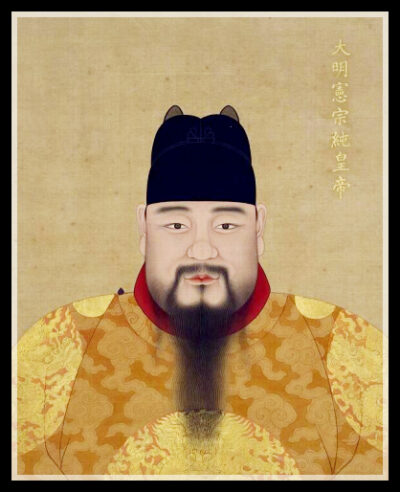
Chenghua Emperor
Chenghua Emperor was the 9th Emperor of the Ming dynasty. Born December 9, 1447, in Beijing. Died September 9, 1487, in Beijing. Positions held include Emperor of China (1464–1487) and crown prince (1449–1452).
Facts
38 facts · 2 confirmed by two sources · 4 cited · 31 from one source · 1 where the sources disagree
What’s different
- Buried in: we show Ming tombs (Sources disagree). Wikidata also lists Maoling Mausoleum (Ming dynasty)
Where this comes from
Papalocal keeps its own record. It started from these sources; what each one said is kept here as it was copied, so a change on their side never changes this page by itself. Tap one to read its version.
What Wikidata says · copied November 16, 2026 · revision 2569074295
- Described as
- 9th Emperor of the Ming dynasty (1447-1487)
- Other names
- Zhū Jiànshēn, Chun Di, Zhu Jianshen, Xian Zong, Jitianningdaochengmingrenjingchongwensuwuhongdeshengxiaochunhuangdi, Zhu Jianjun, Chenghua
- Born
- December 9, 1447
- Died
- September 9, 1487
- Born in
- Beijing
- Died in
- Beijing
- Buried in
- Ming tombs; Maoling Mausoleum (Ming dynasty)
- Citizen of
- Ming dynasty · 1 reference
- Occupation
- painter
- Positions held
- Emperor of China (1464–1487); crown prince (1449–1452)
- Spouse
- Empress Wu; Empress Wang; Empress Xiaomu; Empress Xiaohui Shao Shi; Consort Wan
- Children
- Hongzhi Emperor · 1 reference; Zhu Youyuan · 1 reference; Zhu Youbin; Zhu Youji; Zhu Youyun; Zhu Youshu; Zhu Youpeng; Zhu Youlun; Zhu Youhui; Zhu Youkai; Zhu Youzhi; Zhu Youshun
- Father
- Zhengtong Emperor · 1 reference
- Mother
- Empress Xiaosu
- Siblings
- Princess Guangde; Princess Chun'an; Princess Jiashan; Princess Jiaxiang; Princess Chongde; Princess Longqing; Princess Chongqing; Zhu Jianpei; Zhu Jianzhi; Zhu Jianxun
- Wikipedias with a page
- 34
Wikidata item Q9991 (wikidata.org/wiki/Q9991), public domain (CC0). Copied November 16, 2026.
What Wikipedia says · copied November 16, 2026 · revision 1385104497
The Chenghua Emperor (9 December 1447 – 9 September 1487), personal name Zhu Jianshen, changed to Zhu Jianru in 1457, was the ninth emperor of the Ming dynasty of China, reigning from 1464 to 1487. He succeeded his father, Emperor Yingzong.
Zhu Jianshen was born during his father's first reign. When he was only two years old, Mongol forces captured his father during the Battle of Tumu Fortress, and his uncle ascended the throne as the Jingtai Emperor. During this time, Zhu Jianshen was appointed heir to the throne, but his uncle later removed him from the position. He was not reinstated as heir until 1457, when Emperor Yingzong overthrew the ailing Jingtai Emperor in a coup and reascended the throne.
The Chenghua Emperor began his reign at the age of sixteen. During the initial years of his reign, he implemented a new policy that included tax cuts and a focus on strengthening the state's power, but as time passed, the positive impact of these changes diminished. In the later years of his rule, the Forbidden City was dominated by court eunuchs, particularly the notorious Wang Zhi and Liang Fang. The Emperor's preference for favorites over promoting capable individuals gradually eroded the positive aspects of his rule. This resulted in widespread corruption and the enrichment of his supporters at the expense of the state treasury. Peasant uprisings erupted throughout the country and were brutally suppressed. The Emperor ruled with increasing autocracy, bolstering the secret police to monitor the sentiments of the people. Wan Zhen'er, a palace lady much older than the Chenghua Emperor, held significant sway over him and eventually became his favorite concubine. This was especially true after she gave birth to a son in 1466, although the child died shortly after. Lady Wan used her loyal eunuchs to force other women to have abortions if they became pregnant with the Emperor's child, and she did not hesitate to resort to poisoning mothers and their children. It was not until 1475 that the Emperor discovered the existence of his five-year-old son, Zhu Youcheng, who had been kept hidden until then. Zhu Youcheng later succeeded him as the Hongzhi Emperor.
The Chenghua Emperor was known for his military prowess and placed great emphasis on the strength of his army. During the 1470s, the reorganized Ming troops achieved notable triumphs in their battles against the Mongols, marking the first major victories since 1449. In addition, defensive walls were constructed in Shaanxi and Shanxi, laying the groundwork for the enduring Great Wall of China. The Ming also formed an alliance with Korea and effectively waged war against the Jurchen tribes in eastern Manchuria.
- Born, in its opening lines
- December 9, 1447
- Died, in its opening lines
- September 9, 1487
From the Wikipedia article “Chenghua Emperor” (en.wikipedia.org/wiki/Chenghua_Emperor), by its contributors, under CC BY-SA 4.0 (creativecommons.org/licenses/by-sa/4.0/). Copied November 16, 2026; not changed.
Confirmed Two sources agree. Cited One source, and it names where it got it. One source One source, without a reference of its own. Sources disagree The sources disagree. We show the best-supported value and keep theirs below.
