
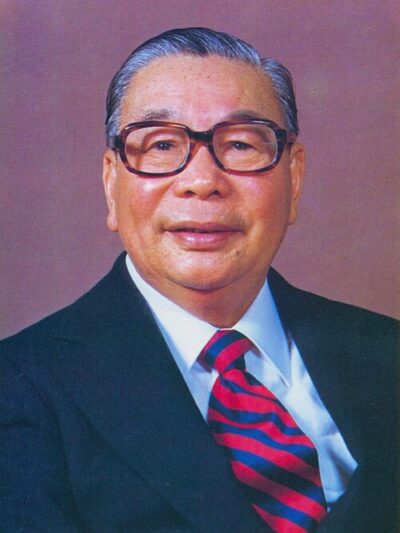
Chiang Ching-kuo
Chiang Ching-kuo was the 6th and 7th President of Republic of China. Born April 27, 1910, in Fenghua District. Died January 13, 1988, in Seven Seas Residence. Positions held include Vice Premier of the Republic of China (1969–1972), Premier of the Republic of China (1972–1978) and President of the Republic of China (1978–1988). Known for Chiang Ching-kuo Diaries. Educated at Moscow Sun Yat-sen University and V. I. Lenin Military-Political Academy. Awards include Order of the Cloud and Banner.
Facts
32 facts · 2 confirmed by two sources · 2 cited · 28 from one source
Where this comes from
Papalocal keeps its own record. It started from these sources; what each one said is kept here as it was copied, so a change on their side never changes this page by itself. Tap one to read its version.
What Wikidata says · copied November 16, 2026 · revision 2565547027
- Described as
- 6th and 7th President of Republic of China
- Other names
- Jiang Jingguo, Tsching-kuo Tschiang
- Born
- April 27, 1910 · 3 references
- Died
- January 13, 1988 · 7 references
- Born in
- Fenghua District
- Died in
- Seven Seas Residence · 1 reference
- Buried in
- Touliao Mausoleum · 1 reference
- Cause of death
- cardiovascular disease
- Citizen of
- Qing dynasty (–1912); Republic of China (1912–1949); Taiwan (1949–)
- Occupation
- politician
- Positions held
- Vice Premier of the Republic of China (1969–1972); Premier of the Republic of China (1972–1978); President of the Republic of China (1978–1988)
- Political party
- Kuomintang
- Education
- Moscow Sun Yat-sen University; V. I. Lenin Military-Political Academy; Communist University of the Toilers of the East
- Known for
- Chiang Ching-kuo Diaries
- Awards
- Order of the Cloud and Banner · 1 reference
- Spouse
- Chiang Fang-liang (1935–1988) · 1 reference
- Children
- Chiang Hsiao-wen; Chiang Hsiao-chang; Chiang Hsiao-wu; Chiang Hsiao-yung; Chiang Hsiao-yen; Winston Chang
- Father
- Chiang Kai-shek · 1 reference
- Mother
- Máo Fúméi
- Religion
- Methodism; Buddhism
- Military rank
- general
- Lived in
- Seven Seas Residence (1968–1988) · 1 reference
- Wikipedias with a page
- 53
Wikidata item Q313598 (wikidata.org/wiki/Q313598), public domain (CC0). Copied November 16, 2026.
What Wikipedia says · copied November 16, 2026 · revision 1385910789
Chiang Ching-kuo (, 27 April 1910 – 13 January 1988) was a Chinese and Taiwanese statesman and diplomat. He served as the president of the Republic of China from 1978 until his death in 1988, and acted as a de facto leader of the country by serving as Premier from 1972 to 1978. He was also the chairman of the ruling Kuomintang (KMT) party from 1975. During his presidency, Taiwan ended martial law and began political liberalization.
Chiang was born in Fenghwa, Chekiang as the eldest and only biological son of Chiang Kai-shek, the commander of National Revolutionary Army and KMT leader. He attended school in Shanghai and Beijing, where he became interested in socialism and communism. As a teenager in 1925, when the KMT and the Chinese Communist Party (CCP) were allied in the First United Front, he was sent to the Soviet Union (USSR) to attend university; he spoke Russian fluently. In 1927, due to the KMT's White Terror against the CCP, the Soviets sent Chiang to work in a steel factory in the Ural Mountains where he met and married Faina Vakhreva. In 1937, the Soviets returned the couple back to China shortly before the Second Sino-Japanese War. He entered the Nationalist government and served as the administrative commissioner of Gannan Prefecture in Jiangxi province from 1939 to 1945 during World War II. In 1948, Chiang went to Shanghai to enforce strict economic controls and fight inflation. He tried to freeze prices and force wealthy merchants to turn in Chinese gold yuan, but the campaign ultimately failed amid severe economic collapse. In 1949, he moved to Taiwan when the KMT lost the Chinese Civil War.
Chiang held successively powerful government posts on Taiwan. Initially he was director of Taiwan Garrison Command, the military secret police organization which used arbitrary arrests and torture to support the White Terror. He became Minister of Defense in 1965, vice-premier in 1969, premier in 1972, and then president for two terms starting in 1978 and 1984 respectively. He became KMT chairman after Chiang Kai-shek died in 1975. As president, the authoritarian state became more tolerant of political dissent, eventually relaxing restrictions to media and speech and permitting Democratic Progressive Party candidates to stand for election. Chiang increased the political representation and participation of local Taiwanese (benshengren) over post-World War II migrants from the mainland (waishengren) who had typically been favored; his successor, Lee Teng-hui, was benshengren. Chiang is credited with Soviet-inspired city planning policies, economic development with the Ten Major Construction Projects, anti-corruption efforts and Taiwan's democratic transition.
- Born, in its opening lines
- April 27, 1910
- Died, in its opening lines
- January 13, 1988
From the Wikipedia article “Chiang Ching-kuo” (en.wikipedia.org/wiki/Chiang_Ching-kuo), by its contributors, under CC BY-SA 4.0 (creativecommons.org/licenses/by-sa/4.0/). Copied November 16, 2026; not changed.
Confirmed Two sources agree. Cited One source, and it names where it got it. One source One source, without a reference of its own. Sources disagree The sources disagree. We show the best-supported value and keep theirs below.
