
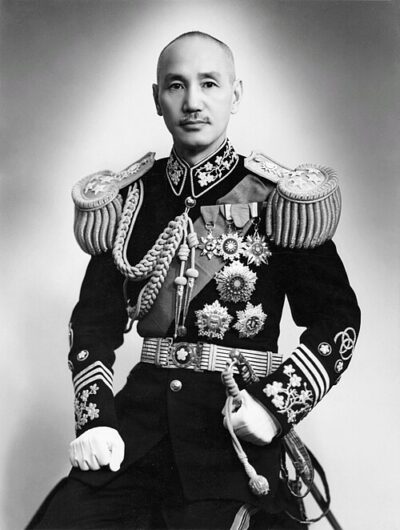
Chiang Kai-shek
Chiang Kai-shek was a Chinese politician, military leader, and President of the ROC. Born October 31, 1887, in Xikou. Died April 5, 1975, in Taipei. Positions held include President of the Republic of China (1948–1975), President of the National Government of the Republic of China (2 times) (1928–1948) and Premier of the Republic of China (3 times) (1930–1947). Educated at Baoding Military Academy. Awards include Grand Cross of the Legion of Honour, Honorary Knight Grand Cross of the Order of the Bath and Order of the White Lion.
Facts
51 facts · 2 confirmed by two sources · 7 cited · 42 from one source
Where this comes from
Papalocal keeps its own record. It started from these sources; what each one said is kept here as it was copied, so a change on their side never changes this page by itself. Tap one to read its version.
What Wikidata says · copied November 16, 2026 · revision 2568981849
- Described as
- Chinese politician, military leader, and President of the ROC (1887–1975)
- Other names
- Jiǎng Zhōutài, Chiang Chou-t‘ai, Chiang Chi-chi'ing, Chiang Chou-tai, Chiang Chung-cheng, Jiang Zhiqing, Jiǎng Zhōngzhèng, Jiang Jieshi, Chiang Chieh-shish, Chiang Jui-yuan, Jiang Zhoutai, Chang Kai-shek
- Born
- October 31, 1887 · 9 references
- Died
- April 5, 1975 · 11 references
- Born in
- Xikou
- Died in
- Taipei · 1 reference
- Buried in
- Cihu Mausoleum
- Cause of death
- liver cancer
- Name at birth
- 蔣瑞元
- Citizen of
- Taiwan (1912–); Qing dynasty (–1912)
- Occupation
- politician · 2 references; military personnel
- Positions held
- President of the Republic of China (1948–1975); President of the National Government of the Republic of China (2 times) (1928–1948); Premier of the Republic of China (3 times) (1930–1947); chairperson (1931–1946); member of the 1st National Assembly of the Republic of China (1947–1975); member of the Constituent National Assembly (1936–1946)
- Political party
- Kuomintang; Chinese Revolutionary Party
- Education
- Baoding Military Academy
- Awards
- Grand Cross of the Legion of Honour · 1 reference; Honorary Knight Grand Cross of the Order of the Bath (1942) · 1 reference; Order of the White Lion; Legionnaire of Legion of Merit; Time Person of the Year (1937) · 1 reference; Collar of the Spanish Order of the Civil Merit (1965) · 2 references; Royal Order of the Seraphim · 1 reference; Order of the Rajamitrabhorn · 1 reference; Order of Leopold · 1 reference; Philippine Legion of Honor · 1 reference; Order of Propitious Clouds · 1 reference; Silver Cross of the Virtuti Militari · 1 reference; Order of National Glory · 1 reference; Order of Blue Sky and White Sun · 1 reference; Order of the Sacred Tripod · 1 reference
- Spouse
- Máo Fúméi (1901–1927) · 1 reference; Yao Yecheng (1911–1927); Chen Jieru (1921–1927) · 1 reference; Soong May-ling (1927–1975) · 1 reference
- Children
- Chiang Ching-kuo · 1 reference; Chiang Wei-kuo
- Father
- Chiang Chao-tsung
- Mother
- Wang Caiyu
- Siblings
- Chiang Kai-ching; Chiang Jui-lien; Jiang Ruiqing
- Religion
- Buddhism; Methodism · 1 reference
- Military branch
- Imperial Japanese Army · 1 reference
- Military rank
- generalissimo; general · 1 reference
- Wikipedias with a page
- 138
Wikidata item Q16574 (wikidata.org/wiki/Q16574), public domain (CC0). Copied November 16, 2026.
What Wikipedia says · copied November 16, 2026 · revision 1384681237
Chiang Kai-shek (; 31 October 1887 – 5 April 1975) was a Chinese military commander, revolutionary, and statesman who was the president of the Republic of China from 1948 to 1975 and the head of the Nationalist government from 1925 to 1948. As the de facto leader of the Republic of China (ROC), he ruled the country through World War II and oversaw the relocation of its government to Taiwan following defeat in the Chinese Civil War.
Born in Zhejiang, Chiang received a military education in China and Japan, joined Sun Yat-sen's Tongmenghui in 1908, and, after the 1911 Revolution, participated in the National Protection War. In 1923, he was appointed by Sun as chief of staff of the Army and Navy Marshal stronghold, and served as commandant of the Whampoa Military Academy from 1924 until its closure in 1930. After Sun's death, Chiang wrested control of the party and National Revolutionary Army from Wang Jingwei in the Canton Coup. From 1926 to 1928, Chiang led the Northern Expedition and largely unified China under a Nationalist government based in Nanjing. He broke the First United Front by purging Chinese Communist Party (CCP) members in the Shanghai massacre, triggering the Chinese Civil War.
During the Nanjing decade, Chiang pursued modernization of China while prioritizing the suppression of the Communists over confrontation with Japan following the latter's invasion of Manchuria. The Xi'an Incident in 1936 forced him to form a Second United Front with the CCP against Japan. Between 1937 and 1945, Chiang led China in the Second Sino-Japanese War, mostly from the wartime capital of Chongqing, resulting in a victory for the National Revolutionary Army. In 1943, Chiang attended the Cairo Conference to discuss the terms of Japan's surrender, including the retrocession of Taiwan, after which he suppressed the February 28 incident.
When World War II ended, the Chinese Civil War resumed. In 1949, Chiang's KMT was defeated by Mao Zedong's CCP and retreated to Taiwan. He imposed martial law and White Terror on the island that lasted until 1987 and 1992, respectively. Beginning in 1948, he was re-elected five times by the same Eternal Parliament with six-year terms as the president of the ROC, the head of a de facto one-party state, for 25 years until his death. Chiang presided over land reform, economic growth, and the Taiwan Strait crises twice in 1954–1955 and in 1958. Taiwan also pursued an ultimately unsuccessful nuclear weapons programme. Chiang was considered the legitimate leader of China by the United Nations until 1971, when the ROC's seat in the Security Council was transferred to the People's Republic of China.
Chiang is a controversial figure. Supporters credit him with unifying the nation and ending the century of humiliation, leading the resistance against Japan, fostering economic development and preserving Chinese culture in contrast to Mao's Cultural Revolution. He is also credited with safeguarding the Forbidden City's treasures during the wars, a substantial portion now housed at the Taipei Palace Museum. Critics fault him for his early appeasement of Japan, the deliberate flooding of the Yellow River, cronyism and corruption linked to the four big families, and authoritarian rule on both mainland China and Taiwan.
- Born, in its opening lines
- October 31, 1887
- Died, in its opening lines
- April 5, 1975
From the Wikipedia article “Chiang Kai-shek” (en.wikipedia.org/wiki/Chiang_Kai-shek), by its contributors, under CC BY-SA 4.0 (creativecommons.org/licenses/by-sa/4.0/). Copied November 16, 2026; not changed.
Confirmed Two sources agree. Cited One source, and it names where it got it. One source One source, without a reference of its own. Sources disagree The sources disagree. We show the best-supported value and keep theirs below.
