
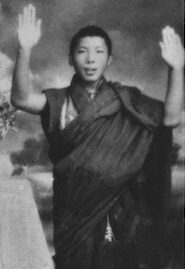
Chögyam Trungpa
Chögyam Trungpa was a Tibetan Buddhist lama and writer. Born March 5, 1939, in Kham. Died April 4, 1987, in Halifax. Positions held include Trungpa tülku. Known for Shambhala: The Sacred Path of the Warrior and divine madness. Educated at St Antony's College.
Facts
24 facts · 2 confirmed by two sources · 4 cited · 18 from one source
What’s different
- Born: we show March 5, 1939 (Confirmed). Wikidata also lists 1940
Where this comes from
Papalocal keeps its own record. It started from these sources; what each one said is kept here as it was copied, so a change on their side never changes this page by itself. Tap one to read its version.
What Wikidata says · copied November 15, 2026 · revision 2565500222
- Described as
- Tibetan Buddhist lama and writer (1939-1987)
- Other names
- Trungpa, Chogyam Trungpa Rinpoche
- Born
- March 5, 1939; 1940 · 2 references
- Died
- April 4, 1987 · 3 references
- Born in
- Kham
- Died in
- Halifax · 1 reference
- Cause of death
- liver cirrhosis
- Citizen of
- Tibet; United States · 1 reference; United Kingdom
- Occupation
- philosopher; painter; writer; guru; scholar; professor; monk · 1 reference
- Positions held
- Trungpa tülku
- Education
- St Antony's College
- Known for
- Shambhala: The Sacred Path of the Warrior; divine madness
- Spouse
- Diana Judith Mukpo · 1 reference
- Children
- Sakyong Mipham; Gesar Mukpo
- Religion
- Shambhala Buddhism
- Website
- http://www.shambhala.org/
- Wikipedias with a page
- 26
Wikidata item Q548323 (wikidata.org/wiki/Q548323), public domain (CC0). Copied November 15, 2026.
What Wikipedia says · copied November 15, 2026 · revision 1377249107
Chögyam Trungpa (Wylie: Chos rgyam Drung pa; March 5, 1939 – April 4, 1987), formally named the 11th Zurmang Trungpa, Chokyi Gyatso, was a Tibetan Buddhist master and holder of both Kagyu and Nyingma lineages of Tibetan Buddhism. He was recognized by both Tibetan Buddhists and other spiritual practitioners and scholars as a preeminent teacher of Tibetan Buddhism. He was a major figure in the dissemination of Buddhism in the West, founding Vajradhatu and Naropa University and establishing the Shambhala Training method. The 11th of the Trungpa tülkus, he was a tertön, supreme abbot of the Surmang monasteries, scholar, teacher, poet, artist, and originator of Shambhala Buddhist tradition.
Among Trungpa's contributions are the translation of numerous Tibetan Buddhist texts, the introduction of the Vajrayana teachings to the West, and a presentation of Buddhism largely devoid of traditional trappings. Trungpa popularized the term "crazy wisdom", referring to some spiritual masters' unconventional and flamboyant teaching methods. Some of his own methods and actions, particularly his heavy drinking, sexual predation, and his ordering of the sexual assault (forced stripping) of a student and his girlfriend, caused controversy during his lifetime and afterward.
- Born, in its opening lines
- March 5, 1939
- Died, in its opening lines
- April 4, 1987
From the Wikipedia article “Chögyam Trungpa” (en.wikipedia.org/wiki/Chögyam_Trungpa), by its contributors, under CC BY-SA 4.0 (creativecommons.org/licenses/by-sa/4.0/). Copied November 15, 2026; not changed.
Confirmed Two sources agree. Cited One source, and it names where it got it. One source One source, without a reference of its own. Sources disagree The sources disagree. We show the best-supported value and keep theirs below.
