
Christian Kramp was a French mathematician. Born July 8, 1760, in Strasbourg. Died May 13, 1826, in Strasbourg. Educated at University of Strasbourg. Awards include Knight of the Legion of Honour.
Facts
13 facts · 2 confirmed by two sources · 7 cited · 4 from one source
Where this comes from
Papalocal keeps its own record. It started from these sources; what each one said is kept here as it was copied, so a change on their side never changes this page by itself. Tap one to read its version.
What Wikidata says · copied November 18, 2026 · revision 2568566652
- Described as
- French mathematician
- Born
- July 8, 1760 · 1 reference
- Died
- May 13, 1826 · 1 reference
- Born in
- Strasbourg · 1 reference
- Died in
- Strasbourg · 1 reference
- Name at birth
- Chrétien Kramp · 1 reference
- Citizen of
- France
- Occupation
- mathematician · 1 reference; university teacher
- Worked for
- University of Strasbourg (1809–1826) · 1 reference
- Education
- University of Strasbourg (–1783) · 1 reference
- Member of
- French Academy of Sciences; Royal Prussian Academy of Sciences
- Awards
- Knight of the Legion of Honour · 1 reference
- Wikipedias with a page
- 20
Wikidata item Q560935 (wikidata.org/wiki/Q560935), public domain (CC0). Copied November 18, 2026.
What Wikipedia says · copied November 18, 2026 · revision 1349467282
Christian Kramp (8 July 1760 – 13 May 1826) was a French mathematician, who worked primarily with factorials.
Christian Kramp's father was his teacher at grammar school in Strasbourg. Kramp studied medicine and graduated; however, his interests certainly ranged outside medicine, for in addition to a number of medical publications he published a work on crystallography in 1793. In 1795, France annexed the Rhineland area in which Kramp was carrying out his work and after this he became a teacher at Cologne (this city was French from 1794 to 1815), teaching mathematics, chemistry, and physics. Kramp could read and write in German and French.
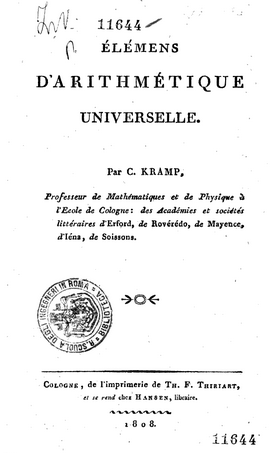
Kramp was appointed professor of mathematics at Strasbourg, the town of his birth, in 1809. He was elected to the geometry section of the French Academy of Sciences in 1817. As Bessel, Legendre and Gauss did, Kramp worked on the generalised factorial function which applied to non-integers. His work on factorials is independent of that of James Stirling and Vandermonde. He was the first to use the notation n! in Elements d'arithmétique universelle, 1808. In fact, the more general concept of factorial was found at the same time by Arbogast.I use the very simple notation n! to designate the product of numbers decreasing from n to unity, i.e. n(n − 1)(n − 2) ... 3 . 2 . 1. The constant use in combinatorial analysis, in most of my proofs, that I make of this idea, has made this notation necessary. [...] I have given it the name 'faculty'. Arbogast has substituted the name 'factorial' which is clearer and more French. In adopting his idea I congratulate myself on paying homage to the memory of my friend.
Kramp's function, a scaled complex error function, is today better known as the Faddeeva function.
- Born, in its opening lines
- July 8, 1760
- Died, in its opening lines
- May 13, 1826
From the Wikipedia article “Christian Kramp” (en.wikipedia.org/wiki/Christian_Kramp), by its contributors, under CC BY-SA 4.0 (creativecommons.org/licenses/by-sa/4.0/). Copied November 18, 2026; not changed.
Confirmed Two sources agree. Cited One source, and it names where it got it. One source One source, without a reference of its own. Sources disagree The sources disagree. We show the best-supported value and keep theirs below.
